Can braces alone fix my bite?
Some bite problems can be treated with tooth movement alone; others need a discussion about changing the jaw relationship. An orthodontist and surgeon should explain the diagnosis, realistic alternatives, risks and complete treatment sequence before you choose.
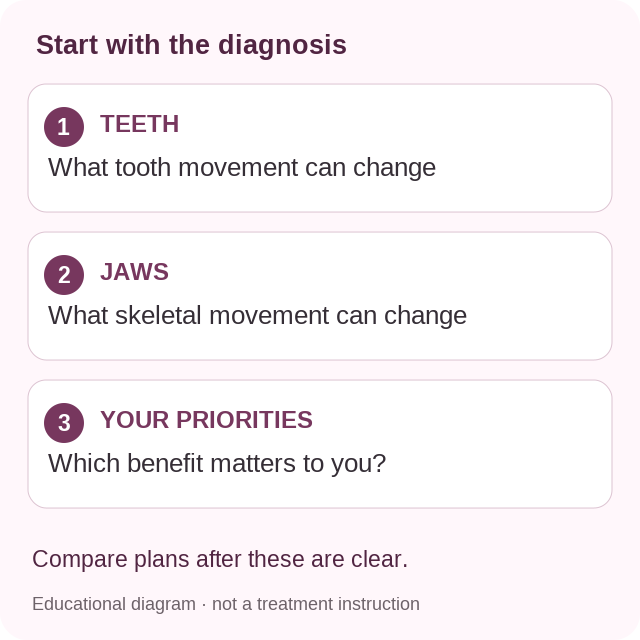
Start with the problem you want treatment to solve
An underbite, a protruding tooth and a jaw that sits further forward are not interchangeable diagnoses. A photograph may show a concern, but it cannot establish how the teeth meet, how the jaw joints function, or where movement can be made safely. A useful first appointment separates those findings from your priorities. Explain which everyday task is difficult, which appearance change matters, and what you would prefer to leave alone.
Write down examples rather than a hoped-for operation: “I cannot bite through a sandwich with my front teeth,” or “My lower teeth bite inside the upper teeth on one side.” Bring previous orthodontic records if you have them. Ask whether the proposed treatment is intended to address that particular problem, or a different finding discovered at examination. A good decision begins with a shared problem statement, not with selecting a procedure from photographs.
Teeth and jaw bones are related but different
Orthodontic treatment moves teeth within the supporting bone. Corrective jaw surgery changes the relationship of the jaw bones themselves. Some bite problems can be treated with orthodontics alone; others involve a skeletal discrepancy that prompts consideration of combined orthodontic and surgical treatment.
The visible severity of a smile does not reliably tell you which category applies. Ask the orthodontist to explain the dental findings and the skeletal findings separately. This is especially useful when you have received different recommendations from clinics that emphasize different services.
What the assessment should clarify
Expect questions about your general health, dental history, previous braces, growth, gum health and treatment goals. Examination and appropriate dental records help the team distinguish tooth position from skeletal position. X-rays, photographs and dental models or scans may contribute, but a particular scan is not automatically necessary for every patient. Ask what each investigation will change in the decision and whether existing records can be used.
Request an explanation you can repeat in your own words: which discrepancy is dental, which is skeletal, and what evidence supports that conclusion? If a measurement is outside an average range, ask how it relates to your symptoms and options. A number alone does not tell you what outcome you will value. Similarly, a computer simulation is a planning aid, not a promise that your face, bite or recovery will match a preview.
Understand what camouflage means
A camouflage plan aims to improve the dental relationship without correcting the underlying jaw relationship surgically. Ask what it could accomplish in your case and what compromise would remain in the bite or profile. The term should not be used as either a criticism or a promise; it describes a treatment strategy with its own objectives.
If surgery is an alternative, request a side-by-side explanation of the goals, limitations, treatment burden, and risks. You may value avoiding an operation, improving a functional problem, or changing a particular facial relationship differently. The clinician should help you understand the tradeoffs rather than assume your priorities.
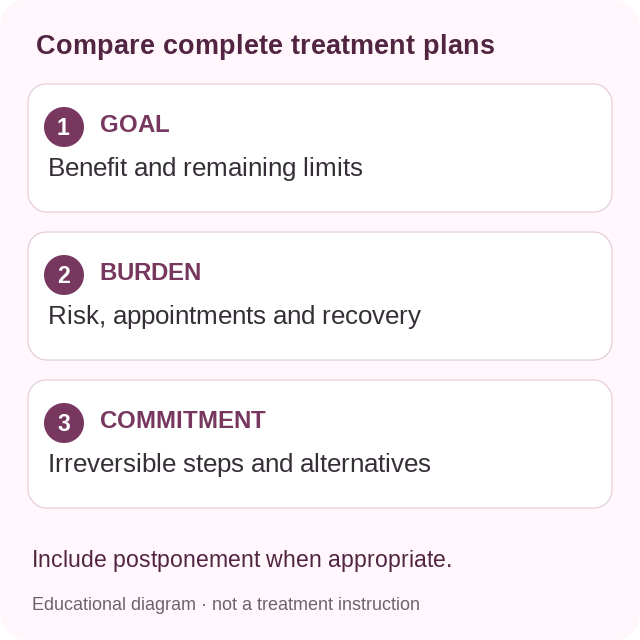
Compare three realistic endpoints, including no immediate treatment
Ask for the expected endpoint of orthodontics alone, combined orthodontic and surgical care, and observation or postponement when medically reasonable. “No immediate treatment” does not mean ignoring dental disease or symptoms. It means asking what should be monitored, what might change the recommendation, and how much time you have to decide. Treat active dental problems according to your dentist's advice regardless of the wider choice.
For a nonsurgical plan, ask what happens to the original jaw relationship, whether extractions or other irreversible changes are proposed, and what limitations remain. For combined care, ask which jaw movements are proposed and what benefit those movements are expected to add. There is no universal ranking of these options. The right comparison is whether the additional expected benefit is worth the additional risk and burden for your own priorities.
Do not treat camouflage as a synonym for poor care. It may be a reasonable compromise for some people. Equally, “avoids surgery” is not enough information if the proposed dental movement cannot meet your main goal. Ask the clinician to describe both the best plausible outcome and the compromise you are accepting.
Balance the burdens and risks on both sides
Braces require continuing dental care, cleaning and attendance. Ask the orthodontist about risks relevant to your teeth and gums, including tooth decay around appliances, gum problems, root changes and teeth moving again after treatment. These questions matter even when you are trying to avoid an operation. Request an explanation of what monitoring and retention are intended to prevent and what they cannot guarantee.
Surgery adds anaesthesia, a period of restricted eating and activity, and operation-specific risks. The surgical discussion should include bleeding, infection, altered sensation that may persist, bite problems, relapse and the possibility of further treatment. Your own risk depends on the procedure and health history; a general percentage from an online article cannot substitute for that discussion. Ask which complications would change your day-to-day life most, who would treat them, and what additional care might be necessary.
NHS: braces and tooth movement ↗
Cambridge University Hospitals: jaw surgery and consent ↗
Leeds Teaching Hospitals: benefits and risks of orthodontic treatment ↗
Combined care needs shared planning
When surgery is chosen, orthodontics often prepares the teeth to fit the planned jaw positions and later refines the bite. Ask why each phase is needed and whether a surgery-first pathway is relevant. A shorter presurgical phase does not automatically mean a shorter or easier overall course.
Ask who confirms readiness for surgery and how the plan will be reviewed if tooth movement differs from expectations. The orthodontist and surgeon should be working toward the same final dental relationship, with a clear method for sharing records and decisions.
Ask about irreversible steps before they occur
If extractions or other substantial preparatory changes are proposed, ask how they relate to the selected pathway and what would happen if you later decided against surgery. This is a useful question before treatment begins, not only after a change of mind.
Make sure the plan addresses oral health as well as alignment. Discuss existing gum disease, decay, missing teeth, and restorations. A technically attractive orthodontic-surgical plan still needs to be workable for the condition of your teeth and their supporting tissues.
Questions to settle before a deposit or extraction
Ask whether both clinicians agree on the final bite and the order of treatment. Then ask what would happen if you changed your mind after preparatory orthodontics began. Tooth movements made to prepare for surgery may not match the goals of a nonsurgical plan. You deserve to understand the consequences before an extraction, a major change of tooth position or a financial commitment, rather than discovering them later.
A written comparison can have five headings: intended benefit; limitations; irreversible steps; appointments and recovery; and responsibility if the plan changes. Ask for missing answers instead of using the document as a scoring system. A clinic with the shortest schedule is not automatically offering the same endpoint as another clinic. Estimates should explain their assumptions and when the plan will be reviewed. Take enough time to consider the information without a sales deadline deciding for you.
Why two reasonable plans may have different goals
A nonsurgical and a surgical proposal can both be coherent while aiming for different endpoints. One may prioritize an improved dental fit while accepting the existing skeletal profile. Another may aim to change the jaw relationship as well as the teeth. Before deciding that the opinions conflict, ask each clinician to state the intended endpoint and the compromise being accepted.
This is especially important when you are satisfied with your appearance but troubled by the bite, or when the opposite is true. Your priorities should influence the discussion, but the clinician should also explain what is feasible and what risks accompany each option. Shared planning means making those differences explicit rather than assuming that everyone wants the most dramatic change.
A useful exercise is to write what you would consider a worthwhile improvement and what burden you would find difficult to accept. Bring that list to the consultation. It can reveal whether the proposed pathway fits your life as well as your anatomy. The aim is an informed choice among realistic options, not an automatic escalation from braces to surgery because one treatment sounds more definitive.
For patients considering Korea
Choose the treatment sequence before choosing the travel dates. If orthodontics will happen at home and surgery in Korea, ask both clinicians to confirm that arrangement in writing. Clarify records, appliances, appointments, postoperative adjustments, and who manages an unexpected bite problem. Comparing complete pathways is more useful than comparing a braces price with a surgical package price that excludes the rest of treatment.
Recommended listed clinics for a diagnosis-led conversation
Faceline Plastic Surgery is a relevant listed option to investigate because its official international website describes a two-jaw surgery service. For this decision, ask its team to explain which proposed changes require bone surgery and which could be achieved with orthodontic treatment alone. Request the orthodontist's role and a discussion of alternatives. This is a recommendation to investigate a relevant service, not an endorsement of results or a statement that surgery is appropriate for you.
Sinsa Oral & Maxillofacial Surgery also lists orthognathic services on its international website. Its listed location is Changwon, so do not assume a consultation or operation takes place in Seoul. Ask where assessment and follow-up occur and who will coordinate any existing orthodontic care. Selection here is based on relevant publicly described services and an existing platform profile, not a safety ranking. Current clinicians, availability, language support and individual suitability need direct confirmation.
Frequently asked questions
Can clear aligners replace jaw surgery? An appliance choice does not answer whether a skeletal change is needed. Ask what movement is being proposed and whether it can meet the agreed goals within the limits of the supporting tissues. If aligners are considered as part of surgical treatment, the orthodontist and surgeon must agree how they fit that pathway.
Does being an adult mean I need surgery? No. Age alone does not decide the treatment. Adults can have orthodontic treatment, while a substantial jaw discrepancy may require a different discussion. Ask how growth, dental health and the nature of the discrepancy influence your options.
What if two clinics disagree? Compare the diagnosis, intended endpoint, information used and accepted compromises before comparing prices. A second opinion is especially useful when one plan involves irreversible preparation. Take the same records and your written goals so the opinions address the same question.
Explore the listed clinic and clinician
Faceline Plastic Surgery: platform profile ↗
Faceline: international website ↗
Sources & further reading
- AAOMS: corrective jaw surgery ↗
- Nottingham University Hospitals: jaw surgery treatment ↗
- University Hospitals Plymouth: orthognathic treatment ↗
- Dorset County Hospital: orthognathic surgery ↗
- Mayo Clinic: jaw surgery, preparation and risks ↗
- NHS: braces and tooth movement ↗
- Cambridge University Hospitals: jaw surgery and consent ↗
- Faceline: official two-jaw surgery service ↗
- Sinsa Oral & Maxillofacial Surgery: international website ↗
- Leeds Teaching Hospitals: benefits and risks of orthodontic treatment ↗
For personal recommendations, discuss your examination and records with your treating surgeon and orthodontist.