How should the orthodontist and surgeon coordinate?
Both clinicians should agree the treatment goal, the sequence, responsibility for records and how surgical and orthodontic follow-up will be coordinated.
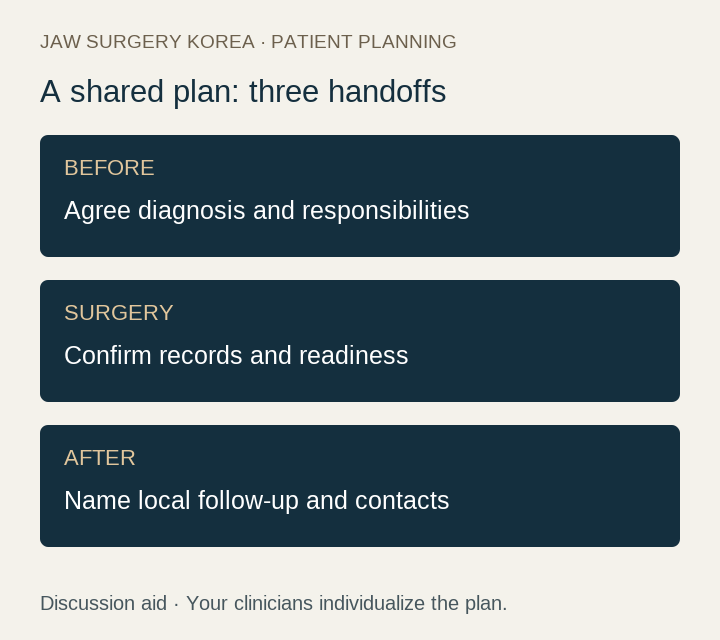
Why two specialists need one plan
Jaw surgery changes the relationship of the jawbones; orthodontics moves teeth within those bones. Those jobs are related, but they are not interchangeable. An orthodontist considers tooth alignment and how the upper and lower teeth will meet. An oral and maxillofacial surgeon assesses the jaw relationship and the proposed operation. Your dentist may also need to address decay or gum disease. Ask the team to explain who is responsible for each part of your care and how they will communicate before you begin any irreversible step.
This matters particularly when orthodontic appointments take place in one country and surgery in another. A proposal that sounds clear in two separate consultations can still leave a gap: who will adjust the appliance immediately before surgery, who will see you after the operation, and who will continue the bite treatment after you return? The answer should be an agreed arrangement between clinicians, not an assumption that a local orthodontist will take over.
Start with the diagnosis, not a flight date
Bring your functional concerns as well as your appearance goals. Explain which teeth do not meet, where chewing is difficult, whether you have pain or difficulty closing your lips, and what previous treatment changed. Ask the surgeon and orthodontist to show you which findings involve tooth position and which involve the position of the jawbones. Request an explanation of why a combined approach is being considered, what alternatives might address, and what could remain unresolved without surgery.
There may be more than one clinically reasonable pathway. Braces alone may camouflage a skeletal difference in selected situations, while a combined plan may aim to change the relationship of the jaws. Neither option is automatically right for you. Discuss potential benefits, limits, uncertainty, risks and the option of postponing or declining. A remote consultation can help you prepare questions, but the treating team must decide what examination and records are needed before confirming a plan.
Make the two clinicians identifiable
Write down the names, professional roles, practice contact details and language arrangements for the surgeon and orthodontist. Ask who is the lead for the overall plan and whether both have reviewed your records together. Do not assume that a website listing several professionals means a particular orthodontist has accepted responsibility for your treatment. Ask for confirmation of the individual clinicians, location of appointments, and who takes over if a clinician is unavailable.
A joint consultation may happen in person or through an agreed exchange of records; the precise arrangement depends on the teams. Guy’s and St Thomas’ describes a joint jaw-surgery appointment with a surgeon and consultant orthodontist. That is a useful model for the questions to ask, not a promise that every Korean clinic uses the same system.
Ask what a shared plan should contain
The written plan should explain the diagnosis, proposed sequence, which jaw or jaws are being considered, and what orthodontic work is expected before and after the operation. It should identify which details remain provisional. Ask the team to describe how they will confirm readiness, who will review the fit of any surgical splint or wafer, and what happens if the bite, dental health, medical assessment or your preferences change before the operation.
A sensible plan also says what it does not promise. Images or simulations can help explain proposed movements but are planning aids, not guaranteed predictions of the final face or bite. Ask how the team will discuss changes to the plan and whether a new consent discussion is needed. Keep your own copy of the current plan and ask which language version should be relied on if translations differ.
Records: ask what is needed and how to transfer it
Your clinicians may request photographs, dental scans or models, X-rays or other imaging, periodontal records, an orthodontic treatment summary, and a current medication and health history. Different tests answer different questions, and older records may no longer represent your present bite. Ask each team which records are necessary, which are still useful, their preferred format, and whether a new scan or examination is justified. More imaging is not automatically better; discuss the clinical purpose and radiation considerations with the treating team.
Share records through a route the practices approve, after checking names, dates and image orientation. Ask whether files were received and could be opened. A screenshot of a report may not substitute for an original image or scan, and a translated summary can omit details. Never send sensitive records to an unfamiliar address simply because it appears in a message. Obtain the destination directly from the practice and consent to the transfer.
Before surgery: agree readiness and responsibility
Orthodontic preparation may take months and sometimes longer. Timing varies with the bite, growth, dental health, the chosen approach and attendance. A published schedule from another person or clinic is not your clearance date. Ask the orthodontist and surgeon how they will decide that your teeth are ready, how often the plan will be reassessed, and whether the proposed surgical date is provisional. Some pathways differ from the conventional sequence; ask why the team recommends yours.
Arrange routine dental care during orthodontics. Sore gums, broken brackets, loose wires or a change in your bite should be reported to the responsible clinician. Guy’s advises contacting the treating team if braces break before the operation because a repair may be needed. Do not attempt to make adjustments yourself. Ask who can help if a component breaks while you are travelling and whether the Korean team needs to assess the repair.
Splints, appliances and the final visit
A surgical splint, sometimes called a wafer, can be used as a guide for positioning the bite. It is not the same thing as a general-purpose mouthguard, and not every patient follows the same appliance plan. Some teams check the fit of a patient-specific splint and the final movement plan shortly before surgery. Ask where this appointment takes place, whether you need an in-person visit, and what happens if the fit or your orthodontic setup changes.
Clarify whether hooks, wires or elastics are expected and which clinician places or removes them. Written instructions should identify who to contact about an appliance concern and whether to keep a spare. Do not copy someone else’s elastic pattern, remove a splint, or change a device without the treating team’s directions. An online photograph cannot tell you which movements or materials are appropriate for your treatment.
After surgery: plan the handover before departure
Surgical and orthodontic follow-up answer different questions. The surgeon may assess healing, swelling, sensation, jaw position and complications; the orthodontist evaluates tooth movement, appliances and the developing bite. Cambridge University Hospitals describes follow-up with both clinicians and notes that elastics can be used to guide the bite after surgery. Your personal schedule and restrictions must come from your treating team rather than a general article.
Before leaving Korea, ask for a written discharge summary, the operation performed, relevant imaging or records, medication instructions, appliance instructions and the recommended review schedule. Ask which clinician will receive the information at home and confirm that they have accepted that role. Clarify who will interpret changes in the bite, who can request new imaging if needed, and how a concern will be escalated if the teams disagree or cannot reach one another.
Know the difference between a routine question and an emergency
Ask for a written contact plan covering Korean office hours, nights, weekends and your return journey. A loose bracket or a question about an elastic still needs a named contact, but it should not delay urgent assessment for a potentially serious problem. Difficulty breathing, severe uncontrolled bleeding, collapse, rapidly worsening swelling that affects breathing or swallowing, or another severe deterioration warrants immediate local emergency care. Do not wait for a message reply from a distant clinic before obtaining emergency help.
For concerns that are not immediately life-threatening, such as a broken appliance, increasing pain or new wound changes, contact your treating team promptly for individual advice and ask whether local examination is needed. Do not use a generic online timeline to decide that a worsening symptom is normal. Keep a concise copy of your procedure and medication list available to local clinicians, especially if you are unable to speak comfortably.
Discuss travel as a clinical and practical decision
Book flexible travel and accommodation where possible. Ask the surgeon which appointments must occur before departure and when they will assess your fitness to fly. A discharge from hospital does not automatically mean that a long flight, independent travel or return to work is appropriate. Travel planning includes access to food and fluids, medication, mobility, a companion if needed, communication, and the possibility that a complication or missed review changes the itinerary.
Agree what would happen if you must remain longer, miss an orthodontic visit, or require local urgent care at home. Ask about emergency contact methods and the limits of remote advice. Your own medical history and operation matter; no article can give a universal safe departure day. Discuss insurance, coverage exclusions, and who pays for unscheduled care directly with the insurer and providers before you commit.
Questions to put to both teams
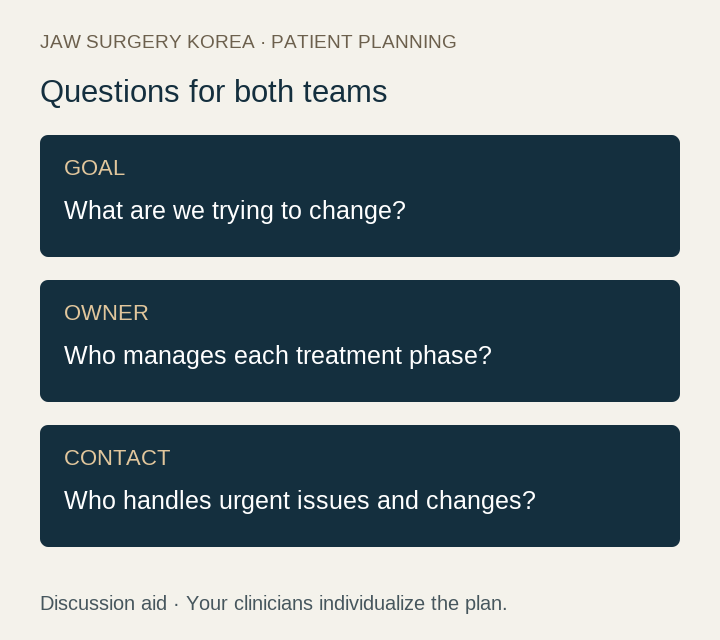
Before you commit, ask: Have both specialists reviewed the same records and agreed the treatment goal? Who is responsible for each phase and how are proposed changes communicated? What appointments must be in Korea? Can my home orthodontist accept the handover, and what documentation do they need? What are the fees for preparation, surgery, appliances, follow-up and potential additional treatment? What happens if the dates or plan change?
Also ask who handles broken braces, who makes decisions about elastics, when to seek emergency help, how to obtain copies of imaging and a discharge summary, and how to arrange an interpreter. Ask about practical availability rather than assuming any language support. Write the answers down in your own words and check them with both teams. If an essential handover is unresolved, resolve that gap before relying on a proposed travel or surgical date.
Use the plan to make your own decision
Coordinated care does not guarantee a particular appearance, perfect symmetry or an uncomplicated recovery. It gives you a clearer way to understand who will assess problems and how the many stages fit together. You may ask for a second opinion, take time to consider the trade-offs, or decide not to proceed. If two clinicians propose different pathways, ask each to explain the diagnosis and trade-offs rather than comparing only a single quoted price or the number of days in Korea.
At consultation, request a named point of contact and an opportunity to clarify information you do not understand. Bring a trusted person if useful and ask for an interpreter where necessary. Your best next step is a plan that both clinicians and you understand, with the necessary local follow-up confirmed—not a fixed itinerary built around an unconfirmed operation.
A listed clinic to discuss coordination
Faceline Plastic Surgery’s international website lists a two-jaw surgery service. Its listed profile also describes an orthodontic service, making it one option for asking how surgical and orthodontic planning are coordinated. Confirm who would perform each part and whether your own orthodontist can participate. Inclusion is not a guarantee of suitability or acceptance.
Explore the listed clinic and clinician
Explore the clinic directly
Explore Faceline’s international website ↗Sources & further reading
- Guy’s and St Thomas’ NHS: Jaw surgery appointments ↗
- Cambridge University Hospitals: Jaw or chin corrective surgery ↗
- Nottingham University Hospitals: Jaw surgery treatment ↗
- Faceline international: two-jaw surgery ↗
For personal recommendations, discuss your examination and records with your treating surgeon and orthodontist.