Why are braces needed before jaw surgery?
Braces prepare the teeth for the planned jaw relationship. This can temporarily make the bite seem worse. Agree the preparation goal with both your orthodontist and surgeon before starting, especially when orthodontics and surgery will take place in different countries.
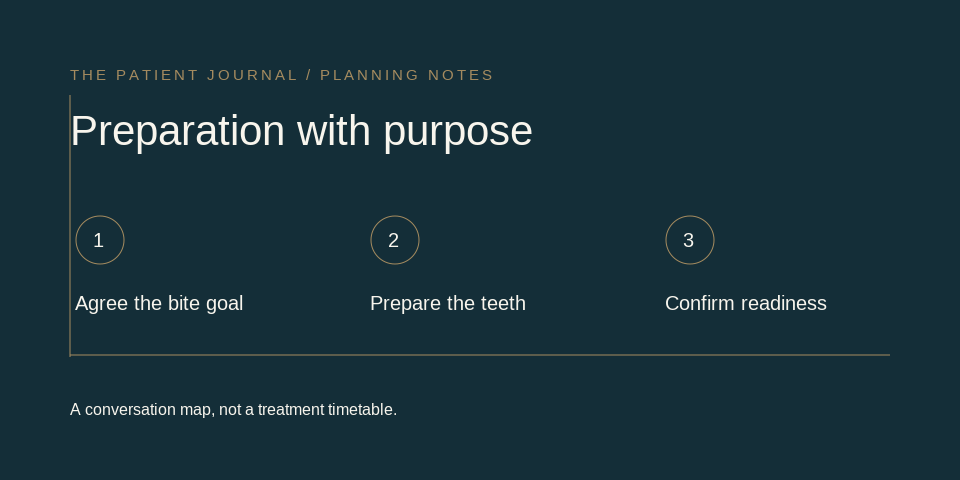
Preparation has a different goal from camouflage
In combined treatment, braces prepare the teeth for the planned jaw relationship. This is not necessarily the same goal as moving teeth to disguise an underlying jaw discrepancy. Ask your orthodontist to explain what they are preparing for and how the intended tooth positions support the operation.
The preparation phase can be a major part of the overall commitment. Before starting, ask whether the surgeon has reviewed and agreed the plan. This is especially important if you intend to begin orthodontics at home and travel to Korea later. Starting treatment without a shared plan can leave different clinicians working toward different assumptions.
Why the bite can look worse during preparation
Teeth and jaws are separate parts of the correction. If teeth have been positioned in a way that partly masks a jaw discrepancy, moving the jaws without preparing the teeth may leave them unable to meet as intended. Orthodontic preparation arranges the teeth for the planned postoperative relationship. This can make the existing bite appear worse before the jaw movement is performed, a possibility described in BAOMS patient guidance.
The temporary appearance therefore needs to be judged against the agreed treatment sequence, not treated as evidence that every stage should look more attractive than the last. This does not mean every new difficulty is expected or should be ignored. The orthodontist should explain the anticipated intermediate changes and assess anything that differs from that explanation.
Know what changes to expect along the way
Ask what you may notice in your bite and appearance during preparation. The path to the final result may not look like steady cosmetic improvement at every appointment. A planned intermediate change is different from an unexpected problem, and the team should explain that distinction before treatment begins.
Request a clear point of contact if chewing, discomfort or appliance problems become difficult to manage. Do not alter elastics or stop attending because an intermediate stage feels disappointing. Ask the orthodontist to explain whether what you are experiencing fits the plan and what can be done to support you.
Plan around readiness, not a fixed holiday
Ask how the team decides that you are ready for surgery. The answer should describe clinical readiness and the records needed, not only a predicted number of months. An initial estimate can help with budgeting, but it should leave room for progress to differ from expectations.
If you have a narrow travel window, discuss it before beginning. Ask what happens if preparation is incomplete when that window arrives and whether postponement affects deposits or other bookings. Do not pressure the clinical plan to fit a nonrefundable flight. Keep travel arrangements flexible until the team confirms the relevant milestones.
Protect the teeth throughout the process
Ask for practical appliance-care and oral-hygiene instructions suited to your braces. Continue the dental care recommended by your clinicians and report breakages promptly. A surgical plan depends on the condition of the teeth and gums as well as their position.
Before the final preoperative visit, confirm which appointments, imaging and records are still needed. Ask whether special appliance adjustments are planned near surgery and who will make them. A written sequence helps avoid arriving in Korea with an orthodontic task that neither team expected to complete there.
What decompensation means for your decision
Decompensation describes removing tooth positions that partly compensate for the relationship between the jaws. In ordinary language, the teeth may have tilted to make an underlying mismatch less obvious. Preparing them for a different jaw relationship can temporarily reveal that mismatch. AAOMS explains why a bite can initially seem worse during preparation. This is a reason to understand the sequence, not a reason to accept every uncomfortable change without assessment.
A practical question is: what is the intended endpoint of my orthodontics? Ask your clinician to distinguish the position needed for a surgical correction from the best achievable position if you choose orthodontics alone. Those endpoints may differ. Have this discussion before agreeing to extractions or a substantial change in tooth position, so you know which decision each step depends on.
Avoid treating preparation as a test of whether you like the idea of surgery. You can reconsider treatment, but stopping midway may require a new plan. Ask what options would remain if your health, finances or preferences changed. The answer should explain the dental consequences and possible additional work without pressuring you to continue an operation you no longer want.
Starting braces at home and having surgery in Korea
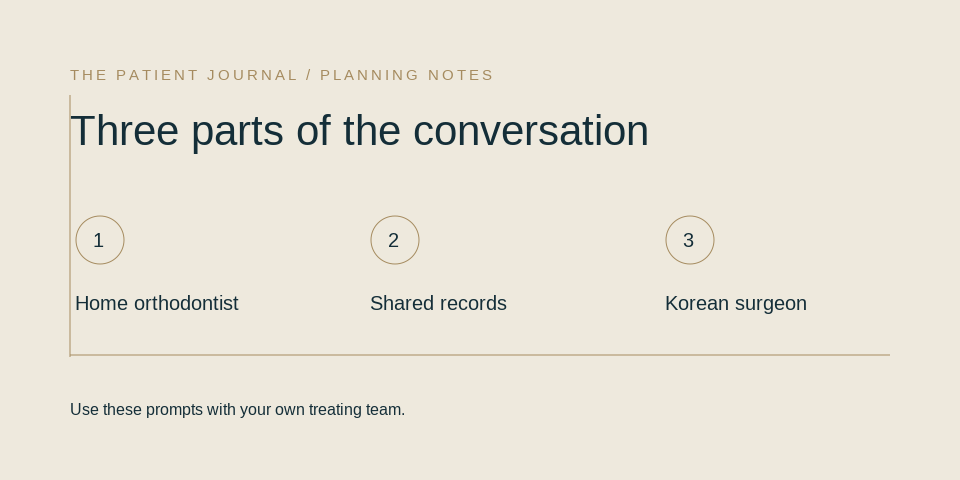
Before your first adjustment toward a surgical plan, ask each practice to confirm the other clinician's name and contact details. Give permission for direct record sharing through the channels they recommend. Your role is to make the arrangement possible; it should not be to translate technical instructions between professionals who have never agreed on the treatment.
Build a short responsibility sheet. Who arranges dental records? Who orders any new imaging? Who provides urgent help if a bracket breaks before departure? Who approves the final readiness assessment? Who adjusts the appliance after you return? For each task, put a clinician or practice beside it rather than writing simply 'the clinic'. Keep a copy with your appointment information.
Also ask whether the Korean consultation could change the proposed operation. If so, the home orthodontist needs a route for reassessment before continuing preparation. A preliminary online opinion is useful for deciding what to investigate; it does not make an examination unnecessary. Book the clinical review early enough that a changed recommendation can be considered before flights and deposits create pressure.
How to compare preparation estimates
Two estimates can differ because they describe different endpoints. One may count only the remaining preparation; another may include dental-health treatment, surgery and orthodontic finishing. Ask both clinicians to label their estimate clearly. Record the expected start point, the clinical tasks still required, and which parts depend on progress rather than a calendar date.
A useful progress conversation has three questions: what has changed since the last assessment, what still needs to change, and what could delay the next decision? You do not need measurements to understand every answer. The clinician might explain that a space still needs management or that the arches are not yet coordinated. Ask for that explanation in language you can repeat accurately.
Resist comparing your duration with someone who had a different bite, appliance history or surgical sequence. Instead, agree when your own estimate will be reviewed. If an important work or family commitment is approaching, disclose it promptly. Discuss postponement while there are still practical choices, rather than waiting until the team is asked to fit clinical readiness into a fixed travel window.
Questions about discomfort, eating and appliance problems
Ask the orthodontic practice to provide its own instructions for discomfort, cleaning and a broken appliance. Keep these separate from the later surgical discharge instructions; they apply to different stages. If the bite is harder to use, describe the particular task that is difficult, such as biting through food or finding comfortable contact, rather than reporting only that everything feels wrong.
Use a brief symptom note for the appointment: what changed, when it began, whether it is improving, and which daily activity it affects. That is more useful than repeatedly testing the teeth or moving appliances yourself. A photograph may help explain a visible issue, but the practice should decide whether an examination is needed. Do not make your own changes to elastic patterns or wires.
A relevant clinic and orthodontic consultation
Faceline Plastic Surgery in Seoul lists two-jaw treatment and orthodontic care, and its official team includes Dr. Lee Shin-jung as an orthodontic clinician. This makes it a relevant listed option for discussing preparation around surgery. Selection here is based on documented service relevance, not a ranking or an assurance of suitability.
Before requesting a consultation, prepare your existing orthodontic diagnosis, current appliance details and the name of your home clinician. Ask whether the practice will assess a shared international treatment pathway. Request the expected responsibilities in writing. Review the clinic and doctor profiles below, then use the international website to discuss whether an appointment would answer your specific question.
Frequently asked questions before committing
Can I avoid braces because my teeth look straight? Straight-looking front teeth do not establish that the upper and lower arches will meet appropriately after jaw movement. Ask for a bite assessment. Conversely, having an uneven bite does not prove that surgery is needed: orthodontics alone, a different treatment plan or no treatment may be reasonable depending on the findings and your priorities.
Does surgery-first mean there is no orthodontic treatment? No. It describes a different sequence for selected cases, not an automatic exemption from tooth alignment. If you are offered that pathway, ask how the postoperative bite will be managed and what appointments it requires. Compare the complete commitment with orthodontics-first rather than comparing only the time before surgery.
Can I change surgeons after preparation has started? Ask the new team to review your records and explain whether the existing preparation fits its proposal. Do not assume a new operation can simply be inserted into the old schedule. Keep both clinicians informed and obtain a clear revised plan before further irreversible decisions.
What should I take away from the first appointment? Aim for a written explanation of the problem, the preparation goal, reasonable alternatives, likely appointment pattern, fees and the next decision point. If a question remains unanswered, record who will answer it and when. A clear next step is more useful than a surgery date that the clinical team cannot yet confirm.
Explore the listed clinic and clinician
Explore the clinic directly
Discuss your plan with Faceline ↗Sources & further reading
- East and North Hertfordshire NHS: Orthognathic surgery ↗
- BAOMS: Why orthodontics is needed with jaw surgery ↗
- Faceline: Two-jaw service and team ↗
- Official clinician biography ↗
- AAOMS: Why orthodontic preparation can change the bite ↗
For personal recommendations, discuss your examination and records with your treating surgeon and orthodontist.