How can you arrange aftercare after returning home?
Arrange an accepting local clinician before travel, obtain the operation and discharge records, and know how to access urgent local care.
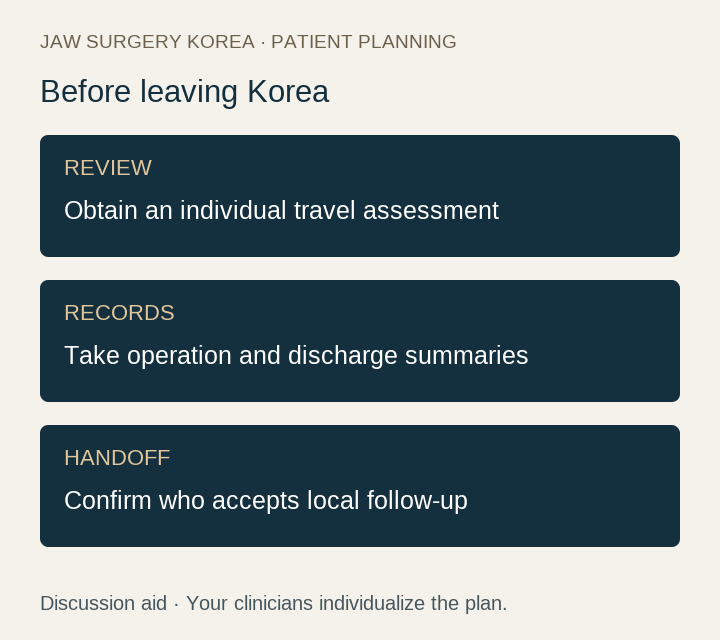
Arrange acceptance before treatment abroad
Identify the clinician who will manage postoperative orthodontics and who can assess surgical concerns locally. Ask whether they are willing to take on the planned role and what information they need. A general promise to see you as a patient may not cover all aspects of a complex postoperative case.
Discuss this with the Korean surgeon before treatment. The teams should understand each other's responsibilities and how they will communicate. Do not assume that a remote messaging service can provide every type of follow-up that a physical examination may require.
Make the discharge plan transferable
Request a clear summary of the operation, current findings, restrictions and planned reviews. Ask what the home clinician should assess and what changes should prompt direct contact with the surgeon. Include the current medication list and relevant records.
If the plan uses elastics, splints or specific appliance adjustments, ensure the instructions are explicit and current. Conflicting advice can be difficult for a recovering patient to resolve. Ask the clinicians to discuss disagreements rather than expecting you to translate technical recommendations between them.
Know the limits of remote review
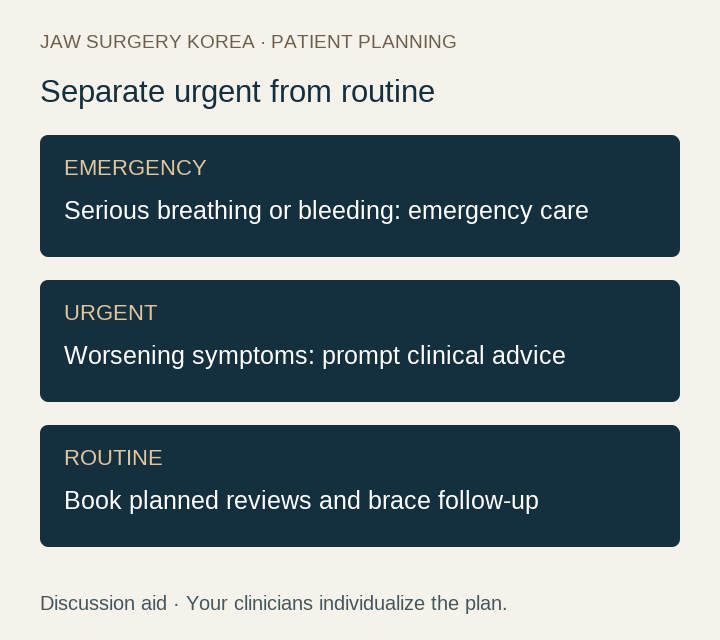
Photographs and video calls can support communication, but ask when symptoms require an in-person assessment. Obtain a clear contact pathway for routine questions, urgent concerns and emergencies. If you have a serious or rapidly worsening problem, seek appropriate local care rather than waiting for an international reply.
Keep a brief record of symptoms and changes so you can describe them accurately. Note when the issue started and what instructions you were given. Do not turn this into self-diagnosis; it is a way to help the clinician understand the situation.
Plan the practical and financial handoff
Ask about local follow-up charges, additional imaging and how records will be shared. Clarify whether the Korean clinic contributes to any of these costs or whether they are your responsibility. If insurance is involved, confirm the relevant terms directly with the insurer.
Keep the first home appointment in place and ask what to do if travel is delayed. The goal is continuity through the transition, not simply reaching your home airport. A clear arrangement lets you focus on recovery while knowing where each kind of question belongs.
What does a handover need to accomplish?
A good handover gives a receiving clinician enough information to understand what was done, what the treating team expects next, and what needs a fresh assessment. It does not transfer responsibility automatically. Before travel, ask the proposed home clinician whether they can accept the role, which tasks they can perform, and whether they need a referral or records before they agree.
You may need more than one local contact. An orthodontist may adjust braces but may not provide urgent maxillofacial surgical assessment. Your general dentist, family doctor, oral and maxillofacial service and emergency department have different roles. Write down who has agreed to each role and how to reach them, rather than assuming a single appointment covers everything.
Before you commit to the operation
Ask the Korean treating team for a proposed follow-up schedule and the conditions that could change the expected departure. Ask which reviews must be in person, what remote reviews can and cannot assess, and whether your home clinician has agreed to the transition. The schedule is a working plan, not a promise that you can fly on a particular date.
The UK government’s medical tourism advice recommends considering aftercare, possible complications and whether you are well enough to travel after treatment. Check the arrangements that apply to your own country. Ask your insurer in writing about planned overseas surgery, complications and follow-up; ordinary travel cover is not automatically a treatment or complication guarantee.
The documents to ask for
Request an operation note that identifies the procedure, date, surgical team, jaw or jaws treated, and any implants or fixation relevant to future care. Ask for copies of discharge instructions, current medication and allergy lists, imaging reports, relevant imaging files, and the expected orthodontic plan. Your receiving team can tell you which formats they can open and what additional records they need.
A patient-friendly summary can sit alongside technical records. It might say what textures are currently allowed, which activities are restricted, when reviews are expected, and who can modify those instructions. Avoid relying solely on screenshots of a chat or a translated marketing brochure. Request a correction if your identity, dates or operation details are wrong.
Orthodontic and appliance continuity
Confirm who will review the bite, adjust orthodontic appliances, and prescribe or change elastics or splints. A device in your mouth is part of a plan, and its appearance alone does not tell a new clinician what should happen next. Ask for written settings, the purpose of the device, and the contact for breakage or a change in bite.
Do not remove, cut, tighten or change a device on your own unless your team has specifically taught you an emergency action for your situation. If an instruction appears to conflict with what your home clinician says, ask the clinicians to speak directly. Contact an urgent local service for a serious problem rather than waiting for a routine international reply.
Travel readiness and a delayed departure
Leaving hospital and being ready for a long flight are separate decisions. Ask the operating team to assess your particular recovery, planned route, ability to drink and take medicines, and access to assistance before clearing travel. A complication, missed review or change in your condition can alter the plan even if a departure date was initially suggested.
Keep accommodation and a caregiver plan flexible where possible. Discuss the cost and logistics of a delayed flight or added appointment before you book non-refundable arrangements. Ask who can provide a written update to the airline or insurer if necessary. A personal plan is more useful than copying a number of days from another patient’s story.
Know which problems cannot wait
Breathing difficulty, heavy or uncontrolled bleeding, collapse, chest pain, or severe rapidly worsening illness need immediate local emergency help. Do not wait for a message from an overseas clinic or try to complete a records transfer first. Your companion can tell emergency staff that you recently had jaw surgery and show the discharge summary if it is immediately available.
For a new fever, increasing swelling, wound discharge, worsening pain or an unexpected bite change, contact the treating team or an appropriate local clinician promptly using the plan you were given. Urgency depends on the symptom and how quickly it is changing. If you cannot reach them and are concerned about a rapidly worsening problem, seek urgent local assessment.
Appointments, costs and written expectations
Clarify what the overseas fee covers, what is excluded, and who pays for additional local visits, imaging, appliance repairs or treatment of a complication. Ask for answers in writing and check policy terms with the insurer and local provider. A quotation for surgery does not automatically establish who pays for follow-up elsewhere.
Arrange a first home review before departure when practical, and ask what to do if the date has to move. Bring a companion if communication or eating remains difficult. Keep appointments even when you feel well unless the responsible clinician changes the plan; a comfortable day is not itself evidence that bone or orthodontic treatment is complete.
A practical handover conversation
Ask the Korean surgeon: “What was done, what must be protected, and which findings require a call or examination?” Ask your local clinician: “Which parts can you manage, what documents do you need, and where should I go after hours?” Ask the orthodontist: “Who can alter the appliances, and how will you communicate with the surgeon?”
Confirm secure record transfer with the providers rather than posting sensitive images in a public forum. Tell the team your preferred language and request a clear translation when technical details are difficult to understand. Keep a personal copy, but allow clinicians to exchange technical questions directly with your permission.
If the planned receiving clinician cannot accept you
Pause and clarify the alternative before proceeding with an elective trip. Ask the surgeon whether another suitably qualified local service can accept the relevant responsibilities and whether the proposed timing remains realistic. A clinic directory may be a starting point for enquiries, but a listing is not confirmation that a particular clinician has accepted your case.
An emergency department is a route for emergencies, not a substitute for a planned orthodontic or surgical follow-up agreement. If the plan changes after treatment, notify your surgeon and contact an appropriate local service. Keep the current discharge summary accessible while a new arrangement is established.
When you return to a different health system
Ask the receiving clinic how referrals, appointments and out-of-hours access work in your destination. Rules and costs vary by country and service; a Korean follow-up plan cannot guarantee access through another health system. Confirm the first appointment, the language of the records it requires and who will translate technical instructions if needed.
A useful personal summary includes the operation date, the hospital and surgeon, a current medicine list, allergies, dietary restrictions and the next planned review. Store it where you and your companion can find it, and share it securely with a clinician when needed. If you seek urgent care, say that the operation was recent and provide the summary if readily available. Do not delay emergency assessment while searching for documentation.
After the first local appointment, ask whether the receiving clinician has questions for the operating team and how those questions will be sent. Confirm the next action and the person responsible for it. An unanswered referral is not the same as an accepted appointment; keep contacting an appropriate service until you know how follow-up will occur.
A listed clinic to discuss your plan
Faceline Plastic Surgery’s international site describes both orthognathic surgery and an orthodontic service, making it one listed option to ask about how treatment and follow-up are coordinated. Review the clinic profile and official service information, then ask whether it can accommodate your specific needs; a listing is not a guarantee of suitability or acceptance.
Explore the listed clinic and clinician
Explore the clinic directly
Explore Faceline’s international website ↗Sources & further reading
- CDC Yellow Book: Medical tourism ↗
- UK government: Medical treatment abroad ↗
- Faceline international: two-jaw surgery ↗
For personal recommendations, discuss your examination and records with your treating surgeon and orthodontist.