What is the difference between corrective jaw surgery and V-line surgery?
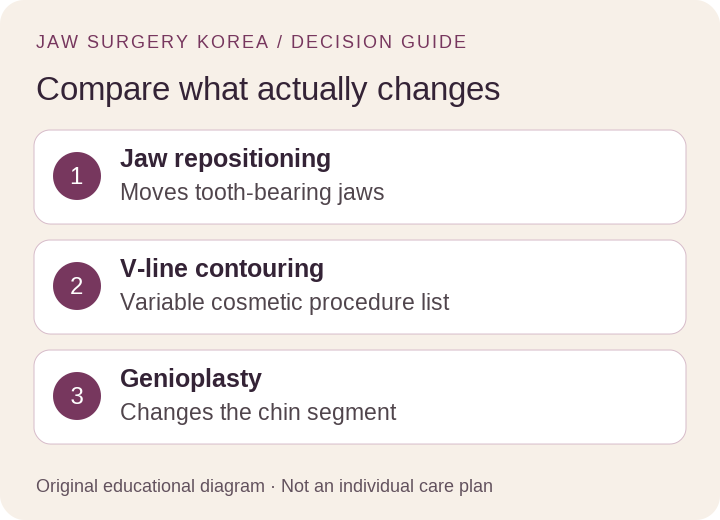
Corrective jaw surgery repositions tooth-bearing jaws; V-line commonly describes cosmetic lower-face contouring and is not a standardized operation. Contouring alone does not correct a skeletal bite discrepancy. Ask for the exact procedure list, diagnosis, alternatives and purpose of every proposed component.
Begin with what the operation moves
Corrective jaw surgery changes the position of the jaw bones to address their relationship and the bite. V-line is a cosmetic term commonly used for lower-face contouring. The procedures marketed under that label can vary. Ask for the exact operation names rather than assuming that every V-line package contains the same components.
The distinction is practical: changing an outer contour is not the same as changing where the upper and lower teeth meet. A person can have a wide-looking jaw with a functional bite, or a narrow-looking face with a significant skeletal discrepancy. Appearance alone does not establish which type of treatment is relevant.
Translate your concern into separate questions
If you dislike the width near the jaw angles, ask what contributes to it and what tissue would be changed. If you struggle to bite food or have an underbite, ask for an orthodontic and skeletal assessment. If both concerns exist, they should be evaluated together without assuming that a combined operation is automatically necessary.
Write down the result you want in everyday language. For example, a wish for less lower-face width is different from a wish to bring the lower teeth behind the upper teeth. This makes it easier to detect when a proposed treatment addresses a different concern from the one that brought you to the clinic.
Be careful with package terminology
Terms such as three-point contouring, mini V-line, or facial balancing do not replace an operation list. Request the anatomical region, the planned bone or soft-tissue change, and the reason for each component. If genioplasty is included, ask whether it changes projection, height, width, or centering.
A clinic may offer both contouring and orthognathic treatment, but availability does not establish suitability. Ask who assesses the bite, who performs each operation, and whether the recommendation was developed jointly when orthodontic treatment is involved.
Compare risks for the actual procedures
Both categories can involve significant surgery. Ask about the risks relevant to the specific plan, including sensation, healing, bleeding, asymmetry, and dissatisfaction with the result. Do not assume that a cosmetic label means a minor procedure or that a functional label guarantees an aesthetic outcome.
If a combined plan is proposed, request an explanation of the additional benefit and burden of each component. Ask which goals would still be met without the optional contouring. This supports a more deliberate decision than accepting all changes because they can be performed during one anesthetic.
Questions that clarify the choice
Does my bite show a dental or skeletal discrepancy? Will this operation move the part of the jaw carrying my teeth? What feature is each component intended to change? Could orthodontics, no treatment, or a more limited operation meet my priorities? What cannot be improved by the plan? For treatment in Korea, make sure the English consent form uses the specific procedure names, not only the marketing package title.
Use a three-part decision record
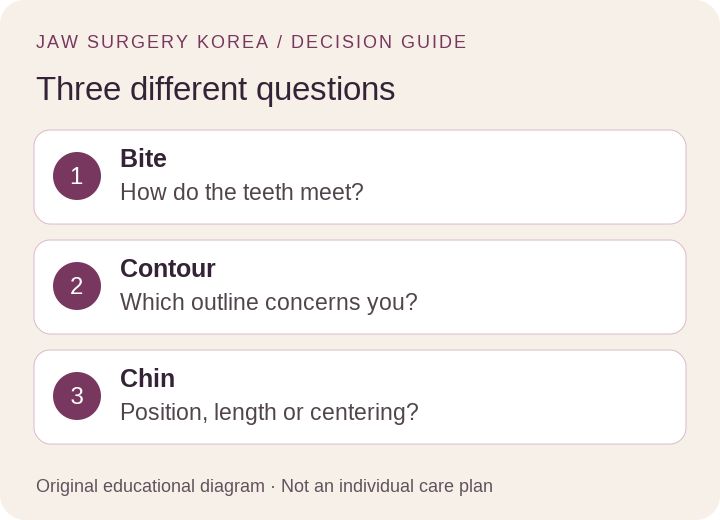
Start by separating bite, contour and chin. Under bite, record the practical problem: for example, difficulty bringing particular teeth together. Under contour, describe the outline that concerns you without assigning its cause. Under chin, note whether the concern is projection, length or centering. Bring this record to the consultation so that the clinician can explain which findings relate to each concern. This is a communication tool, not a way to diagnose yourself from a mirror.
Next to each concern, write the proposed treatment and what would happen if you left it untreated. Ask the clinician to distinguish a dental problem from a skeletal one and to explain the limits of each option. If the answer is simply a package name, request an anatomical explanation. You should be able to understand whether teeth are being moved, the tooth-bearing jaw is being repositioned, or a separate contour is being changed.
Finally, record what matters most to you and what you do not want. An acceptable tradeoff for one patient may be unacceptable for another. Tell the team if you are unwilling to accept a particular recovery burden or if your preferences remain uncertain. A good consultation allows you to consider a narrower plan, another opinion or no intervention.
What orthodontics, chin surgery and no treatment can offer
Orthodontic treatment moves teeth. It may be sufficient for some dental alignment problems, while a substantial skeletal discrepancy can require a different discussion. Ask what orthodontics alone could achieve in your case and what limitations would remain. Do not interpret this as a choice between braces and surgery in every situation: corrective jaw treatment often requires both as parts of one pathway.
A bony genioplasty changes the chin segment and does not by itself reposition the tooth-bearing jaws to correct a skeletal bite discrepancy. It may be considered for a chin concern, but an isolated chin procedure should not be presented as a substitute for assessing a functional jaw problem. Conversely, a wish to change the chin is not automatically a reason to operate on both jaws.
No treatment is a valid option to discuss, especially when a proposed change is elective. Ask about the likely consequences of waiting and whether any separate dental problem still needs care. If appearance concerns feel urgent or overwhelming, taking more time can protect the quality of the decision. The aim is an informed choice that fits your priorities, not to make every feature conform to a particular facial trend.
Mayo Clinic: jaw surgery, alternatives, preparation and risks ↗
A combined operation needs separate reasons and consent
A clinic may propose jaw repositioning together with contouring or genioplasty. Ask to see the main jaw plan first and the additional appearance changes separately. For each addition, ask what it is intended to improve, what risk or recovery burden it adds, and whether deciding later is a reasonable option. Combining procedures should not make an optional choice invisible.
Ask whether the proposed combination changes the operating time, admission needs, aftercare or cost. These are questions for the team, not reasons to assume a combination is either safer or less safe in every patient. The answer depends on the actual procedures and your health. A single recovery period may sound convenient, but convenience alone does not establish that every component is worthwhile.
If the plan changes after you arrive in Korea, request the updated procedure names and reasons in a language you understand. Make sure you have an opportunity to consider them without relying on a coordinator's brief summary. Translation access should extend to the clinical consent conversation, including alternatives and complications, rather than only the booking process.
Cambridge University Hospitals: jaw or chin corrective surgery and consent ↗
Compare material risks and the limits of prediction
Ask the surgeon about bleeding, infection, altered sensation, tooth or bone injury, contour irregularity, asymmetry, healing problems and possible further treatment as relevant to the proposed operation. A cosmetic label does not make an operation risk-free. For jaw repositioning, also discuss bite stability and jaw-joint symptoms. Which risks apply, and how they matter, must be explained for the actual techniques rather than borrowed from a different procedure.
The lower face contains nerves and other structures that place limits on surgery. Ask how imaging and examination inform the planned extent of change. Do not choose a reduction amount from a photograph or ask a clinic to match an unrelated person's jaw. More reduction is not automatically a better outcome, and an appealing front-view simulation does not answer every question about profile, function or soft-tissue response.
Before-and-after images can show selected examples, but they do not tell you the probability of your result or the experience of every patient. Ask about the timing, lighting and selection of photographs, and what happens when a result is not satisfactory. Digital planning can help communication, but it is not a guarantee of skin response, symmetry or how you will feel about the change.
Mayo Clinic: jaw surgery, alternatives, preparation and risks ↗
Cambridge University Hospitals: jaw or chin corrective surgery and consent ↗
Recovery and costs are not interchangeable between procedures
Ask for the postoperative instructions for the exact operation, including food, mouth care, activity, follow-up and any appliances. Someone else's experience of jaw-angle contouring may not apply to an upper- and lower-jaw osteotomy. The appearance of swelling also cannot tell you when normal chewing or strenuous activity is permitted. Follow the treating team's staged instructions rather than switching plans when you feel better.
When comparing costs, use identical headings: assessment, imaging, surgery, anesthesia, admission, orthodontics if needed, medicines, reviews, and management of an unexpected problem. Keep optional components separate. A lower headline fee may omit preparation or continuing care, while a higher figure may include services you do not need. Neither number establishes clinical quality without understanding the scope.
For travel, ask where the operation and reviews actually take place, how long you should plan to remain available locally, and what could extend the stay. Confirm home follow-up before you depart. Do not use a V-line travel timetable as clearance after double-jaw surgery, or treat any advertised package duration as a guarantee that you will be fit to fly.
Cambridge University Hospitals: jaw or chin corrective surgery and consent ↗
Relevant listed clinics for a scope-focused consultation
Faceline Plastic Surgery publishes both two-jaw surgery and facial-bone contouring on its international website. It is relevant to this comparison because you can ask the team to distinguish the bite-related purpose of jaw repositioning from a separately proposed contour change. Review the platform profile, then use the international website to request an explanation of your options and their limitations.
Sinsa Oral & Maxillofacial Surgery in Changwon also lists jaw realignment and facial-bone services. Ask how it assesses the bite before recommending a contouring plan, and whether orthodontic coordination would be necessary. Confirm the treatment city rather than assuming the clinic name refers to Seoul.
These are consultation options selected for relevant published services, not endorsements or outcome rankings. Confirm the current operating clinician and exact procedures directly. Neither a directory listing nor a service page establishes personal suitability, and no enquiry or payment is collected by this guide.
Questions to settle before you compare quotes
Will V-line surgery correct my underbite? Not by changing the outer contour alone. Ask whether the underbite comes from tooth position, jaw position or both, and what the proposed procedure actually moves. A package containing other operations must be explained component by component rather than relying on the V-line label.
Will two-jaw surgery automatically make my face narrower? Do not assume so. Its effect depends on the actual movements and your anatomy. Ask the surgeon to separate anticipated bite changes from appearance changes, explain residual asymmetry and identify any optional contouring rather than treating a narrower silhouette as a guaranteed result.
What if two clinics recommend different procedures? Ask both to state the diagnosis, the goal and the tradeoffs in writing. Then obtain an independent assessment if the disagreement remains important. Comparing explanations is more useful than choosing the clinic with the most confident promise or the most attractive package name.
Explore the listed clinic and clinician
Faceline Plastic Surgery: profile and current photo context ↗
Faceline: enquire through the international website ↗
Sources & further reading
- AAOMS: corrective jaw surgery ↗
- Cambridge University Hospitals: genioplasty ↗
- Mayo Clinic: jaw surgery, alternatives, preparation and risks ↗
- Cambridge University Hospitals: jaw or chin corrective surgery and consent ↗
- NHS: treatment abroad checklist ↗
- CDC Yellow Book 2026: medical tourism ↗
- Faceline: international website and contact route ↗
- Sinsa: official international clinic and jaw services ↗
For personal recommendations, discuss your examination and records with your treating surgeon and orthodontist.