What should you understand before double-jaw surgery in Korea?
Double-jaw surgery repositions both jaws in a coordinated plan. It is appropriate only when examination and records show why both jaws need treatment. Compare alternatives, orthodontic arrangements, procedure-specific risks and the complete follow-up pathway before agreeing to surgery.
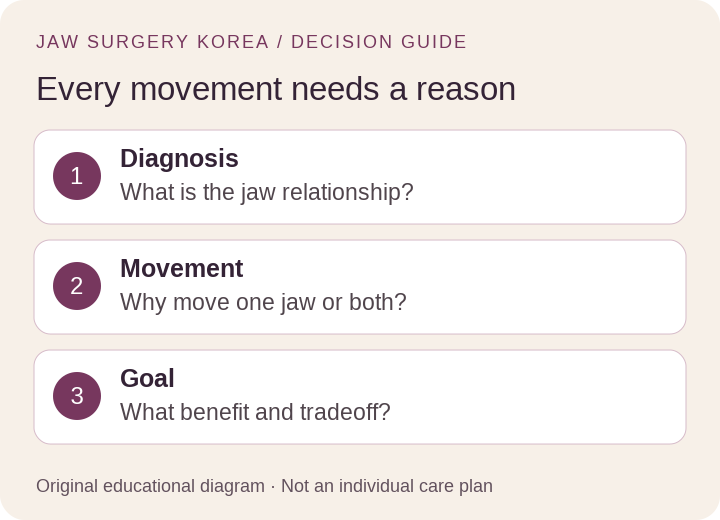
Two jaws, one coordinated bite
Double-jaw surgery, also called bimaxillary surgery, repositions both the upper and lower jaws. The goal is a coordinated relationship between the two dental arches and the face. It is not automatically a more complete or better operation than surgery on one jaw. Its value depends on whether moving both jaws offers a sounder solution to the diagnosed problem.
A person who sees a prominent lower jaw in the mirror may assume that only the lower jaw needs treatment. The assessment may instead identify a combination of upper-jaw position, lower-jaw position, facial height, and asymmetry. Ask the surgeon to show which findings justify each movement rather than treating the name of the operation as the explanation.
How the two movements are coordinated
The upper jaw carries the upper dental arch and the lower jaw carries the lower arch. Moving either changes their relationship; moving both allows the correction to be distributed between them. A surgical splint, when used, represents a planned dental relationship and helps guide positioning. It is not the same as a cosmetic preview. The final plan coordinates the bones, dental contacts, and facial goals rather than treating each jaw as an independent appearance feature.
What the planning conversation should contain
A useful plan separates forward-backward movement, vertical movement, and rotation. These directions affect different features and should be understandable even without reading a scan. Ask how the proposed upper-jaw position establishes the bite and how the lower jaw will be matched to it.
Ask to compare the recommended plan with a credible one-jaw alternative, if one exists. The comparison should discuss the bite, facial proportions, airway considerations, stability, and surgical burden. You do not need to choose millimeters yourself; you do need to understand why the team believes its plan balances those objectives.
Appearance and function need separate goals
A two-jaw plan may change several facial relationships at once. That makes it especially important to describe your priorities accurately. Bring a short list of concerns in your own words, such as difficulty closing the bite or a smile that looks tilted. Photographs can help communicate a concern, but copying another person's facial proportions is not a substitute for an individualized plan.
Ask what is expected to remain asymmetrical or unchanged. Soft tissues, dental shape, and existing differences between the two sides of the face do not become identical simply because the bones are repositioned. A candid discussion of residual differences can be more informative than a polished simulation.
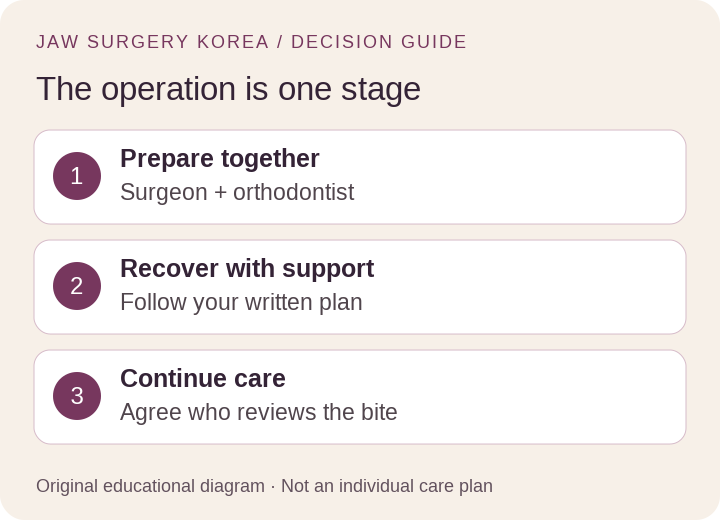
Prepare for the combined recovery pathway
The postoperative plan should explain eating, oral hygiene, elastics or a splint if used, follow-up examinations, and the point at which orthodontic treatment resumes. Ask which instructions apply specifically to the upper-jaw component and which to the lower-jaw component. Do not combine advice from unrelated operations into your own recovery schedule.
For treatment in Korea, request the sequence of required visits before deciding how long to stay. Establish who can assess a new bite change or concerning symptom outside clinic hours, and what records your home clinician will receive. A short stay advertised online should not overrule the treating team's assessment.
Cambridge University Hospitals: jaw or chin corrective surgery and consent ↗
Questions that test the recommendation
Why are both jaws being moved in my case? What would be compromised with one-jaw treatment? Is genioplasty included, and does it serve a separate purpose? How will you measure whether the bite is ready for surgery? Which risks are added by the second jaw? If the final plan changes after orthodontics, how will I be involved in that decision?
Before surgery: agree who owns the orthodontic plan
The surgical consultation is not the point at which you should stop thinking about your teeth. Ask your orthodontist and surgeon to agree on the sequence together. In a conventional pathway, teeth may need to be repositioned before the jaw operation and refined afterward. A surgery-first pathway changes that sequence for selected patients; it does not mean that everyone can skip orthodontics. The decision depends on your bite and the team's plan, not on how soon you would like to travel.
Ask what the team needs before it can give you a reliable operation date: dental health checks, up-to-date records, preparation of the arches, and a joint review may all be relevant. If one clinician is in your home country, confirm that the two teams have actually accepted the arrangement. A patient forwarding screenshots between clinics is not a substitute for agreement about who changes the braces, assesses readiness, and handles a postoperative concern.
Keep a single written plan with the current procedure names, the date it was agreed, the people responsible, and the next decision still outstanding. If your bite changes during preparation, ask whether the surgical proposal must be reviewed. A preliminary online estimate should remain preliminary until the team has assessed the necessary records and examined you.
Understand risks without treating a list as your personal forecast
Material risks include bleeding, infection, nerve injury, tooth or bone injury, an unsatisfactory bite, relapse, jaw-joint symptoms, and further treatment. Altered feeling around the lower lip and chin can be temporary or persistent. Ask what the proposed upper- and lower-jaw techniques mean for you, particularly if you already have numbness, joint symptoms or previous surgery. A general complication list cannot tell you your individual likelihood or the consequences for your daily life.
Discuss sleep and breathing separately from appearance. Moving jaws can affect airway relationships, but an ordinary two-jaw plan is not automatically a treatment for sleep apnea. Tell the team about snoring, a diagnosed sleep disorder and any breathing device you use. Similarly, do not assume that jaw-joint pain will disappear after correcting the bite; symptoms can persist or worsen. Ask which concerns need assessment by another clinician before deciding.
If a clinic provides outcome figures, ask which procedures and patients they cover, how complications were defined, how long follow-up lasted, and whether the figures were independently checked. A reassuring slogan or a photograph is not enough to explain a risk. It is reasonable to take time, seek a second opinion, or decide against surgery when the expected benefit does not justify the burden for you.
Mayo Clinic: jaw surgery, alternatives, preparation and risks ↗
Cleveland Clinic: double-jaw surgery (updated September 2026) ↗
Plan recovery by permission, not by a social-media calendar
Early recovery involves more than visible swelling. Your team will give instructions for food texture, mouth care, medicines, movement, and any elastics or splint. Ask them to demonstrate the tasks you or your companion will need to perform. If an instruction says soft food, clarify whether chewing is permitted; the words soft and no-chew are not interchangeable. Do not test bone healing by trying a harder meal.
Ask for separate milestones for discharge, returning to desk work, exercise, normal eating, and flying. These decisions can occur at different times. Looking comfortable in a video call does not establish that the bone has healed or that a long journey is appropriate. Build practical support around what you will be able to do, including preparing food, attending reviews, communicating when speech is tiring, and resting without work pressure.
Know how to reach urgent local care as well as the operating clinic. Breathing difficulty or heavy uncontrolled bleeding needs immediate medical help, not an email exchange. Contact the team promptly for worsening symptoms, a new bite change, inability to maintain fluids, or concerns about the wound. Ask for written instructions that explain which problems require emergency care and which can be assessed through the clinic.
Cambridge University Hospitals: jaw or chin corrective surgery and consent ↗
Cleveland Clinic: double-jaw surgery (updated September 2026) ↗
A complete quote is a pathway, not only an operation fee
Ask each clinic to separate diagnostic records, surgical planning, the operation, anesthesia, admission, orthodontics, medicines, follow-up, and any optional chin or contouring work. Also ask what is excluded if the plan changes or an additional review is needed. This is a comparison checklist, not a claim that every service is billed separately. The useful answer is a written description of what your own estimate includes.
For an international patient, add accommodation, companion costs, transport to the actual treatment city, translation if needed, flexible return travel, and care after returning home. Check insurance directly rather than assuming a clinic package covers complications. Ask who pays for an extended stay or further treatment. Do not choose between quotations until you understand whether they describe the same clinical plan and follow-up responsibilities.
Relevant listed clinics to consider for a planning consultation
Faceline Plastic Surgery in Seoul publishes an international two-jaw surgery service. This makes it a relevant place to ask how a proposed two-jaw plan coordinates bite correction with any separately proposed contouring. Review its platform profile and official service information, then request a consultation to discuss suitability, the operating clinician, orthodontic coordination, and the limits of prediction.
Sinsa Oral & Maxillofacial Surgery is in Changwon, not Seoul's Sinsa district. Its international website lists jaw realignment and facial-bone services. It is another relevant option for discussing a bite-led plan. Ask how it would work with your orthodontist and what in-person reviews would be required before returning home.
These suggestions are based on listed treatment scope, not a ranking or a guarantee. Published services do not establish that an operation is right for you. Confirm the current clinician, location, care setting and written plan directly. Enquiries go to each clinic's international website; this guide does not book treatment or collect medical records.
Common questions before agreeing to a two-jaw plan
Is double-jaw surgery always better than one-jaw surgery? No. Ask which part of your diagnosis requires each jaw to move and what a one-jaw option would leave unresolved. More surgery is not a measure of quality. The best explanation connects the recommended plan to your specific bite, facial priorities and acceptable tradeoffs.
Does double-jaw surgery include chin surgery? Not necessarily. Genioplasty is a separate procedure with its own purpose and risks, even if performed during the same operation. Ask for a plan that distinguishes the contribution of the upper jaw, lower jaw and chin, and have optional components identified clearly before consenting.
Can photographs tell me my likely result? Photographs can help you describe a concern, but they cannot establish your diagnosis or predict your exact result. Ask how the plan was derived from examination and records, what the simulation cannot predict, and how the team will assess both the bite and your recovery over time.
Explore the listed clinic and clinician
Faceline Plastic Surgery: profile and current photo context ↗
Faceline: enquire through the international website ↗
Sources & further reading
- AO Surgery Reference: coordinated two-jaw planning ↗
- British Orthodontic Society: your jaw surgery ↗
- AAOMS: corrective jaw surgery ↗
- Mayo Clinic: jaw surgery, alternatives, preparation and risks ↗
- Cleveland Clinic: double-jaw surgery (updated September 2026) ↗
- Cambridge University Hospitals: jaw or chin corrective surgery and consent ↗
- NHS: treatment abroad checklist ↗
- Faceline: official international two-jaw service ↗
- Sinsa: official international clinic and jaw services ↗
- Cambridge University Hospitals: genioplasty ↗
For personal recommendations, discuss your examination and records with your treating surgeon and orthodontist.