Can you have jaw surgery with clear aligners?
Clear aligners can form part of a surgical orthodontic plan for selected patients, but they are not a universal replacement for fixed braces. The decision needs agreement between the orthodontist and operating surgeon. The important outcome is a prepared and finished bite that fits the jaw correction; the visibility of the appliance is one preference within that larger decision.
Separate two questions at the first visit. Can orthodontics alone address my concern, or is a skeletal correction being considered? If surgery is appropriate, which appliance strategy can prepare and finish my teeth reliably? An attractive digital tooth simulation does not answer both questions. Ask the team to describe the diagnosis before comparing appliance brands or paying for an initial aligner series.
2025 systematic review of aligners with orthognathic surgery ↗
Start with suitability, then appearance
Clear aligners may appeal because they are removable and less visually prominent than fixed braces. In a surgical case, however, the relevant question is whether the orthodontist and surgeon consider them suitable for the movements and treatment sequence you need. Ask for an assessment of your specific case rather than assuming any orthodontic method can be substituted into the plan.
Discuss the complete pathway, including preparation, the operation and postoperative adjustments. A proposal that explains only how the first set of aligners will straighten teeth is incomplete for someone planning jaw surgery. You should understand how the appliance strategy fits the intended jaw correction.
Ask about the surgery stage explicitly
Ask what appliances or attachments the surgeon requires around the operation and whether additional fixed components may be needed. Clarify who places them, who removes them and whether this work is included in the estimate. The practical details can differ between teams.
If you are receiving aligners at home and surgery in Korea, both clinicians must agree to the arrangement. Ask whether the surgeon has reviewed the orthodontist's proposed sequence and whether a different approach would be required if the teeth do not move as expected. Do not rely on a coordinator to infer this agreement.
Discuss the everyday commitment
Removable treatment requires you to follow the wear and care instructions given by your orthodontist. Ask what will happen if an aligner is lost, damaged or no longer fits. Travel adds another layer: you need access to the correct appliances and a way to obtain help without making unauthorized changes to the sequence.
Ask how eating, hygiene and postoperative restrictions will be managed during recovery. These practical questions deserve answers before surgery, when you have time to organize supplies and support. A treatment method that seems convenient before the operation may require different arrangements afterward.
Compare the total plan and cost
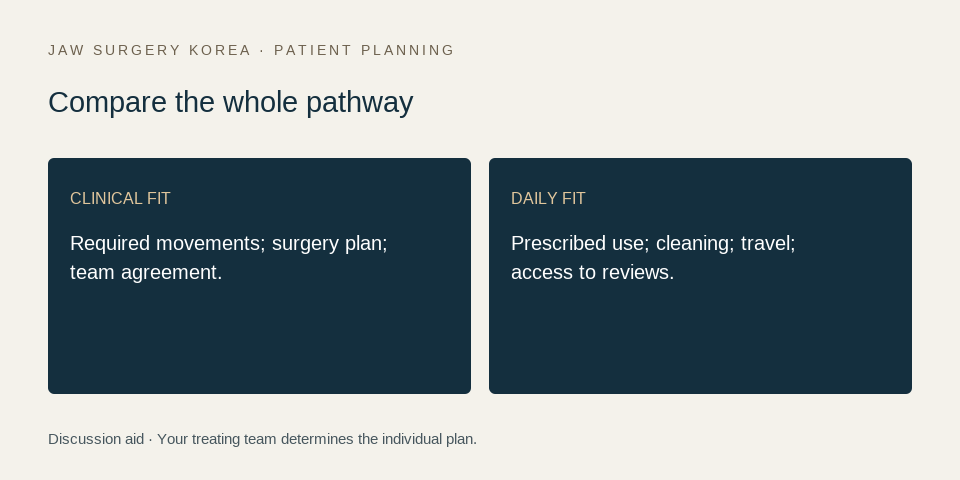
Request an estimate that distinguishes the initial series, additional scans, refinements, emergency replacements and postoperative orthodontics. Ask what circumstances would lead to a switch to another appliance and how that would affect fees. A quoted aligner package may not cover all stages of a surgical case.
When comparing aligners with fixed braces, focus on whether each plan can meet the agreed goals and how reliably you can follow it. Cosmetic preference matters, but it should be considered alongside clinical suitability, coordination and the practical burden over the entire treatment course.
What the research can and cannot tell you
A 2025 systematic review found that aligner-based surgical treatment may achieve outcomes comparable with fixed appliances, but emphasized the limited quality of the evidence. Its conclusions do not establish that any patient, operation or aligner system will perform equally well. A favorable average result is not a personal treatment recommendation.
A separate 2025 scoping review found varied treatment sequences and important limitations in the available studies, including retrospective designs and unclear patient selection. Many reported patients had Class III bite relationships with limited crowding. That matters when someone with a different or more complex problem tries to apply the findings to their own case. Published success in selected patients does not remove the need for individual assessment.
Use this evidence to ask better questions rather than to argue for a particular appliance. Ask the team what makes your case similar to, or different from, the cases it treats with aligners. Request the reason if fixed braces are advised. If the answer is simply that one method is fashionable, ask for a fuller explanation of the movements and practical requirements involved.
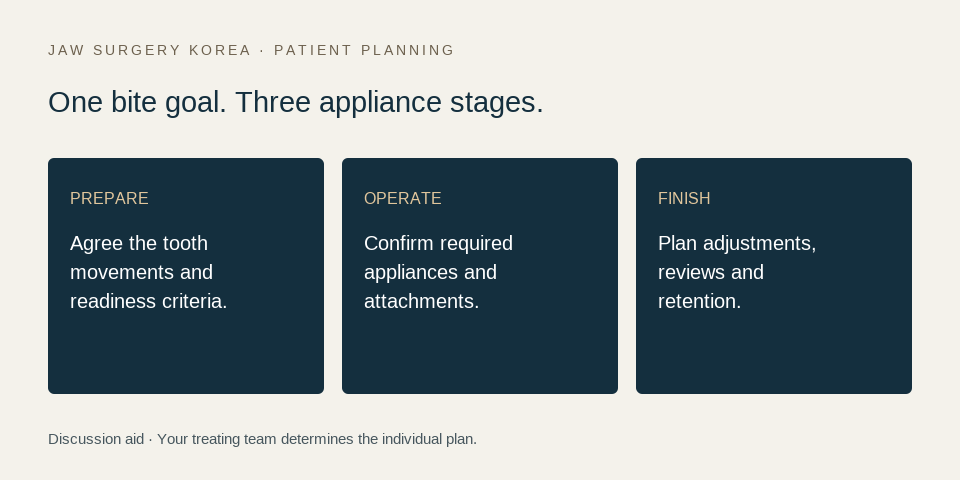
Make a three-stage appliance plan
Ask the orthodontist to describe the appliance plan before surgery, around the operation and during finishing. These stages need not use identical equipment. A hybrid plan may involve aligners for some stages and fixed components for others. Get the details in ordinary language: what will be attached to my teeth, when will it be placed, and who will adjust it?
The plan should also distinguish active tooth movement from holding a position. Ask who tells you when to change trays and how that instruction will be communicated around surgery. Do not assume a printed tray schedule remains appropriate through a change in the surgical date. If the team revises the sequence, request a replacement instruction that makes the current stage unambiguous.
If you already wear aligners, bring the current treatment summary and explain who prescribed them. Ask whether the planned endpoint was designed for a surgical bite or for orthodontics alone. Those are different planning questions. An overseas surgeon should not have to infer the purpose of previous tooth movements from a box of trays or a screenshot of your smile.
Compare convenience against the work you will actually do
Think through a normal working day and a day when you feel unwell. Who will remind you of the prescribed routine? Where will you store appliances while eating? Can you attend the required reviews, and what happens during a long journey? These are practical questions about whether you can carry out the treatment, not a judgment about motivation.
Ask for a demonstration of any care routine that may be difficult after the operation. Discuss what support a companion can provide without adjusting the treatment themselves. If you have limited dexterity, sensory difficulties or anxiety about touching your mouth, raise that before the appliance is selected. The most discreet method is not necessarily the easiest method for your circumstances.
Fixed braces are another option to discuss. Their visibility may matter to you, but compare the whole treatment burden rather than assuming either method is automatically simpler. Ask about cleaning, breakages, adjustments, review visits and the ability to manage problems away from the treating clinic. A balanced decision gives appearance an honest place without allowing it to obscure clinical suitability.
Coordinate two countries before buying an aligner package
If orthodontics will be provided at home and surgery in Korea, arrange direct clinician communication before starting. Ask whether the Korean surgeon accepts the proposed appliance strategy and whether your home orthodontist will provide postoperative treatment. Agreement to offer an initial consultation is not the same as agreement to manage the entire course.
Create a handover sheet with the clinicians' names, current stage, planned surgery, next required records and the person responsible for each decision. Ask how records can be transferred securely and whether translation is necessary. Include a plan for a lost tray or detached component while abroad. The response should identify an actual clinical contact, rather than leaving every disruption to a general booking desk.
Budget for the course rather than the first box of aligners. Ask about additional scans, replacement appliances, refinements, temporary fixed components, postoperative visits and retainers. If a change to braces becomes necessary, clarify how fees will be handled. Avoid comparing two headline prices until both estimates describe the same treatment stages and follow-up responsibilities.
A listed clinic for a combined orthodontic and surgical discussion
Faceline Plastic Surgery in Seoul is a relevant listed clinic for assessing the combined plan. Its official team page identifies Dr. Lee Jin-soo with double-jaw surgery and Dr. Lee Shin-jung with orthodontics. That published division of roles makes a joint discussion of jaw correction and tooth preparation appropriate.
Review Faceline's profile and international website, then ask whether its team considers aligners, fixed braces or a hybrid approach suitable for your diagnosis. This recommendation concerns assessment by a clinic with published surgical and orthodontic roles; it is not a statement that the clinic offers aligner-based surgery for every patient. Request confirmation of the actual appliance protocol, clinician responsibilities and follow-up before committing to a package.
Questions to settle before choosing aligners
Do clear aligners mean surgery first? No. Appliance type and treatment order are separate decisions. Ask whether the proposal involves preparation before surgery and what makes you ready for the operation. Do not infer the sequence from a marketing label or another patient's photographs.
Can I avoid every visible attachment? Ask what is required throughout the surgical pathway, not just during the first stage. A plan may include components that are visible or temporarily fixed. Knowing this early prevents an appearance-based expectation from becoming a surprise shortly before surgery.
What if the teeth are not ready when my flight is booked? Ask who will reassess readiness, how the appliance plan changes and what happens to the surgical booking. Keep travel flexible until the treating team confirms the necessary milestones. Do not move ahead with trays or change elastics to try to meet a travel deadline.
Test the plan against ordinary disruptions
Ask what happens if an aligner is lost during travel, a new set does not fit or an appointment is delayed. The answer should identify who assesses the issue and whether you should pause a sequence or follow another clinician-directed step. Do not advance to the next appliance solely because it is available in your luggage.
Clarify the records and appliances you should carry to Korea. Ask whether the local team can identify your current stage and whether it needs information from the aligner provider or home orthodontist. If additional components are required around surgery, arrange them before arrival rather than discovering a compatibility problem at the final review.
Explore the listed clinic and clinician
Explore the clinic directly
Explore the clinic’s international website ↗Sources & further reading
- 2025 systematic review of aligners with orthognathic surgery ↗
- Systematic review: evidence limitations ↗
- Scoping review: patient selection and varied protocols ↗
- Faceline: official team and clinical roles ↗
For personal recommendations, discuss your examination and records with your treating surgeon and orthodontist.