How should I assess swelling after jaw surgery?
Swelling is expected after jaw surgery, but its size alone cannot show whether recovery is uncomplicated. Track the direction and speed of change and accompanying symptoms. Contact your team for increasing swelling with pain, fever or drainage. New breathing difficulty, rapidly expanding swelling or inability to manage saliva needs emergency assessment; do not wait for a photo reply.
What to tell the team when a photograph misses the change
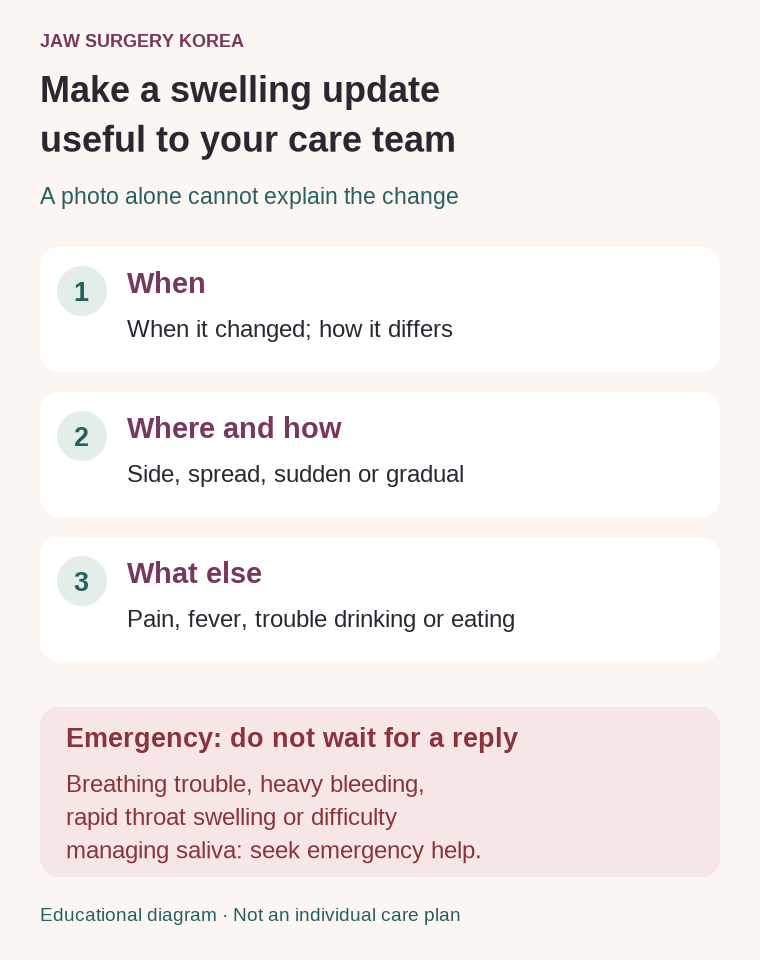
Your face may look similar in two photos even though one side feels different. When you call, describe when you first noticed the change, which side it affects and whether it is becoming harder to drink or swallow. Mention any new pain, fever or bleeding. These details help a clinician decide how promptly you need examination. Difficulty breathing needs emergency help immediately, even if you have already sent a photograph.
The useful question is what has changed
Swelling after jaw surgery is expected, but a swollen face does not explain its own cause. The most useful questions are whether the swelling is settling or increasing, how quickly it changed, and what else you are experiencing. New difficulty breathing, rapidly expanding swelling, or an inability to manage saliva needs emergency assessment. Do not wait for a scheduled review or a photograph reply when these symptoms occur.
This guide helps you describe swelling and decide which clinical contact to use. It cannot tell from a photograph whether your recovery is uncomplicated. Your operation, examination and discharge instructions remain the basis for personal advice. If the instructions do not cover a new change, contact the treating team rather than interpreting a general recovery chart as permission to wait.
Why swelling does not follow one reliable calendar
Jaw surgery affects bone and the surrounding tissues. Swelling can be visible outside the face and also present inside the mouth. University hospital guidance describes a more noticeable early phase followed by slower settling; subtle swelling can remain for months. This is a broad pattern, not a deadline for your face and not a reason to dismiss a new problem.
Ask what the team expects after the exact operation you are having: upper jaw, lower jaw, both jaws, or an additional chin procedure. A patient who had a different operation is not a useful measuring stick. Even if two people use the same procedure name, the surgical plan and recovery circumstances may differ. A photograph labelled with a postoperative day does not show all of that context.
When asking how long swelling will last, explain what you need to plan. Being comfortable on a video call, feeling ready to meet friends, and receiving permission to travel are different questions. Ask for a review point and a contingency if recovery is slower, rather than asking the surgeon to promise a day on which every visible change will disappear.
Cambridge University Hospitals: Jaw or chin corrective surgery ↗
Edema, bruising and a hematoma are different observations
Edema means fluid accumulated in tissue. Bruising describes discoloration associated with blood in the tissues, while a hematoma is a collection of blood outside the blood vessels. These processes can coexist after surgery. The color of the skin alone does not identify the cause of a swelling or tell you whether it is safe to observe.
The distinction matters because a collection of blood and pronounced swelling can affect nearby structures, including the airway. You do not need to diagnose a hematoma before seeking help. Report rapid enlargement or pressure and any change in breathing or swallowing. Do not press the area, probe an incision, or try to drain anything to find out what is underneath. An examination may be needed to distinguish the possibilities.
One side looks bigger: describe the change, not just the photograph
If one side looks fuller, tell the team where the difference is and whether it has been present since surgery or is newly increasing. Mention accompanying pain, warmth, discharge, or a change in how the teeth meet. A new concern deserves a specific answer; it should not be dismissed only because postoperative swelling is common.
Photographs also change with camera distance, lighting, posture and expression. A comparison can be useful when the clinic asks for it, but it cannot replace examination of the wound, bite or deeper tissues. Ask which views are needed and use the agreed private communication channel. Avoid filters and avoid pushing the face into a position just to make two images match.
For a stable appearance concern, ask when the clinician wants to reassess that particular area and what change should prompt an earlier call. For a fast physical change, use the urgent pathway instead. Separating these questions helps prevent an appearance discussion from obscuring a developing medical concern.
Swelling with other symptoms: when to contact the team promptly
Increasing swelling with worsening pain, fever, new redness, drainage or feeling unwell needs clinical advice. UChicago Medicine includes increased swelling, fever and drainage among signs patients should report after jaw surgery. These symptoms do not prove an infection, but a clinician should assess the concern. Do not wait for every possible sign to appear before contacting the team.
Tell them if swelling had been improving and has now started to increase again. Include any injury, recent treatment change, or difficulty taking the food and fluids allowed in your plan. If drinking has become difficult, say so clearly rather than describing the issue only as a puffy face. Ask whether you need to be examined that day and where to go if the clinic cannot see you.
A message marked as sent is not a medical assessment. Before discharge, ask which number is answered outside normal hours and what to do if that contact does not respond. If you become severely unwell or develop breathing or saliva-management difficulty, seek emergency care rather than continuing to wait for an ordinary clinic reply.
Breathing and rapidly worsening swelling: do not wait online
Jaw surgery can affect the airway, and severe swelling or bleeding may narrow the breathing passage. New breathing difficulty, rapidly expanding swelling, inability to swallow saliva, or severe deterioration should be treated as an emergency. Use local emergency care where you are. Do not wait to identify the cause, collect comparison pictures, or obtain permission from a booking coordinator.
If a companion is present, they can communicate the operation and location while help is being arranged. Keep a short operation summary and medicine list accessible, but do not delay care to retrieve them. Tell the assessing team that you recently had jaw surgery and whether any fixation or appliances are in place. Follow the emergency instructions supplied for your own operation; this article does not provide instructions for changing appliances.
A short swelling record that helps a clinician
Prepare a brief report rather than an album of unexplained pictures. Start with the operation and date, where you are recovering, and the area that concerns you. Then describe when it changed and whether the change is gradual, sudden, or occurring after an earlier improvement. Separate what you can observe from what you suspect: “the left cheek enlarged this morning” is clearer than “my operation has failed.”
Add what matters for immediate assessment: your breathing and swallowing, whether you can manage saliva and permitted fluids, associated symptoms, and any bleeding or drainage you have noticed. Include current medicines, allergies and any recent change in treatment. You do not need to press a wound, repeatedly test jaw movement, or provoke a symptom to make the report more complete.
An example message structure is: “I had [operation] on [date]. Since [time], [area] has changed in this way: [description]. Other symptoms are [description]. I am in [location]. Do I need an examination today, and where should I go?” Use this only for non-emergency communication. A breathing emergency needs direct help, not a carefully composed message.
Use the aftercare plan, not a new swelling remedy
The treating team may recommend positioning, cold applications or other measures for your procedure. Ask for the precise instructions and precautions rather than assuming advice for another patient applies to you. This guide does not supply a massage routine, medication plan, device setting or pressure technique. More intensive treatment is not automatically more useful.
Do not add heat, compression, facial massage, supplements or advertised swelling treatments without checking with your clinician. Reduced sensation and healing incisions are reasons to obtain individualized advice. Tell the team the exact product or service you are considering, including herbal and over-the-counter preparations, so that they can check it against your treatment and medicines.
If two sets of written instructions conflict, ask the treating team to reconcile them. Keep the corrected version with you and your support person. Do not stop or change a prescribed medicine just because swelling remains, and do not use someone else’s prescription to try to meet a social deadline. The practical goal is a plan you understand and can follow, with a named contact for questions.
AAOMS: Recovery from orthognathic surgery ↗
Cambridge University Hospitals: Jaw or chin corrective surgery ↗
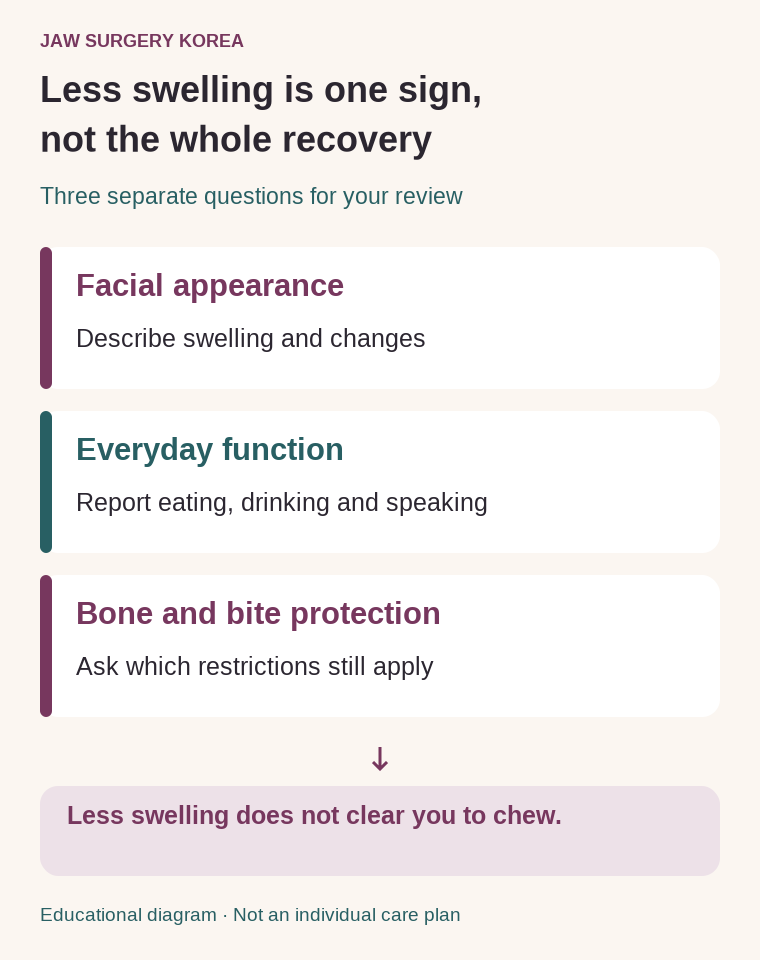
Less swelling does not mean unrestricted chewing or flying
Visible facial settling, bone healing and orthodontic progress are different parts of recovery. A face that looks closer to normal does not itself establish that unrestricted chewing, exercise or travel is appropriate. Continue the restrictions given for your operation until the responsible clinician changes them.
At review, ask two separate questions: “Does the swelling pattern need further assessment?” and “Which activities are now allowed?” This avoids treating a reassuring comment about appearance as clearance for everything else. If your return flight is approaching, ask whether an in-person assessment is needed before departure and what would require postponement.
Before leaving Korea, agree how a new swelling concern will be assessed at home. Ask for the operation summary, current restrictions and a usable contact route. A local clinician may need to examine you even if the original team can review photographs remotely. Clarify who will receive records and who is responsible for the next review; do not assume a directory listing creates an aftercare arrangement.
A relevant listed clinic to discuss a swelling follow-up plan
Faceline Plastic Surgery is included in our clinic directory, and its official international website describes two-jaw surgery and jaw reduction. That makes it a relevant option to research when you are comparing jaw-surgery consultations. The reason for including it here is the published surgical service, not evidence that its patients have less swelling or recover faster.
Review the Faceline profile and official service page linked below, then ask how the proposed operation changes expected swelling, who examines a new one-sided increase, and where you should seek care after hours. Ask which follow-up visits must occur before leaving Korea and whether instructions can be provided in a language you understand. The answers should identify the actual clinical team, not only the booking contact.
If another surgeon performed your operation, start with that treating team or appropriate local urgent care. Do not assume that a clinic mentioned in an educational guide has accepted responsibility for a complication or offers emergency walk-in assessment. For a new consultation, take your records and use the appointment to establish suitability and a written recovery plan.
Faceline official website: Two-jaw surgery / jaw reduction (English) ↗
Questions to bring to your next review
Ask what the team thinks is causing the remaining fullness, what they can assess today and what will need a later review. Point to the area of concern without repeatedly pressing it. If the recommendation is observation, ask when it will be reviewed and which changes should trigger an earlier call. A clear review plan is more useful than a promise that your face will look a certain way by a particular date.
Also ask whom to contact if the problem changes overnight, whether a photograph would be useful, and whether your travel or activity plan needs adjustment. Keep the advice with the date and name of the clinician who gave it. This allows you, your companion and any clinician at home to work from the same current instructions.
Explore the listed clinic and clinician
Sources & further reading
- Cambridge University Hospitals: Jaw or chin corrective surgery ↗
- University Hospitals Plymouth: Orthognathic treatment ↗
- Cleveland Clinic: Edema ↗
- AAOMS: Recovery from orthognathic surgery ↗
- UChicago Medicine: Jaw surgery FAQs ↗
- 自治医科大学:顎変形症専門外来 ↗
- 横浜市立大学:顎矯正手術 Q&A ↗
- 札幌医科大学:顎変形症 ↗
- Faceline official website: Two-jaw surgery / jaw reduction (English) ↗
For personal recommendations, discuss your examination and records with your treating surgeon and orthodontist.