What should I do about nasal congestion after upper-jaw surgery?
Nasal blockage can occur after upper-jaw surgery. Follow the care plan for your operation and ask before nose blowing, rinses, new products or breathing-device changes. Severe breathing difficulty or sudden confusion needs emergency help, not a routine clinic reply.
Quick answer: a blocked nose still needs a clear plan
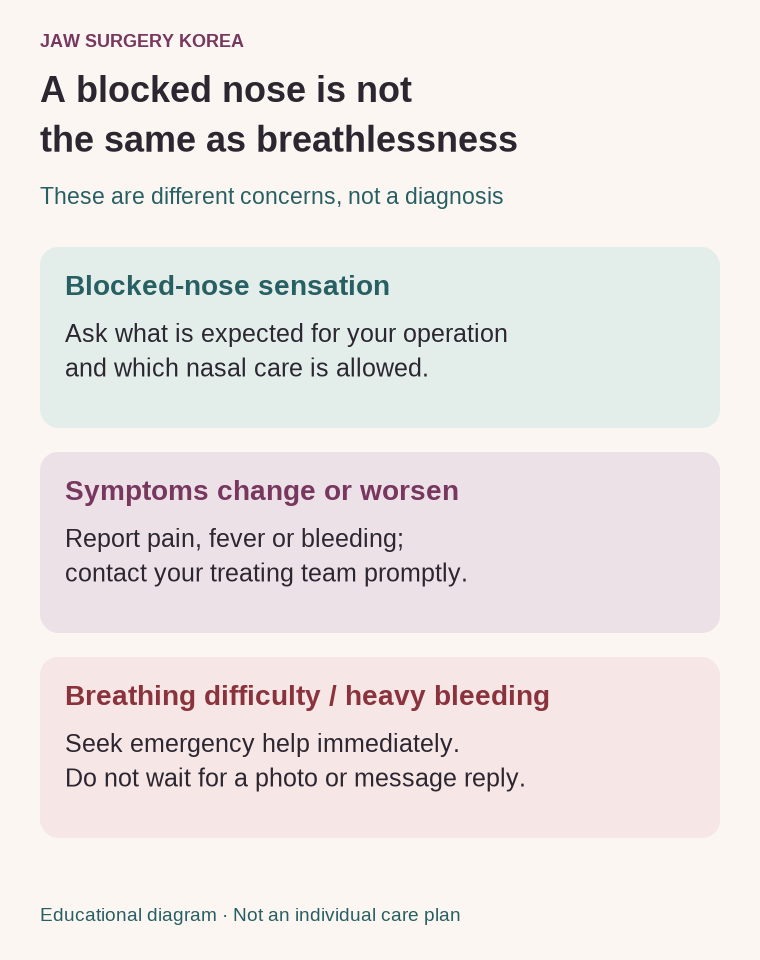
Nasal congestion can occur after upper-jaw surgery, but a blocked feeling is not a diagnosis and does not explain away breathing difficulty. Follow the nasal-care instructions written for your own operation. Ask before blowing your nose, changing a spray, using a rinse or restarting a breathing device. There is no single clearance date that applies to every jaw procedure.
If you are struggling to get air, choking, becoming confused or developing rapidly worsening symptoms, seek emergency help rather than waiting for a routine clinic message. If you are still in hospital, alert staff immediately. This guide explains the questions to ask about congestion; the separate breathing-emergency guide covers emergency preparation.
Why upper-jaw surgery is relevant to the nose
The upper jaw lies next to the nasal passages. Hospital patient information describes nasal blockage and some nasal bleeding after jaw surgery, while the South African Society of Maxillofacial and Oral Surgeons notes that both the upper-jaw procedure and tubes used during surgery can contribute to stuffiness. That explains why a nasal-care discussion belongs in your discharge appointment, even when you did not have cosmetic nose surgery.
Tell the surgeon what your nose was like before treatment: whether one side was usually blocked, whether you had allergies or sinus problems, and which medicines or devices you used. Also identify any additional nasal procedure performed at the same time. Keep these details with the operation name. Advice given to someone having lower-jaw-only surgery may not match the restrictions following an upper-jaw operation.
Separate three symptoms before describing the problem
Congestion means that air feels obstructed through the nose. Bleeding means blood is coming from the nose or draining into another area. Breathlessness means difficulty getting enough air. These can overlap, so avoid sending only “my nose is bad” when you contact the team. Explain which symptom you mean and whether it is changing.
Do not test the distinction by forcing airflow, repeatedly clearing the nose or delaying help to see whether a spray works. Severe difficulty breathing, gasping, choking, inability to get words out because of breathlessness, or sudden confusion warrants emergency assessment. Ordinary difficulty pronouncing words with jaw appliances is a different issue, but uncertainty about someone’s breathing should not be settled by comparing recovery photographs.
Ask what no nose blowing means for your operation
Upper-jaw postoperative instructions may include precautions against blowing the nose and creating pressure. The SASMFOS patient guide explains that pressure can force air into nearby tissues after upper-jaw surgery. Its example instructions are not a personal clearance schedule for every reader. Your surgeon should specify which precautions apply, what they protect and when they will be reviewed.
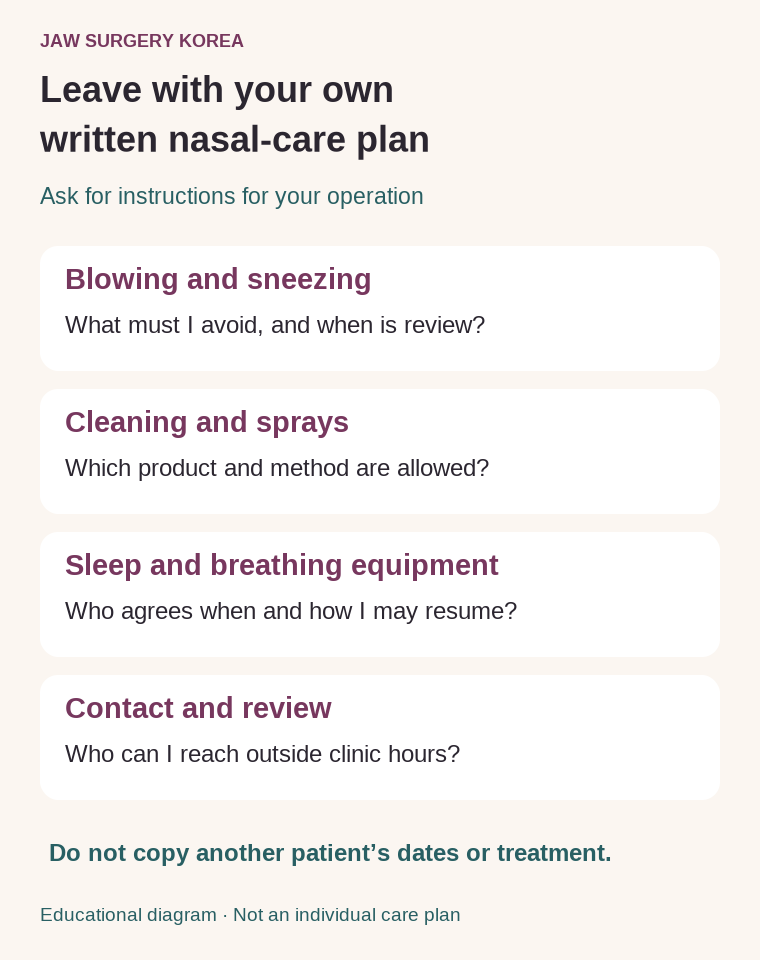
Ask these questions before discharge: Does the restriction apply to both nostrils? What should I do when mucus collects? What is the permitted way to deal with the outside of the nostril? Who decides when blowing is safe again? If the instructions give a date, ask whether symptoms or an examination could change it. Do not try a gentle version of a prohibited action simply to check whether healing has finished.
If you accidentally blow your nose, report what happened and any new swelling, pain, bleeding or breathing change. Do not repeat the action as a test. The clinician can decide whether examination is needed; the absence of an immediate dramatic symptom is not permission to abandon the restriction.
Sneezing: clarify the advice before you need it
Ask the team how to handle a sneeze with your particular elastics, splint and mouth-opening restrictions. Specialist postoperative guidance discusses avoiding a sneeze with the mouth closed, but a generic instruction to open widely may conflict with an individual jaw-care plan. Have the team demonstrate or explain a safe response that does not require changing your appliances yourself.
Mention hay fever, repeated sneezing and the products you normally use. Ask whom to contact if sneezing becomes frequent or painful. Keep the written answer with your nasal-care plan, especially if a companion is helping. If translated instructions are unclear, ask for the original wording and a clinical explanation rather than relying on a literal machine translation of an unfamiliar surgical term.
Spray, rinse and cleaning are different questions
A nasal spray, a high-volume rinse and cleaning around a nostril are not interchangeable activities. The product, delivery method and pressure may differ. Some hospital instructions mention nasal products or cleaning, but that does not authorize every over-the-counter product or a technique demonstrated in an unrelated video. Obtain the exact method your team permits and ask for a demonstration if needed.
For a prescribed product, record its name, purpose, frequency and intended duration from the prescription. Ask what to do if it seems ineffective, causes discomfort or runs out before your next review. Do not add another product just because the packaging says it treats congestion. Bring the packaging or a clear list to the pharmacist so ingredients and potential duplication can be checked against the surgical plan.
Avoid probing inside the nose, pulling at crusts or improvising deep cleaning to find the obstruction. Ask whether any visible material should be left alone or assessed by the team. If you cannot follow the advised care comfortably, request help instead of using more force. The goal is a workable, approved plan, not a completely clear nose achieved at any cost.
How long should blockage last?
A recovery leaflet can describe a typical experience, but it cannot set your personal deadline. The more useful question is whether your symptoms are following the course expected for your operation. Ask what improvement the team hopes to see before the next appointment, which changes should prompt an earlier call and what they will check if the blockage continues.
Persistent obstruction is not automatically permanent damage, and it should not automatically be dismissed as ordinary swelling. A Japanese case report describes two patients with structural nasal problems after jaw surgery. It cannot tell us how often this happens or diagnose your symptoms, but it illustrates why ongoing obstruction can deserve an examination rather than repeated self-treatment. Ask whether your surgeon should assess you first and whether ear, nose and throat input is appropriate.
A short symptom record makes the call more useful
Record the operation date and procedure, when the blockage began, whether it affects one side or both, and whether it is better, unchanged or worse than at the previous review. Include bleeding, discharge, pain, fever and any new swelling. Explain what the symptom prevents you from doing, such as sleeping or taking the drinks permitted by your recovery plan.
List the products already used and when you last used them. Keep the discharge instructions nearby so the team can check whether your understanding matches the intended plan. A concise factual message is more useful than a long series of photographs without timing or context. Photos may support a conversation, but they cannot show the whole nasal passage or establish the cause.
Ask for a clear next step: a telephone review, an examination, an approved care change or observation with a defined review point. If you are told to observe, ask which change should end that waiting period. New breathing difficulty or severe bleeding overrides a routine appointment plan.
Sleep apnea and CPAP need their own agreement
If you use CPAP or another treatment for sleep apnea, tell the surgeon and anesthesia team before the operation. General perioperative guidance emphasizes planning for sleep apnea, but a general surgery leaflet cannot decide how a device should be used after your particular upper-jaw procedure. Ask the clinicians who manage these two parts of your care to agree on the postoperative plan.
Bring the device information and the contact details of the clinician who normally manages it. Ask whether the usual mask and treatment are appropriate, who can authorize a change and how you will be supported if the usual arrangement is temporarily unsuitable. Do not independently stop, resume or change device settings based on congestion or the assumption that jaw surgery has already cured sleep apnea.
A pillow arrangement is not a substitute for prescribed sleep treatment or an assessment of breathing difficulty. If congestion makes rest difficult, explain that problem separately from pain, nausea or anxiety so the team can address the actual obstacle. The sleep-position guide provides practical questions about the rest setup.
University Hospitals Sussex: OSA and CPAP for patients having an operation ↗
Travel and returning home should not interrupt nasal follow-up
Before leaving Korea, tell the team about ongoing nasal symptoms, especially if a flight is approaching. Ask whether the planned journey needs reassessment and whether an examination should happen before departure. Do not treat the date on a ticket as evidence that you have recovered enough to travel.
Request the operation summary, current nasal restrictions and the next review plan in a language you and the receiving clinician understand. Ask who will assess persistent symptoms after you return home and whether that appointment needs arranging in advance. A local clinician should know what was done to the upper jaw and whether any nasal procedure was included, rather than having to reconstruct the operation from a promotional name.
Save the clinic’s clinical contact and after-hours route separately from routine appointment messaging. A coordinator may help with translation or logistics, but ask which clinician will make decisions about symptoms. Keep the accommodation address and discharge information accessible to your companion without delaying urgent care to search for paperwork.
A listed clinic to consider for preoperative planning
Faceline Plastic Surgery is listed in the Jaw Surgery Korea clinic directory. Its official two-jaw service page describes upper- and lower-jaw repositioning and identifies surgical and orthodontic roles. That is a relevant reason to consider a consultation about a proposed upper-jaw operation and its aftercare; it does not establish that the clinic treats every cause of nasal blockage or offers emergency nasal services.
Review the Faceline profile and its official two-jaw surgery page, then ask how your proposed movements affect nasal precautions, who assesses postoperative obstruction and how a Japanese or English discharge plan can be arranged. Confirm language support directly rather than assuming a translated website guarantees a particular interpreter. Selection here is based on a listed, relevant service, not a comparison of outcomes or a promise of suitability.
If symptoms have already appeared after surgery elsewhere, begin with the operating team or the appropriate urgent service. A new consultation request should not delay assessment of a complication. For a planned second opinion, ask what operative records and images are required before booking travel.
Faceline: Two-Jaw Surgery / Jaw Reduction (official English service page) ↗
Before discharge: check that the plan answers your questions
Can you explain back which nasal actions are allowed, which are restricted and who will clear you to change them? Do you know the purpose and duration of each prescribed product? Have you discussed sneezing, existing allergies and any sleep-apnea device? Is there a named contact for worsening symptoms and a separate emergency route?
Ask your companion to read the plan too, then resolve any differences between the verbal advice, translated sheet and prescription while the team is available. Keep the latest version together and mark older instructions as superseded only after the clinician confirms the change. A useful plan reduces guesswork without promising that every uncomfortable sensation can be managed at home.
Explore the listed clinic and clinician
Sources & further reading
- Dorset County Hospital: Orthognathic surgery ↗
- SASMFOS: A patient’s guide to orthognathic surgery ↗
- 昭和医科大学歯科病院:顎変形症のよくある質問 ↗
- 日本鼻科学会会誌:顎矯正術後に鼻腔形態異常を生じた2症例(2023) ↗
- NHS: Shortness of breath ↗
- University Hospitals Sussex: OSA and CPAP for patients having an operation ↗
- Faceline: Two-Jaw Surgery / Jaw Reduction (official English service page) ↗
- Veterans Health Library: Jaw surgery, recovering at home ↗
For personal recommendations, discuss your examination and records with your treating surgeon and orthodontist.