Can I change my elastics or remove my splint?
Follow your current, individual prescription. Do not change elastic strength, attachment points or splint position yourself. Get clear routine and emergency instructions, enough correct supplies, and a named contact for breakage or conflicting advice.
Leave with a record of the current elastic pattern
When your team changes the elastic pattern, ask for the new instructions with the date and the next review appointment. If the team uses a drawing or photograph, have them identify your left and right on it. Ask which copy to give the orthodontist at home and whom to contact if an attachment comes loose. Use the treating team’s instructions for your own appliance.
If the spare elastics do not match the packet in use
Before travelling, put the team’s current written instructions next to the packet you are using. If a spare packet looks different or has another label, ask the orthodontic team to identify which supply goes with the current plan. Colour or size alone cannot confirm the prescribed elastic or where to attach it. Find out how to reach the team if you lose the packet abroad and which photos or labels would help them identify it.
A vocabulary check before you leave the clinic
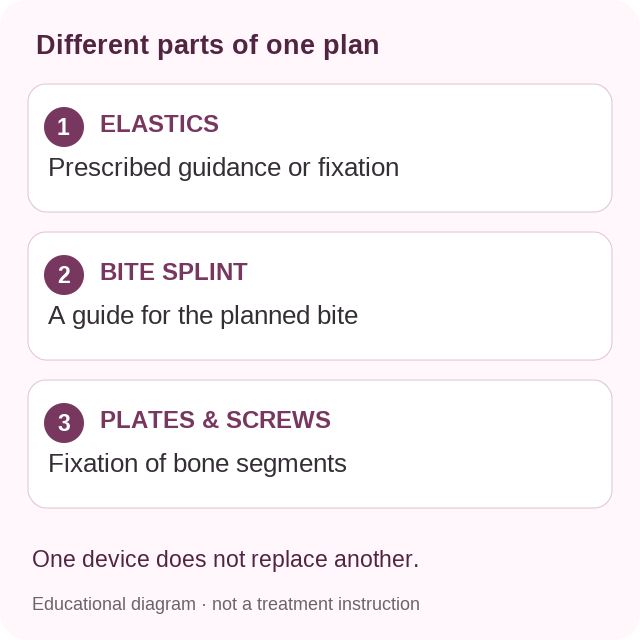
People use “rubber bands,” “jaw fixation,” “wafer,” “splint” and “retainer” loosely in online discussions. Ask your team to name each item in your own mouth and explain its job. A postoperative bite splint is not necessarily the same device as a night guard bought for clenching, and it should not be replaced with one. The important question is what this appliance is meant to do at this stage of your treatment.
Ask whether the appliance is removable by you, removable only by the team, or intended to stay in place until a review. If the answer is “sometimes,” ask for the exact circumstances. Keep that answer with your current instructions. The presence of plates and screws does not give permission to stop wearing elastics or to test the bite by forcefully opening and closing your mouth.
These appliances are part of an individual plan
After jaw surgery, elastics may be used with braces to guide the bite while treatment continues. A splint may also be part of the plan. Their purpose and instructions differ by procedure and stage, so another patient's pattern or wearing schedule should never be copied.
Ask who is responsible for adjustments: the surgeon, orthodontist or both. Establish how they will communicate if you receive care in two countries. An appliance instruction is a clinical prescription, not a preference that can be changed to make eating or speaking easier.
What these devices do differently
An elastic applies force between selected attachment points. Its effect depends on where it is attached and its prescribed characteristics, so changing the pattern changes the instruction to the bite. A splint is a shaped guide related to the planned relationship of the teeth and jaws. Plates and screws have a different role, holding bone segments. These devices are not interchangeable, and having one does not eliminate the purpose of another. Their combined use reflects the plan for skeletal position and tooth contact.
The minimum information an elastic instruction needs
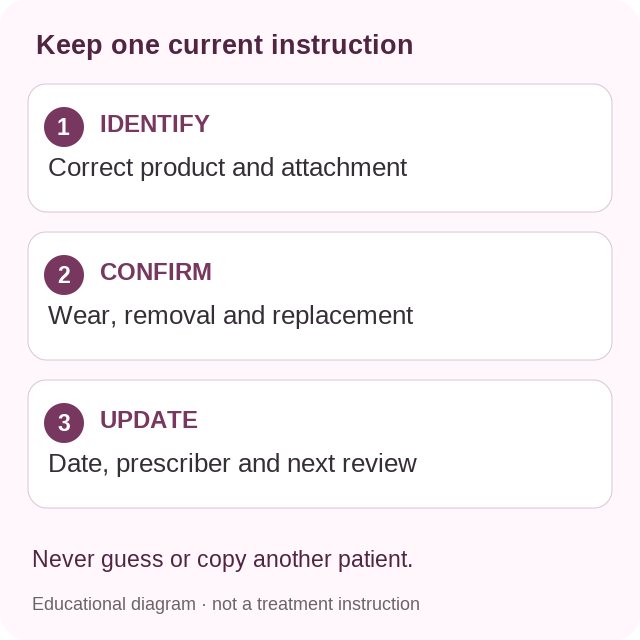
A useful instruction identifies the correct product, attachment points, wearing schedule, permitted removal, replacement method and next review. Ask the team to show which side of the mouth is which on any diagram or photograph. A mirrored selfie can be confusing. The clinician should confirm that the image corresponds to your actual arrangement before you use it as a reminder.
Write down the date and who issued the instruction. If the team changes a single attachment point, ask for an updated reference rather than assuming the old photograph is nearly correct. Small-looking changes can be deliberate. Ask how to obtain advice outside office hours and whether the routine can wait for a reply if you are unable to follow it. This is especially useful before a weekend, when a supply or access problem can otherwise last longer than expected.
Leave with a method you can reproduce
Request a demonstration of the exact attachment points, elastic type and schedule. Ask whether you may remove anything for meals or mouth care and what to do if a band breaks. If the team permits a reference photograph or diagram, keep it with the dated written instructions.
Practice the approved routine under supervision when possible. If swelling, limited opening or difficulty seeing the hooks makes it impossible, say so before discharge. A companion may help if the team teaches them, but they should not guess at placement. The aim is consistent use of the prescribed arrangement.
Practice without turning a demonstration into self-adjustment
A supervised teach-back can show whether you understand the instruction: explain the product and schedule, identify the permitted attachment points, and demonstrate only the movements the team has authorised. Ask the clinician to watch the actual task rather than merely asking whether you understand. If your hands shake, your vision is limited or swelling blocks the view, say so. A more accessible method may be needed.
Do not experiment with a stronger elastic, an extra band, a different hook or a longer wearing period to make the bite feel more even. Orthodontic force and surgical recovery need coordinated decisions. Missing wear should be reported honestly; do not compensate by doubling the next set. If a companion helps, they need the same current instruction and should stop and seek advice when the arrangement is unclear.
University Hospitals Coventry and Warwickshire: discharge advice following jaw osteotomy ↗
Keep the right supplies and a current instruction
Ask for enough of the correct elastics and how to obtain more. Different sizes or strengths are not automatically interchangeable. Keep the packaging so a local orthodontist can identify what was prescribed. Do not add extra bands to compensate for missed wear or a perceived bite problem.
When the plan changes, date the new instruction and mark the old version as superseded. This is especially important if advice arrives through both an orthodontic appointment and a clinic messaging service. Ask the clinicians to reconcile conflicting instructions rather than choosing whichever seems easier.
Plan for a broken band, a loose hook or a displaced splint
Before discharge, ask which problems can be managed using the taught replacement method and which require contact with the clinic. Keep the exact elastic packet and sufficient prescribed supplies. Household rubber bands or an online product that looks similar are not appropriate substitutes. If supplies run low, give the clinic the product details rather than guessing from a colour or size description.
A loose attachment or splint that suddenly rocks, catches or no longer fits needs advice from the treating team. Do not bend a hook, file an edge, glue a component, cut a splint or force it back into position. Explain what changed and whether pain, bleeding, injury or altered tooth contact accompanied it. If a part appears missing, tell the team; choking or breathing difficulty requires emergency help rather than a routine message. Keep broken parts only if safely available, without reaching into the throat or delaying care.
Singapore General Hospital: postoperative care for orthognathic surgery ↗
University Hospitals Plymouth: preparing for and recovering from jaw surgery ↗
Separate everyday troubleshooting from an emergency plan
The team should give you a specific plan for vomiting, severe bleeding and breathing difficulty with your particular fixation. Some patients are taught a release action; others have a different arrangement. This article cannot determine yours and does not provide a generic cutting procedure. Ask before surgery who will teach any required action, what equipment is appropriate, and whether your companion should be trained.
If you are struggling to breathe, choking, unable to manage saliva, collapsing, or experiencing heavy bleeding, seek immediate local emergency help. Follow your team's emergency plan while help is being arranged and do not wait for a portal reply or photograph review. Tell emergency responders that you recently had jaw surgery and describe the fixation if you can. Do not treat the absence of a broken band as reassurance that a breathing problem can wait.
Singapore General Hospital: postoperative care for orthognathic surgery ↗
The bite may still need finishing
A surgical result is often followed by orthodontic refinement. Ask how the current appliance supports that process and what the next milestone is. If the teeth feel different, report the change without repeatedly forcing them together or altering the elastics to create a preferred contact.
Before returning home, confirm that the receiving orthodontist has accepted the handover and understands the surgical restrictions. Arrange the first local appointment in advance when possible. A small supply problem or unclear wearing instruction is easier to resolve when the responsible clinician and communication route have already been identified.
Use follow-up visits to understand the next change
At each review, ask what the team is checking before changing the elastic pattern or splint instruction. A change may relate to the bite, healing or orthodontic finishing, and it should come from the clinicians responsible for the plan. Ask what you should expect to feel after that particular adjustment and what changes should trigger a call. Avoid repeatedly testing whether you can open wider or bring a different tooth into contact.
Keep a simple record of an adjustment and any subsequent difficulty. This can be a dated note rather than frequent photographs. If the teeth suddenly meet differently, an appliance no longer fits, or pain worsens, report it instead of trying to correct the contact yourself. Online comparisons are especially unhelpful here: another patient's surgery, tooth positions and stage of treatment may be quite different even if both people were told they had “double-jaw surgery.”
Recommended listed clinics: ask about appliance teaching
Sinsa Oral & Maxillofacial Surgery lists orthognathic surgery on its international website and is a relevant listed clinic to investigate for this topic. Ask who writes the postoperative elastic instructions, who changes them, and how the surgical and orthodontic teams share updates. Its listed location is Changwon, so confirm where each review occurs. Do not interpret a published treatment name as proof of a particular elastic or splint protocol.
Faceline Plastic Surgery also describes a two-jaw surgery service on its official international website. Ask whether your proposed plan uses elastics, a splint or another form of fixation, and request teaching on routine care and emergencies before discharge. These options are selected for relevant services and platform listings, not comparative outcomes. Current team members, language assistance, the individual fixation plan and follow-up access must be confirmed directly. Review the linked clinic profiles before making an enquiry.
Frequently asked questions about elastics and splints
Are rubber bands the same as having the jaws wired shut? Not necessarily. Different types of fixation and guidance can restrict movement differently. Ask your surgeon what is planned for you, what movement is permitted and what emergency instructions apply. A treatment label or another person's video cannot answer those questions.
Can I remove everything for a meal or a video call? Only removal expressly permitted by your treating team is appropriate. Convenience is a reason to ask for a workable plan, not a reason to change fixation yourself.
Does a splint guarantee the final bite? No appliance guarantees an outcome. The splint is one part of the treatment plan, and clinical review and later orthodontic finishing may still be needed. Ask what the next assessment is intended to establish and who is responsible for continuing that care.
Explore the listed clinic and clinician
Faceline Plastic Surgery: platform profile ↗
Faceline: international website ↗
Sources & further reading
- Dorset County Hospital: orthognathic surgery ↗
- Cambridge University Hospitals: jaw surgery and consent ↗
- East Kent Hospitals: orthognathic surgery aftercare ↗
- University Hospitals Coventry and Warwickshire: discharge advice following jaw osteotomy ↗
- Singapore General Hospital: postoperative care for orthognathic surgery ↗
- University Hospitals Plymouth: preparing for and recovering from jaw surgery ↗
- University Hospitals Plymouth: orthognathic treatment ↗
- Sinsa Oral & Maxillofacial Surgery: international website ↗
- Faceline: official two-jaw surgery service ↗
For personal recommendations, discuss your examination and records with your treating surgeon and orthodontist.