How should I clean my mouth after jaw surgery?
Use the routine taught for your actual operation, incisions and appliances. Ask for a demonstration, written product instructions and permission before removing appliances. Report obstacles or worsening symptoms instead of using stronger rinses or more force.
Show the team where cleaning is difficult
At a follow-up, point out the particular bracket, wire or area of gum you struggle to reach. Bring the brush you use and ask a member of the team to demonstrate on that spot. Ask which parts of your written routine apply while your mouth opening is limited and who can reassess the routine as access improves. This gives you a specific answer to take home.
Practise the part of your cleaning routine you cannot see
At a follow-up visit, bring the brush or other tool the team approved. If you cannot see the back of a particular tooth around your braces, show the clinician exactly where you lose sight of it. Ask them to demonstrate the approach, then try it yourself while they watch. If your opening is limited, ask how they would adapt the plan for that spot. Avoid forcing an instrument behind an appliance or disturbing an incision to get a better view.
Build a mouth-care plan before the operation
A postoperative routine is easier to learn before your lips are swollen and speaking feels tiring. At a planning appointment, ask what equipment the clinic usually provides, which items you should buy, and who will teach you the final routine after surgery. A preoperative explanation is preparation; the discharge instruction must reflect the operation and appliances you actually have.
Tell the team about limited hand movement, difficulty seeing small attachments, a strong gag reflex, or previous reactions to dental products. These practical details can change what you are able to use. If a companion will assist, ask whether they can attend the teaching session. Their role should be agreed with you and the team. Do not assume that someone who helped another patient can safely repeat that patient's routine in your mouth.
A clean mouth matters, but technique is specific
Postoperative mouth care is important, and hospital guidance emphasizes following the prescribed routine. Your operation, incisions, braces, splint and elastics affect what is practical and appropriate. Ask the team to explain when to start each step and which areas need particular care.
Do not assume that ordinary vigorous brushing or rinsing is suitable immediately after surgery. Equally, do not abandon cleaning because you are worried about touching anything. Request a demonstration using the products and equipment the team recommends so that you leave hospital with a routine you can actually perform.
University Hospitals Coventry and Warwickshire: discharge advice following jaw osteotomy ↗
Singapore General Hospital: postoperative care for orthognathic surgery ↗
Separate tooth cleaning, incision care and appliance care
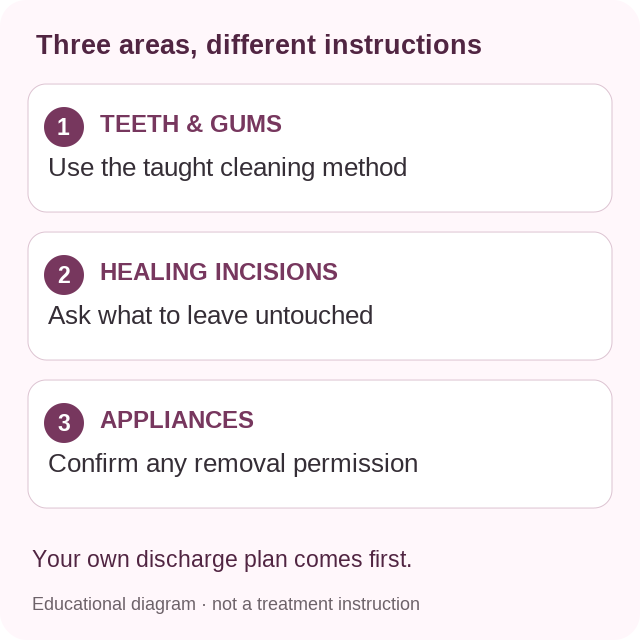
Ask the clinician to identify three areas during the demonstration: teeth and gum margins, healing incisions, and appliances. Those areas may need different handling. “Keep the mouth clean” is an aim rather than a complete instruction. You need to know where a brush can go, what to leave untouched, and what access is possible without stretching healing tissue.
Hospital leaflets commonly describe a small-headed toothbrush and a prescribed rinse, but their start times and routines differ. Use your own team's plan rather than combining steps from several hospitals. A tool that works well after ordinary orthodontic treatment may be unsuitable at an early surgical stage. Ask separately about interdental brushes, floss, powered brushes and water flossers before using them near the surgical area. Do not force a tool through a narrow gap or aim pressure into an incision.
Singapore General Hospital: postoperative care for orthognathic surgery ↗
University Hospitals Coventry and Warwickshire: discharge advice following jaw osteotomy ↗
Why appliances change the cleaning problem
Braces and splints create additional edges and spaces where food and deposits can remain. At the same time, swelling and restricted access make the usual cleaning motion difficult. The solution is a technique suited to those constraints, not simply greater force. A rinse and a toothbrush also perform different tasks; a prescribed rinse does not automatically replace the mechanical cleaning the team wants you to perform. Demonstrating the actual routine is valuable because the problem is one of access and technique as much as remembering to clean.
University Hospitals Coventry and Warwickshire: discharge advice following jaw osteotomy ↗
Singapore General Hospital: postoperative care for orthognathic surgery ↗
Turn instructions into a demonstration
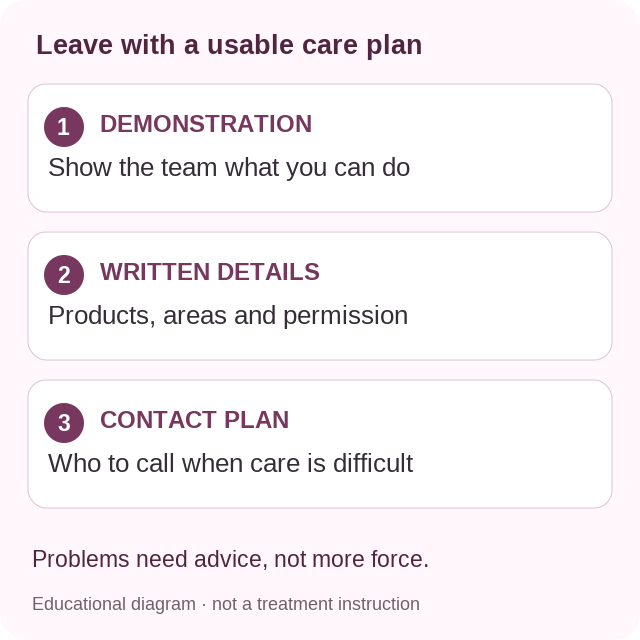
Ask which toothbrush to use, how to reach around appliances and whether any area should be avoided temporarily. If a mouth rinse is prescribed, confirm the product, concentration, timing and duration. Do not substitute a different rinse or mix products because the labels sound similar.
Have a nurse or clinician watch your technique if possible. Explain if restricted opening, numbness or discomfort prevents you from following an instruction. A practical adjustment is more useful than repeatedly trying a method you cannot manage. If a companion will help, they should receive the same demonstration.
University Hospitals Coventry and Warwickshire: discharge advice following jaw osteotomy ↗
Singapore General Hospital: postoperative care for orthognathic surgery ↗
Write down the rinse instructions, not just the brand
If the team prescribes a rinse, record its active ingredient, concentration, how it should be used, how long it is needed, and whether it must be separated from other products. Follow the prescription and label together; if they appear to conflict, ask the prescribing team or pharmacist. A rinse sold for daily fresh breath is not automatically an equivalent to a prescribed medicine.
Chlorhexidine is used in some hospital protocols, but it is not a universal instruction for every patient. Ask about expected side effects such as staining or taste changes and what should prompt stopping the product and seeking advice. Do not dilute, strengthen or extend a course on your own. Never swallow a mouth rinse intentionally. If you have difficulty controlling fluid because of restricted opening or swallowing problems, tell the team so it can show you a workable method.
Make a short routine card that someone can check
Create a card with spaces for the approved brush, areas to clean, areas to avoid, rinse instruction, appliance permission and contact number. Leave an item blank until the team answers it. Include the date and the name or role of the clinician who confirmed it. The card is a memory aid for prescribed care, not a new treatment plan generated from an online checklist.
At a follow-up appointment, ask the team to mark what has changed rather than rewriting everything from memory. If you are exhausted, a companion can read out the agreed sequence while you perform the permitted steps. A simple tick can show that care was completed, but do not use a tick sheet to conceal difficulties. If you cannot reach an area or repeatedly miss a step because it hurts, that is useful clinical information to report.
Keep appliances and wounds distinct
Braces, elastics, a splint and surgical incisions are different parts of the recovery setup. Ask which components may be moved or removed for cleaning and which must be left alone. Do not pull at a stitch or manipulate an appliance because food appears to be caught nearby.
If something feels loose, sharp or difficult to clean, contact the team for advice. Describe the location and whether the problem is new. A photograph may help if requested, but do not place instruments into the mouth to create a better view. The team can decide whether a review or adjustment is needed.
University Hospitals Coventry and Warwickshire: discharge advice following jaw osteotomy ↗
Singapore General Hospital: postoperative care for orthognathic surgery ↗
What to do when cleaning is not working
Describe the obstacle precisely. “I cannot reach the back teeth without pulling my cheek,” “the splint blocks the brush,” and “the rinse causes burning” give the team more useful information than “I cannot clean.” Ask whether you need a demonstration, a different tool or an examination. Do not repeatedly push through resistance while waiting for a routine appointment.
If debris seems trapped near stitches, do not pick it out with a sharp instrument, pull at a stitch or remove a splint. A photograph may help the team understand the location if it requests one, but a photo cannot reliably rule out an infection or a wound problem. Keep any photograph private and send it only through a verified clinical channel. A request for a clearer picture should never lead you to stretch your mouth or manipulate an appliance beyond your instructions.
University Hospitals Plymouth: preparing for and recovering from jaw surgery ↗
Make the routine easy to maintain
Set up a clean, well-lit space with the approved supplies within reach. Keep instructions visible and replace supplies according to their ordinary product guidance or the team's advice. When traveling, carry the items needed for the next part of the day rather than packing everything in inaccessible luggage.
If language is a barrier, ask the clinic to write the generic name of the recommended product and explain acceptable alternatives. Brand availability may differ after you return home. A pharmacist can help identify an equivalent only when the intended ingredient and use are clear.
University Hospitals Coventry and Warwickshire: discharge advice following jaw osteotomy ↗
Singapore General Hospital: postoperative care for orthognathic surgery ↗
Recognize when the problem needs clinical care
Increasing or recurrent swelling, worsening pain, fever, pus, a new unpleasant discharge or a change that worries you warrants prompt contact with the treating team. These symptoms have different possible causes; stronger mouthwash does not establish or treat the diagnosis. If the team cannot be reached, seek appropriate local medical or dental assessment rather than waiting indefinitely for an online reply.
Trouble breathing, rapidly increasing swelling that threatens breathing or swallowing, heavy bleeding, collapse, or inability to manage saliva are emergencies. Seek immediate local emergency help. Do not wait to send photographs or complete the cleaning routine. Follow the emergency instructions supplied for your own fixation while help is being arranged. For less urgent problems, record when the change began, the affected area and whether eating, drinking or the bite has changed, so the clinician can triage it.
Singapore General Hospital: postoperative care for orthognathic surgery ↗
Recommended listed clinic conversations about mouth care
Faceline Plastic Surgery is included because its official website lists two-jaw surgery and it has a detailed platform profile. If considering this clinic, ask for a practical demonstration of cleaning around the actual appliances used in your plan, a written product list and the route for advice if you cannot clean comfortably. The published service establishes relevance; it does not verify a particular aftercare protocol or guarantee its availability.
Sinsa Oral & Maxillofacial Surgery is another listed provider with an official orthognathic service. Ask which clinician reviews mouth care before discharge and whether follow-up includes checking access around the teeth and appliances. Its location is Changwon. Compare the answers rather than assuming that a clinic's surgical marketing describes its day-to-day teaching. Both recommendations are invitations to check relevant services, not rankings. Confirm current staff, location, language support and follow-up arrangements directly.
Frequently asked questions about cleaning
Can I use mouthwash instead of brushing? Ask the team what physical cleaning is required and how to do it safely. A prescribed rinse does not automatically replace tooth cleaning. If brushing is impossible, request help rather than quietly substituting a rinse for the whole routine.
Should I remove my elastics or splint to clean? Only if your team has explicitly allowed and taught that step for your current arrangement. Permission can change as recovery progresses. Never borrow another patient's removal schedule.
When can I have a professional dental cleaning? Ask the surgeon and dentist to agree the timing and any restrictions. Routine dental follow-up remains important, but the clinician doing the cleaning needs to know about the operation, current appliances and healing status. Provide the current instructions rather than expecting the dentist to infer them from appearance.
Dorset County Hospital: orthognathic surgery ↗
University Hospitals Coventry and Warwickshire: discharge advice following jaw osteotomy ↗
Explore the listed clinic and clinician
Faceline Plastic Surgery: platform profile ↗
Faceline: international website ↗
Sources & further reading
- Dorset County Hospital: orthognathic surgery ↗
- University Hospitals Coventry and Warwickshire: discharge advice following jaw osteotomy ↗
- Singapore General Hospital: postoperative care for orthognathic surgery ↗
- East Kent Hospitals: orthognathic surgery aftercare ↗
- University Hospitals Plymouth: preparing for and recovering from jaw surgery ↗
- Cambridge University Hospitals: jaw surgery and consent ↗
- Faceline: official two-jaw surgery service ↗
- Sinsa Oral & Maxillofacial Surgery: international website ↗
- NHS: chlorhexidine side effects ↗
For personal recommendations, discuss your examination and records with your treating surgeon and orthodontist.