What does a no-chew diet actually mean?
A no-chew diet after jaw surgery means following the food texture and eating method your surgical team has approved to protect the recovering jaws. It does not mean swallowing ordinary food without chewing it. Ask for examples of the finished texture, not just a list of ingredients. A food can feel soft yet still need biting, repeated jaw movement or effort to manage. Your operation, fixation and recovery determine the instructions.
Match the written texture instructions to a real meal
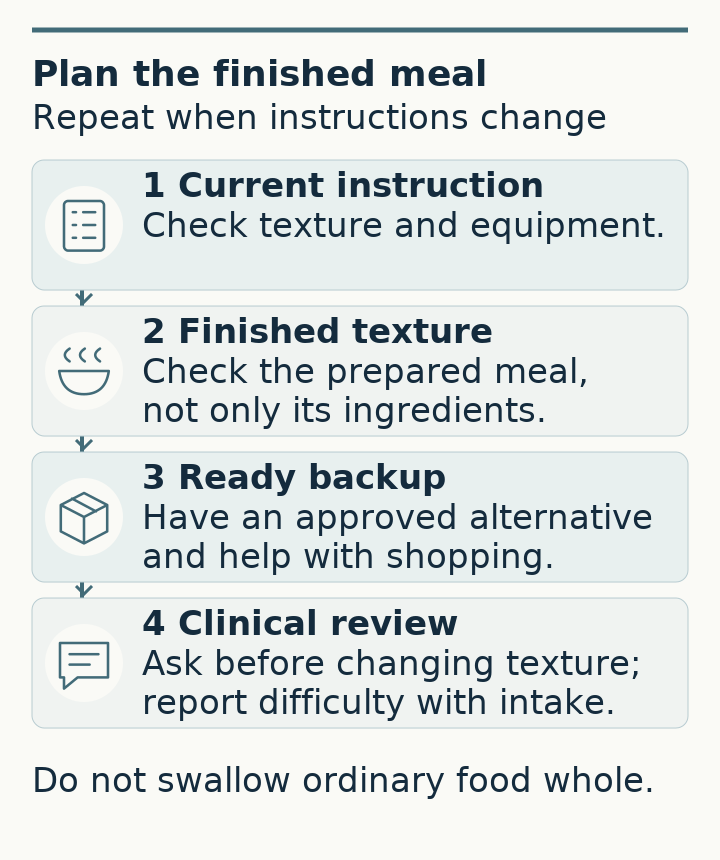
Before discharge, show the team a meal you expect to order and ask whether its texture fits your current instructions. A dish described as soup can still contain pieces that need chewing. Ask what makes that particular dish suitable, what you would need to change and who will tell you when the next texture is appropriate. Keep the dated diet instructions with the contact details for follow-up.
What does “soft” mean for the food you have ordered?
A hotel soup may arrive with pieces of meat, seaweed or rice that still need chewing. Before discharge, give the team an actual menu or the name of a meal you can get near your accommodation. Ask which parts fit your current instructions and what would need to be changed. Write down one complete meal the team considers suitable at this stage and what would prompt them to review the texture. Feeling able to chew one ingredient is not clearance to advance the whole diet.
The immediate goal is a plan you can use at breakfast, in a hotel and when someone else cooks. Write down the current texture, any restrictions on equipment, and who can authorize the next stage. This guide helps you prepare that conversation; it cannot determine whether a particular meal is suitable for your mouth or whether you are ready to chew.
Singapore General Hospital: Diet and nutrition after orthognathic surgery ↗
Cambridge University Hospitals: Jaw or chin corrective surgery ↗
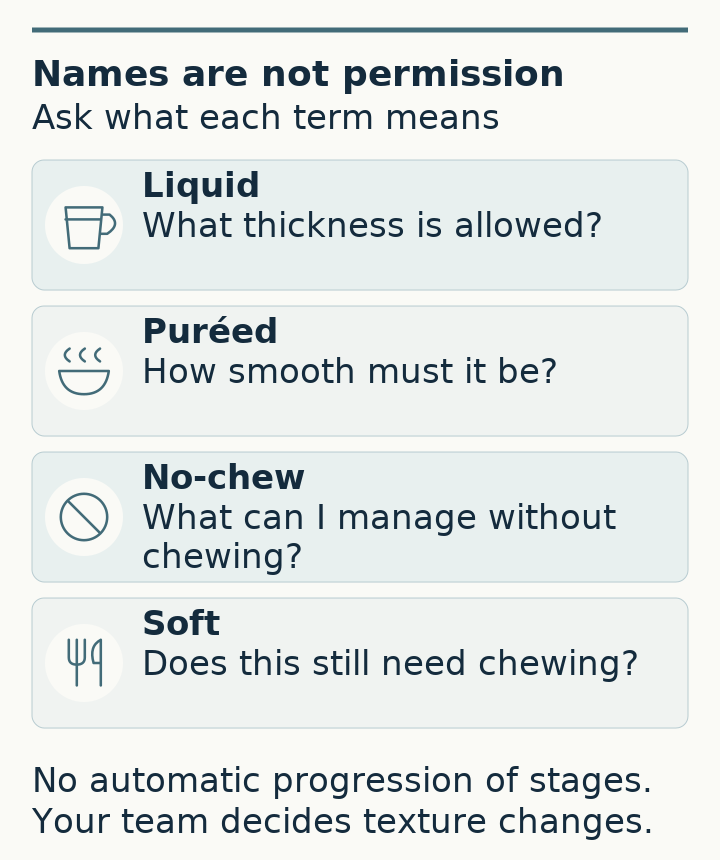
Liquid, puréed, no-chew and soft are different instructions
Liquid describes a food's form, but even liquids vary in thickness and nutritional value. Puréed usually describes a smooth preparation without pieces; the exact consistency still matters. No-chew describes a restriction on chewing demand. Soft food may still need chewing and is not automatically permitted during a no-chew stage. The terms are not a universal ladder with the same timing in every hospital.
Ask the clinician to describe what the food should look and feel like and, if possible, show an example. If your written sheet says soft but the surgeon says no-chew, resolve the difference before choosing meals. Do not use a social-media recovery calendar to translate the instruction. An eating plan for a wired jaw can also differ from a plan for removable elastics or a different operation.
Singapore General Hospital: Diet and nutrition after orthognathic surgery ↗
Judge the whole dish, not its name
Consider a bowl described as porridge. It may contain firm rice grains, shredded meat, seeds, chopped vegetables or a chewy garnish. Soup may contain noodles, mushrooms or separate pieces that change how it must be eaten. Yogurt may contain nuts or fruit skins. A blender does not make every ingredient or every finished mixture appropriate. The actual preparation matters more than the menu category.
Before surgery, select a few familiar dishes and ask which versions can fit the prescribed texture. Show the ingredients and a photograph if useful, but expect the team to ask about consistency. If you cannot establish what is in a restaurant meal, choose an option already agreed with the team rather than trying to swallow pieces whole. A satisfying plan should be repeatable, not an experiment every time you become hungry.
Singapore General Hospital: Diet and nutrition after orthognathic surgery ↗
Build meals around both texture and nourishment
Texture restrictions do not remove the need for a varied diet. Ask the dietitian to help you combine sources of energy, protein and other nutrients in forms your team permits. Depending on the approved consistency and your dietary needs, discussion options might include smooth dairy foods or suitable alternatives, blended pulses, or properly prepared protein-containing soups. These are questions to discuss, not a list cleared for every patient.
Adding more liquid to make a meal easier to manage can also change how much nourishment fits into the volume you can tolerate. Tell the dietitian if you become full before finishing or need excessive effort for every meal. They can assess whether food fortification, a different meal pattern or a prescribed supplement is appropriate. Do not assume a clear broth and a nutritionally complete drink are interchangeable simply because both pour.
Singapore General Hospital: Diet and nutrition after orthognathic surgery ↗
Make a shopping list that reflects your actual kitchen
A kitchen at home and a hotel room in Korea offer different possibilities. Check refrigeration, safe food storage, washing-up facilities and whether cooking equipment is permitted. Confirm equipment arrangements with the accommodation before arrival. If you plan to buy prepared meals, identify an option with ingredients and texture you can verify, and keep a backup for late appointments or shop closures.
Divide your list into approved meals, approved drinks, preparation equipment and cleaning supplies. Check labels for allergens and ingredients you avoid. Buy a manageable initial supply rather than filling a suitcase with products you have not tried or the team has not approved. A companion should know which items are ready to serve and which need preparation. Keep the current written instruction near the food rather than relying on a verbal handover.
A simple meal-planning sheet
Use a short sheet with four columns: the meal, the exact preparation, the person preparing it, and a backup choice. For example, the preparation column should describe the approved finished consistency instead of merely saying soup. Add a place to note questions for the dietitian. The sheet is a practical planning aid, not a substitute for an individualized diet prescription.
Try the preparation process before surgery if possible. Check whether your equipment produces the intended consistency and whether the person helping you understands the instructions. A practice run can reveal practical problems such as an unsuitable container, difficult cleanup or a recipe that is not enjoyable. Do not test postoperative chewing restrictions in advance or assume that a food's preoperative ease establishes its postoperative safety.
Ask the team to demonstrate eating equipment
A cup, spoon, straw, squeeze bottle or syringe may appear in another patient's diary, but none is universally appropriate. Ask your team which method to use for your procedure and have them demonstrate it before discharge. If you cannot use the demonstrated method comfortably or reliably, tell them while they can observe the difficulty. Do not compensate by forcing a large amount into the mouth.
Also ask how elastics or a splint affect meals, and follow the separate written instructions for those devices. Never remove or rearrange them simply to fit a utensil. If a clinician permits removal for a particular purpose, make sure you understand the exact method and replacement instructions. The solution to a difficult meal should be a clarified care plan, not an improvised change to the surgical support.
Cambridge University Hospitals: Jaw or chin corrective surgery ↗
Singapore General Hospital: Diet and nutrition after orthognathic surgery ↗
Restaurant and delivery descriptions need clarification
When ordering food in Korea, describe the texture you have been told to use rather than assuming that a translation of soft conveys it. A restaurant cannot judge surgical readiness. Ask about ingredients, preparation, toppings and separate pieces, then compare the answer with your clinical instructions. If communication remains uncertain, use a pre-approved alternative instead of taking a chance because everyone else is ready to eat.
Your companion can handle calls or shopping while speaking is awkward, but clinical questions belong with your treatment team. Have important dietary instructions translated accurately, particularly allergies and restrictions. A machine translation can help with a simple shopping question; it should not be the only explanation of a clinical restriction you do not understand. Confirm what is meant before relying on the translated phrase.
Keep meals manageable without creating pressure
Give yourself enough time to use the approved method and pause as your team advises. Arrange a calm setting and practical help with preparation. A companion's role is to make food available and notice difficulties, not to insist you finish an arbitrary amount. If the plan repeatedly proves unrealistic, report the problem early rather than hiding unfinished meals or substituting food that requires chewing.
Social meals can be adapted too. Tell friends that you may bring your own approved food, take longer or leave early. You do not need to demonstrate recovery by eating what everyone else eats. Keep the focus on following the plan and meeting your needs. Enjoyable flavor and variety are useful topics for the dietitian, particularly when a monotonous menu is making you avoid meals.
Swallowing difficulty is a separate problem
A no-chew instruction protects the jaws; it does not diagnose or treat swallowing difficulty. Coughing or choking with food or drink, a wet or gurgling voice after intake, food sticking, or breathlessness after eating requires urgent clinical assessment. Do not independently thicken drinks, change swallowing technique or force larger mouthfuls. Seek emergency help for breathing difficulty or severe deterioration.
Tell the team exactly what happened, which food or drink was involved and whether it happens repeatedly. Do not delay because you think all eating problems are expected after surgery. A swallowing assessment may change the plan, and the clinician may involve a speech and language therapist or dietitian. The correct advice depends on the cause, not on how much determination you apply to the same meal.
Poor intake needs a plan change, not tougher chewing
Contact your team if you are repeatedly unable to manage the planned food or fluids, are vomiting, becoming weaker or losing weight unexpectedly. Ask whom to contact outside clinic hours and when to seek local urgent care. A brief record of what you actually managed is more useful than a statement that you are eating badly. Include the practical obstacle: pain, nausea, texture, equipment, access or lack of appetite.
Do not choose harder food merely because you are worried about nutrition, and do not simply stop eating because the texture options are frustrating. Your team should help solve both problems together. For more detail on intake tracking and nutrition support, read the separate protein and hydration guide. Its focus is adequacy; this guide's focus is the texture decision that must remain within the surgical plan.
Singapore General Hospital: Diet and nutrition after orthognathic surgery ↗
Move to the next stage only when the team says so
Ask what the surgeon needs to assess before allowing a change in texture or chewing. A date in a leaflet may be a local example, not permission for your operation. Less swelling, a comfortable jaw or a friend's faster progress is not evidence that your bones are ready for the same demands. Do not take a hard bite to test strength.
At each review, write down the new instruction, who gave it and when it starts. Ask whether it applies to all meals or only specified foods, and whether any earlier restriction still remains. Share the update with your companion and keep the superseded sheet clearly marked. If instructions from the surgeon and another clinician differ, ask them to reconcile the plan rather than choosing whichever is easier to follow.
Cambridge University Hospitals: Jaw or chin corrective surgery ↗
A relevant listed clinic to ask about a food plan
Faceline Plastic Surgery is listed on this platform and its official international website describes a two-jaw surgery service. That documented treatment scope makes it relevant to a consultation about the practical eating restrictions associated with a proposed jaw operation. It does not establish that the clinic has a particular dietitian service, supplies meals, or offers advice in your preferred language; confirm those arrangements directly.
Use the clinic profile and official service link to ask who writes your food plan, whether you can discuss dietary restrictions before surgery, and how problems with intake are assessed after discharge. If you are already receiving care elsewhere, your existing surgical team remains responsible for your instructions. Inclusion here is not a ranking or a guarantee of suitability, nutritional support or treatment outcome.
Questions worth taking to the appointment
Ask: What does my permitted texture mean in everyday meals? Which drinking and feeding method should I use? What should I do if I cannot manage the planned amount? Who can adapt the menu for allergies, diabetes or other dietary needs? What finding, rather than a calendar date alone, allows me to progress? Where do I seek urgent help if eating or swallowing becomes difficult?
Before leaving, explain the answers back in your own words and ask your companion to do the same. Request a written version you can use in Korea and after returning home. The useful outcome is not a perfect collection of recipes. It is a small, workable range of approved meals, a clear way to ask for help and a current instruction that everyone preparing your food understands.
Explore the listed clinic and clinician
Faceline profile: scope, location and information limits ↗
Faceline international website: discuss an individual recovery plan ↗
Sources & further reading
- Singapore General Hospital: Diet and nutrition after orthognathic surgery ↗
- Cambridge University Hospitals: Jaw or chin corrective surgery ↗
- NHS: Swallowing problems ↗
- Veterans Affairs: Recovering at home after jaw surgery ↗
- Faceline: Two-jaw surgery service ↗
For personal recommendations, discuss your examination and records with your treating surgeon and orthodontist.