How can you get enough nourishment after jaw surgery?
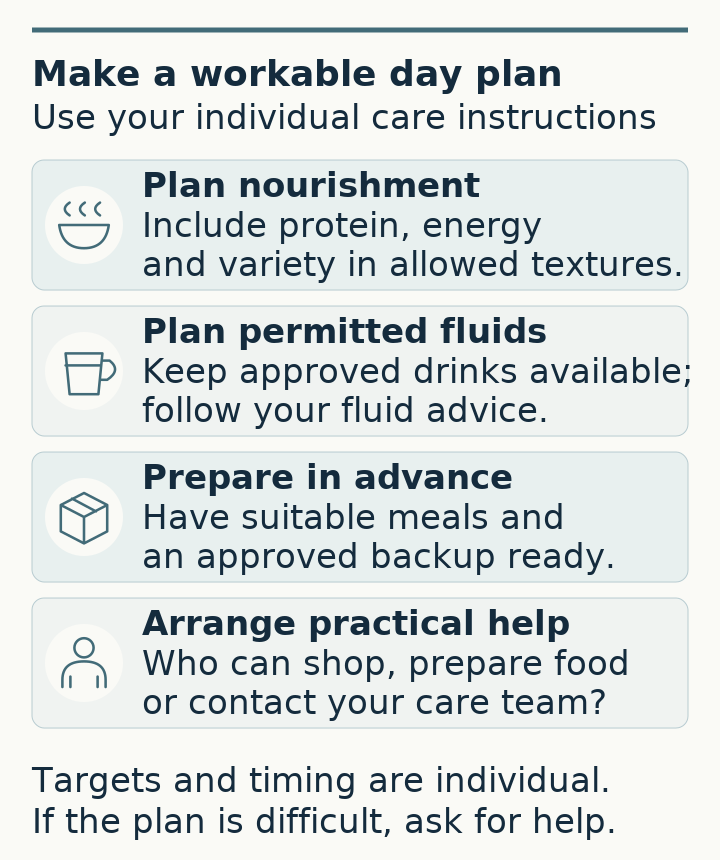
The practical starting point is an individualized food and fluid plan that fits your surgical restrictions and medical history. Ask your surgical team or dietitian what you should aim to manage, how to achieve it in the permitted texture and when to call if you cannot. A generic number for protein, calories or water cannot account for your operation, body size, health conditions or current intake.
This guide is about making that plan achievable and recognizing when it needs professional review. It is not a weight-loss programme, a supplement prescription or permission to change food texture. You may need help with planning even when recovery otherwise appears to be going well. Appetite, access to suitable food and the effort of eating all belong in the same conversation as the nutrients on a label.
Singapore General Hospital: Diet and nutrition after orthognathic surgery ↗
Protein matters, but it is not the whole meal
Protein-containing foods can be part of a recovery diet, but choosing the highest-protein product does not automatically provide enough overall nourishment. Energy, fluid and a varied supply of nutrients still matter. Singapore General Hospital's postoperative nutrition guidance discusses food preparation, energy and protein together rather than treating a single powder as the complete answer. Your dietitian can translate those principles into the texture your surgeon permits.
Bring a realistic description of your usual meals, restrictions and preferences. Tell the team if you avoid dairy, follow a vegetarian or vegan diet, have allergies, or find certain flavors difficult after surgery. The useful question is how to build a workable day of intake, not which fashionable ingredient heals a jaw fastest. No drink or supplement can be promised to speed your individual recovery.
Singapore General Hospital: Diet and nutrition after orthognathic surgery ↗
Agree on personal targets and what counts toward them
Ask the dietitian whether you need a written daily plan and how to track it without making every meal stressful. Clarify what counts as a meal, supplement or fluid in that plan. A bowl of soup, for example, can vary greatly in its ingredients and concentration. Product names alone do not tell the clinician what you are actually consuming.
If you have kidney or heart disease, diabetes, a prescribed fluid limit, a history of nutritional difficulty or another relevant condition, tell the team before adopting a general recovery menu. Your usual clinician's restrictions may need to be reconciled with the surgical instructions. Do not increase fluid, protein or supplements simply because another patient was advised to do so. Ask the professionals responsible for your care to agree on one understandable plan.
NIDDK: Healthy eating for adults with chronic kidney disease ↗
Make each permitted eating opportunity useful
When meals are difficult, an unplanned day can become a series of drinks with little attention to their nutritional content. Put the approved options within reach and decide when you will prepare them. If larger meals are not manageable, ask whether smaller, more frequent eating opportunities suit your plan. The exact pattern should be something you can sustain rather than a rigid challenge.
Discuss ways to adapt favorite foods within your approved texture. A dietitian may suggest fortifying suitable foods or using a particular nutritional drink, but the choice must fit your medical needs and tolerances. Do not change the concentration of a prescribed product or combine several supplements without checking. Bring the packaging or ingredient list when you ask for advice so that the recommendation refers to the product you actually have.
Singapore General Hospital: Diet and nutrition after orthognathic surgery ↗
Read product labels with a purpose
Compare the amount in a whole container with the amount in the portion you are likely to finish. Check the serving size, energy and protein information, ingredients and allergens. A drink marketed for fitness or beauty is not automatically designed to meet postoperative nutritional needs. A product can also contain pieces, seeds or other ingredients that do not fit your surgical texture restriction.
For an imported product, make sure you can understand the label and preparation instructions. Ask a pharmacist or dietitian if a translation leaves an ingredient or instruction unclear. Keep the original package so the clinical team can identify it. Avoid buying a large supply before you know whether it fits the plan, is available throughout your stay and is acceptable to you in practice.
Hydration should be practical, not a competition
Arrange access to the fluids your team permits and use the drinking method they have demonstrated. Keep the container and measuring approach simple if you have been asked to record intake. A companion can help refill drinks and notice when supplies are running low. Do not turn an internet water target into a challenge to drink large amounts rapidly.
Ask how your individual plan changes if you are vomiting, have diarrhea or have been told to restrict fluids. A pharmacist or clinician may recommend an oral rehydration product in particular circumstances, but that is different from choosing a sports drink yourself. If the prescribed eating or drinking method is not working, report the problem rather than forcing fluid into your mouth or substituting equipment from another patient's recovery video.
Know the signs that drinking is not keeping up
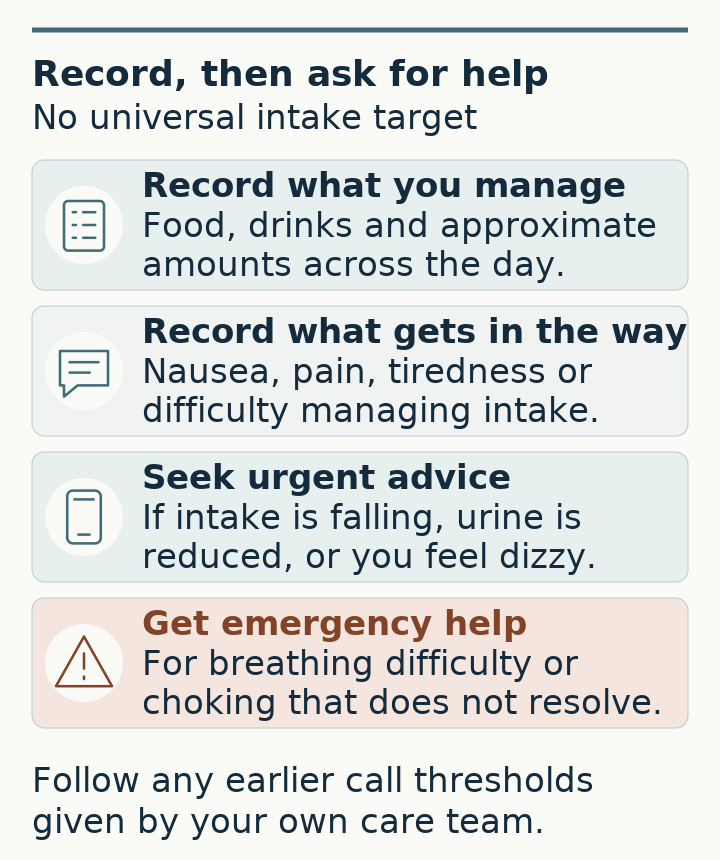
Thirst, dry mouth, darker urine, passing urine less often and dizziness can occur with dehydration. Persistent dizziness on standing, unusual tiredness, rapid breathing or a fast heartbeat need urgent medical advice. These signs are not a home test that proves the cause; after surgery, a clinician should assess the whole situation. Do not wait until the next scheduled review if you are deteriorating.
Breathing difficulty, confusion or difficulty waking a person requires emergency help. If you are in Korea, use local emergency services rather than waiting for an overseas message response. Keep your location and discharge documents available to the person helping you. A dry mouth alone can be uncomfortable for different reasons, so tell the team what you have actually managed to drink and what other symptoms have changed.
Use a short intake record when it helps
A useful record can be one line for each eating or drinking opportunity: time, what you managed, approximate amount if requested, and what made it difficult. Include vomiting or other symptoms you were told to monitor. Do not invent precise values from memory. A rough but honest description is more useful than a perfect-looking log that hides the missed meals.
Bring the record to a review or summarize it when contacting the team. For example, explain that you could manage your approved breakfast yesterday but today nausea prevented it, rather than simply saying recovery feels slow. Ask how long to keep the record and which changes should trigger a call. Tracking should help a decision; it does not need to become a permanent daily calculation after the clinician says it is no longer necessary.
Discuss weight changes without treating loss as a goal
Tell the team if your clothes feel noticeably looser, you are losing weight unexpectedly or you cannot maintain the intake they recommended. Ask whether they want weight checks, how often and how to interpret them alongside other findings. A scale reading on its own does not explain hydration, swelling or nutritional status. Avoid comparing your change with another patient's claimed normal amount.
Recovery from jaw surgery is not a reason to pursue rapid weight loss. If concern about weight or food makes it difficult to follow the plan, raise that privately with the clinician so they can offer appropriate support. A practical adjustment is easier to make before poor intake becomes entrenched. You deserve a plan that considers both the physical demands of recovery and your relationship with eating.
Nausea, pain and medication problems need their own assessment
If nausea, pain or a medication side effect is stopping you from eating, explain that specific obstacle. Do not assume the answer is simply to buy another drink. The clinician may need to review the cause and how the treatment plan is working. Keep a current medication list and describe when the difficulty occurs in relation to meals or doses.
Do not stop, crush, split or mix prescribed medicines into food without checking with a pharmacist or the prescribing team. Some products require particular handling, and the instructions depend on the exact medicine. If you cannot swallow or take a dose as directed, contact the team for an appropriate alternative. Keep original labels and measuring devices so a companion does not accidentally duplicate a dose while trying to help.
Swallowing symptoms are not a nutrition problem to push through
Coughing or choking with drinks, a wet-sounding voice after intake, food sticking or breathlessness after eating should prompt urgent assessment. Increasing the nutritional density of the same meal will not establish whether swallowing is safe. Do not independently introduce thickener, swallowing exercises or a different feeding technique. Tell the surgical team what happened and follow their assessment plan.
If you cannot breathe normally or are severely unwell, seek emergency care. A speech and language therapist or other specialist may be involved when swallowing problems require investigation, but the referral depends on the cause. Keep this distinction clear: a jaw-protection restriction tells you what chewing is allowed; a swallowing assessment addresses how food and drink pass safely. One cannot be substituted for the other.
Set up a reliable food supply during your Korea stay
Before booking accommodation, check the facilities needed for your approved plan. Think about refrigeration, preparation, cleanup and a way to obtain suitable meals when your companion is unavailable. Locate a pharmacy and ask the clinical team where an advised product can be obtained. Availability of a similar-looking drink is not proof that it is equivalent to the one recommended.
Give your companion a practical list: what to buy, how to prepare it, what needs checking and who to call about a problem. Keep an approved backup for days when appointments run late. Do not make sightseeing or restaurant bookings the structure of the recovery diet. The useful arrangement is one that still works when you are tired, speaking is awkward or a review takes longer than expected.
Carry the plan home, not just the product name
Before leaving Korea, request a current summary of the permitted food texture, any nutrition or fluid instructions, medicines and the next review. Ask who will reassess difficulties after you return home and what information they need. A photograph of a Korean product may help identify it, but the ingredients and reason it was recommended are more useful than the brand alone.
If a home clinician or dietitian will continue your care, clarify how the surgical team can share relevant records with your permission. Do not assume a video appointment can replace an examination when symptoms change. Ask what to do if the original product is unavailable, rather than making an unverified substitution or stretching your supply by changing its preparation. Keep the current plan accessible in a language you understand.
A relevant clinic consultation for your nutrition questions
Faceline Plastic Surgery is a listed provider whose official international website describes two-jaw surgery. That service makes its consultation relevant if you are considering a jaw operation and need to understand the associated eating plan. The website's treatment scope does not establish that nutrition counseling, a dietitian, meal delivery or Japanese-language support is included. Those are specific questions to ask before committing to care.
Use the linked profile and official website to ask who assesses intake after discharge, how dietary needs are addressed before surgery, and what happens if you cannot manage the recommended food or fluids. If another clinic is treating you, seek changes through that team rather than adopting another provider's general leaflet. This is a scope-based consultation option, not a ranking or a promise of nutritional or surgical results.
A five-question check before discharge
Can you explain the current food and fluid plan? Can you obtain and prepare what it requires? Do you know whom to call if intake drops? Do you understand which symptoms need urgent or emergency assessment? Is there a named clinician responsible for reviewing the plan after you leave? If any answer is unclear, ask again while the team can help you practice or clarify it.
The goal is a workable routine and a timely response when that routine fails. You do not need to solve every possible nutrition question alone. Keep the texture instructions, medication schedule and help contacts together, and share them with the person supporting you. A small set of clear, individualized instructions is more useful than a large collection of conflicting recovery tips.
Explore the listed clinic and clinician
Faceline profile: scope, location and information limits ↗
Faceline international website: discuss an individual recovery plan ↗
Sources & further reading
- Singapore General Hospital: Diet and nutrition after orthognathic surgery ↗
- AAOMS: Nutrition after oral and maxillofacial surgery ↗
- NIDDK: Healthy eating for adults with chronic kidney disease ↗
- NHS: Dehydration ↗
- NHS: Problems swallowing pills ↗
- NHS: Swallowing problems ↗
- Faceline: Two-jaw surgery service ↗
For personal recommendations, discuss your examination and records with your treating surgeon and orthodontist.