Sensation and movement are different
Numbness means reduced or altered feeling in an area supplied by sensory nerves. Jaw surgery can disturb these nerves, and patients may notice changes around the lips, chin, cheeks, gums or teeth depending on the operation. Sensation can improve over time, but some changes may persist. A specific prognosis requires knowledge of the procedure and examination findings.
Tell your clinician whether you mean reduced touch sensation, tingling, burning, discomfort or difficulty moving a part of the face. These descriptions are not interchangeable. Do not assume that a symptom is harmless simply because another patient calls it numbness, or that a persistent change necessarily means the same injury another person experienced.
Reduced feeling is not the same as weakness
Sensory nerves carry information such as touch from the face toward the nervous system. Motor nerves control muscle movement. A numb lower lip therefore describes a feeling problem, not automatically an inability to move the lip. Tingling or unpleasant sensations are also different from complete loss of feeling. This vocabulary matters at review because it helps the clinician understand which function is affected. New weakness or a sudden change should be described explicitly rather than hidden inside the general word numbness.
Make everyday care more deliberate
Ask the team how altered sensation should affect eating, skin care and mouth care. You may need to be especially attentive to food or liquid left on the lip and to avoiding accidental irritation. Follow the prescribed food texture and check temperature safely rather than relying on a numb area to judge it.
Do not repeatedly pinch, scratch or apply hot or cold objects to test sensation. This can injure tissue and does not provide a reliable nerve assessment. If the team wants you to monitor an area, ask them to explain the method and frequency. Ordinary observations about daily function can be more useful than improvised sensory tests.
Describe the pattern over time
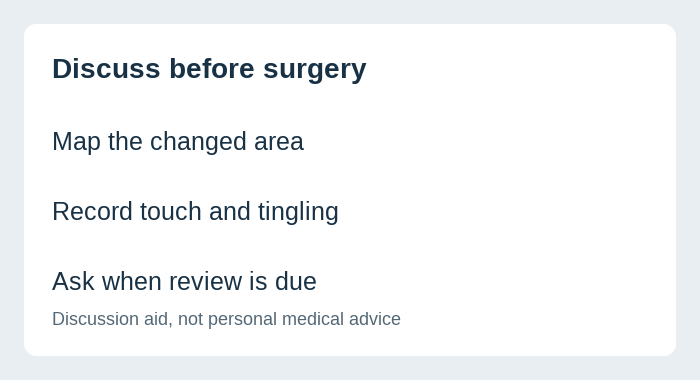
At each review, identify the affected area and explain whether its size or quality has changed. A simple sketch can be clearer than saying the whole face feels strange. Note whether the symptom interferes with eating, drinking, speaking or sleep, and whether it is stable, improving or worsening.
Keep the account factual. A date, location and description of function give the clinician something to compare at later appointments. Ask whether formal sensory testing is appropriate and how results will be recorded. If you will return overseas, request that the baseline assessment and follow-up plan be included in your handover records.
Ask about the threshold for specialist review
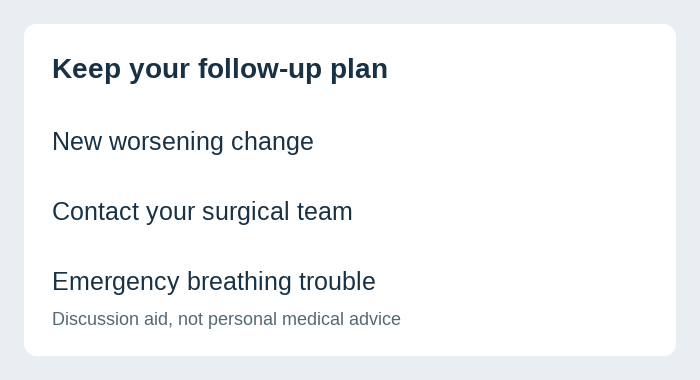
Persistent or troubling altered sensation deserves a plan rather than indefinite reassurance. Ask when the team would reassess it, what findings would change management and whether referral to a clinician with nerve-injury expertise might be appropriate. Do not self-prescribe supplements or treatments marketed as nerve regeneration.
New neurological symptoms, a sudden change or symptoms accompanied by significant swelling, pain or other deterioration need prompt clinical advice. The surgeon should explain which changes are expected in your case and which are not. If a clinician cannot assess you remotely, arrange an examination locally instead of repeatedly sending photographs that cannot measure sensation.
Questions to bring to consent and follow-up
Before surgery, ask which sensory areas are at risk with the proposed movements and how the team discusses temporary versus lasting changes. After surgery, ask what was observed during the operation, whether anything alters your individual follow-up and when sensation will next be assessed.
It is also reasonable to discuss how a persistent change could affect your daily life. Someone whose work involves prolonged speaking or close facial contact may have different practical concerns from another patient. A useful conversation connects the clinical findings to those concerns without promising a fixed date for complete recovery.
Make the consent discussion personal
Ask how altered sensation might affect tasks important to you, such as drinking from a cup, applying makeup, shaving or speaking for long periods. The surgeon may not be able to predict your experience precisely, but the discussion can identify practical precautions and follow-up needs. If a persistent change would be especially difficult for your work or wellbeing, say so before surgery. This is a legitimate part of weighing benefits and risks. After surgery, return to those same activities when describing progress. A functional comparison often communicates more clearly than repeatedly asking whether the nerve is fully healed.
Which areas may be affected?
The pattern depends on which jaw was moved and how close the operation is to sensory nerves. A lower jaw operation may affect feeling in the lower lip or chin; an upper jaw operation may be associated with altered feeling in the upper lip, cheek or teeth. Tongue sensation is another distinct concern. Ask the surgeon to show you which areas are relevant to your proposed procedure and how sensation will be checked. The expected course cannot be predicted reliably from a generic diagram, and a person having both jaws moved has a different operative plan from someone having one jaw moved.
Before treatment, tell the team about existing numbness, nerve injuries, dental procedures and areas of unusual sensitivity. A baseline examination matters because a change after surgery can then be compared with what was present beforehand. Ask whether the team will document light touch or another assessment and when the next comparison will happen.
What recovery can and cannot be predicted
Altered feeling and tingling can occur during recovery. Sensation may improve gradually, but the amount and timing of recovery differ among people. Some sensory changes can be long lasting or permanent. An improvement in swelling is not a measurement of nerve recovery, and another patient’s experience is not a reliable timetable for your own. Before consenting, ask the surgeon to explain the possibility of persistent alteration for your planned operation, what evidence supports their estimate, and any uncertainty.
Keep the discussion separate from motor function. Numbness describes reduced or altered sensation; new weakness, facial droop, difficulty swallowing or a sudden change in speech deserves its own prompt assessment. If you develop severe breathing difficulty or signs of a stroke, seek emergency help rather than waiting for a routine postoperative message.
Protect the lip, mouth and skin while sensation is reduced
A numb lip can be injured without the normal warning sensation. Ask for individual advice on drinking temperature and check hot foods and drinks carefully before they touch the mouth. Avoid biting a numb lip or cheek and inspect the skin and lips for unnoticed irritation. A companion may be able to help you notice a sore spot, but an inspection does not replace a clinical review. Tell the team about a wound or burn rather than continuing to expose it to heat or pressure.
Follow the team’s instructions for cleaning your mouth and protecting healing incisions. Do not apply creams, perform vigorous massage or start a sensory exercise program because another person recommends it online. Ask whether any activity is appropriate for your stage of healing, who should demonstrate it and which symptoms mean you should stop.
How to make a symptom record useful
Once a day or at the frequency your clinician suggests, note the location, quality and approximate extent of the sensation. Describe reduced touch, tingling, burning or discomfort separately. Record when you noticed a change, whether it is getting better or worse, and whether it interferes with eating, speaking or sleep. A diagram can help you communicate the area; it is not a self-diagnosis or a substitute for a formal sensory examination.
At review, take your notes and operative report. Ask who will assess the sensation, how findings will be documented and when you should expect an update. If your planned travel would prevent a follow-up, arrange the alternative before booking. Confirm whether the receiving clinician can examine you in person and how they will communicate with the original surgeon.
When to contact your team
Contact the surgical team if altered sensation is newly worsening, becomes painful, affects a new area or makes ordinary care unsafe. Do not assume that an unusual sensation is either proof of recovery or proof of permanent injury. A clinician can assess its pattern together with the operative history, examination and any other symptoms. Ask how quickly to report changes and whom to contact at night or on a weekend.
Urgent symptoms are different from a stable sensory change. Severe or worsening difficulty breathing, uncontrolled bleeding, rapidly increasing swelling, or new stroke-like weakness requires emergency assessment. If you are away from the treating hospital, use local emergency services and tell them about the operation, its date and your current medicines.
Compare a consultation in Korea
Sinsa Oral & Maxillofacial Surgery lists orthognathic surgery among its services. Its international site describes assessment of jaw alignment and surgical planning, making it relevant when discussing whether skeletal correction is appropriate. Ask specifically who will perform your procedure, the sensory nerves relevant to it, the follow-up schedule and how an overseas patient can obtain an examination after returning home. Inclusion here is not a ranking or a guarantee of suitability. You can read the clinic’s international information using the link below and compare its written plan with another qualified team’s advice.
Before committing, ask what is included in the quote if a postoperative examination or referral is required, how communication is arranged across time zones, and which records you will receive. Do not decide solely on the length of the suggested stay; access to follow-up and an escalation route are just as important.
Explore the listed clinic and clinician
Explore the clinic directly
Review the clinic’s international website ↗Sources & further reading
- University Hospitals of North Midlands: Orthognathic surgery ↗
- AAOMS: Recovery from orthognathic surgery ↗
- Cambridge University Hospitals: Jaw or chin corrective surgery ↗
- NHS: Preparing for an operation ↗
For personal recommendations, discuss your examination and records with your treating surgeon and orthodontist.