Can you talk after jaw surgery?
You may be able to communicate verbally after jaw surgery, but the clarity and comfort of speech depend on your operation, swelling and any appliances or fixation. Singapore General Hospital describes speaking difficulty when elastics restrict mouth opening in its own postoperative pathway. This is a reason to prepare another way to communicate, not a prediction that every patient will be unable to speak. Your team should explain the restrictions that apply to you before treatment.
Make a phone call possible even if speech is hard to understand
Before surgery, practise contacting the clinic with the companion who will be staying with you. Agree how you will signal that you want them to read a written message, and how staff can check an answer directly with you. Keep your name, operation date, current location and callback number in a note you can show or send through the clinic’s approved channel. If you have difficulty breathing, seek immediate emergency help. A text queue for routine recovery questions can wait too long.
There is no single day when everyone should sound normal or return to a full day of calls. Early difficulty getting a message across and a persistent change in speech are different questions. This guide helps you plan communication during recovery and decide what to raise with the treating team. It cannot determine the cause of a speech change or replace an examination. Ask for individual advice if your speech is important to your work, you have previous palate treatment, or you already receive speech therapy.
Singapore General Hospital: Preparing for Orthognathic Surgery ↗
Separate speech clarity, voice and swallowing
When describing a concern, choose the closest everyday description. Are individual sounds hard to understand? Does your voice sound unusually nasal? Is speaking uncomfortable or tiring? Is the problem present during a short sentence, only on telephone calls, or after a longer conversation? You do not need to diagnose yourself. These distinctions help the clinician understand what you are experiencing and decide who should assess it.
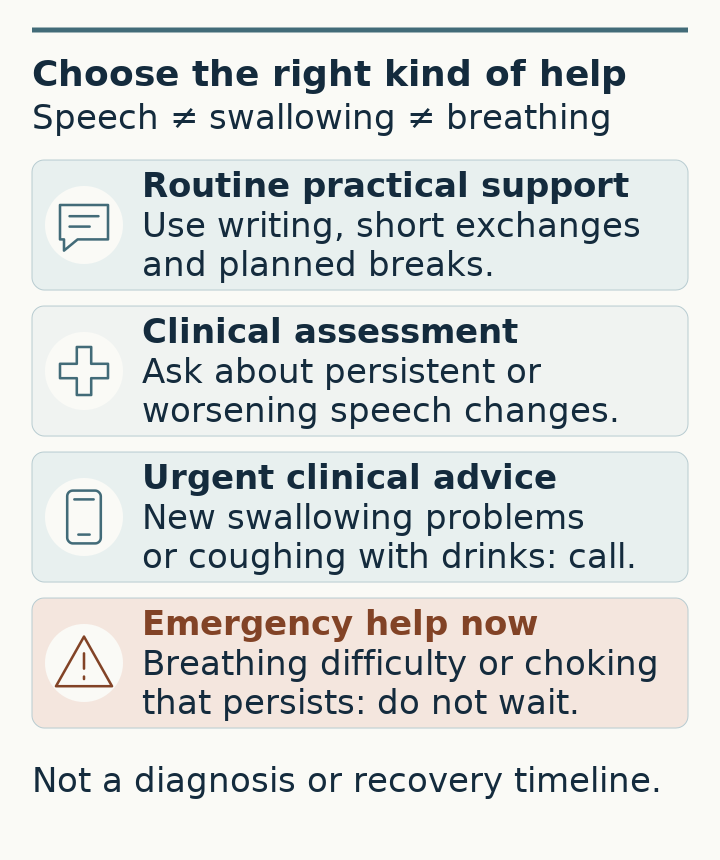
Swallowing and breathing deserve separate attention. Do not report choking, inability to manage saliva or difficulty getting fluids down only as a talking problem. Tell the team directly about those symptoms. Breathing difficulty, choking that does not resolve or inability to swallow saliva needs urgent medical help rather than a routine message. Ask the clinic before discharge which local emergency service to use and how a companion can explain your operation if you cannot speak.
Discuss your baseline before treatment
At consultation, describe what speech is like now and what you hope surgery might change. Mention previous cleft-palate treatment, existing nasal speech, previous speech assessments and any concern about particular sounds. If you use several languages, explain whether the same difficulty occurs in all of them. Bring relevant reports if you already have them, and ask whether the team needs an assessment before the surgical plan is finalized.
Swansea Bay’s cleft-team leaflet explains that moving the upper jaw forward can affect the palate’s ability to close the passage into the nose during speech in some cleft patients. Its discussion of risk and assessment is specific to that clinical context. It should not become a general risk percentage for all jaw-surgery patients. Ask how your own anatomy and treatment history affect the discussion, rather than assuming that jaw surgery will improve every speech concern or inevitably change your voice.
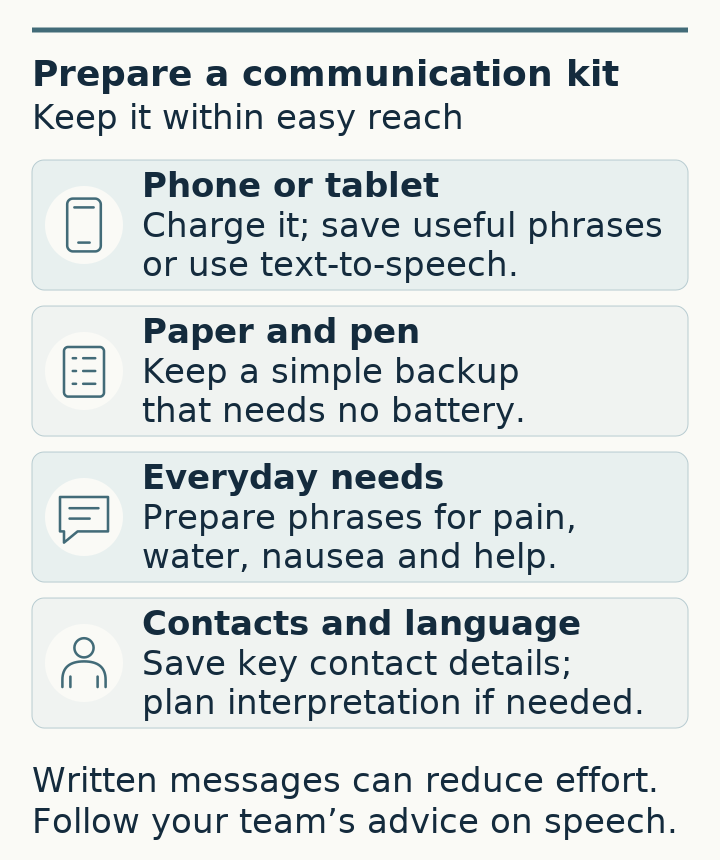
Build a communication kit before admission
Choose one phone note that is easy to open and one paper backup. Put your preferred language, the clinic contact and a short explanation that you may need to type there. Keep a charger within reach. If you use reading glasses or an accessibility setting such as larger text, make sure these will be available after the operation. Test your chosen arrangement with your companion before you need it.
Prepare a few phrases you can point to: I need the nurse; I feel sick; I need pain advice; please write that down; please contact my surgical team. Add a separate way to indicate an urgent breathing or swallowing problem. Leave space for a new symptom rather than relying entirely on preset choices. The purpose is to make a difficult conversation easier, not to replace calling staff or emergency services when urgent help is needed.
Agree how others should help you
ASHA recommends giving someone time to communicate, reducing distractions and using writing, gestures or simple choices when useful. A listener should check the part they understood instead of pretending the whole message was clear. These are general communication accommodations, not a diagnosis of a speech disorder or a jaw-rehabilitation program. You can use them temporarily whenever speaking is difficult.
Tell your companion whether you want help with telephone calls and which information they may share. Ask them to speak to you directly and wait for your answer before replying on your behalf. For a clinical decision, request a written explanation or qualified interpretation when needed. Difficulty speaking does not mean you cannot understand, express a preference or participate in consent. Keep your own questions visible so the appointment does not become a conversation only between the clinician and your companion.
Make international follow-up workable
Before traveling to Korea, confirm which language the consultation, written instructions and urgent calls will use. An English-language website does not establish interpreter availability for every appointment or every language. Ask whether the clinic accepts written postoperative questions, who reads them and what hours that service operates. Distinguish an administrative booking contact from the route for clinical advice.
Save the actual treatment address and the address of your accommodation in a form you can show a driver or helper. Keep the operation date, surgeon’s name and discharge document together. Ask a companion to help with a call if necessary, but do not depend on an unanswered chat for an urgent concern. Before returning home, clarify how the original team will share records with a local clinician if an examination or speech assessment is needed.
Use a short format for non-urgent questions
A useful written question starts with the operation and date, then describes the change and when it began. Add whether the difficulty is improving, unchanged or worsening, and whether it affects ordinary conversation, work or swallowing. For example: I can explain basic needs, but unfamiliar listeners cannot understand several words. Please tell me whether you want to assess this before my planned appointment. This gives the team something specific to respond to.
If the clinic requests a recording, ask what they want you to record and how to send it securely. A short sample in your usual language may be more useful than repeated attempts to sound perfect. A recording cannot assess every cause of altered speech, and you should not force wide mouth opening or prolonged speaking to create one. Do not let making a recording delay care for a new or worsening problem.
Respect the operation and appliances
Ask what speaking and mouth-movement restrictions apply to your fixation, splint and elastics. Write down who can change those instructions and when they will review them. Do not remove or alter an appliance to make a meeting easier, and do not copy another patient’s elastic schedule. If a device seems to be the main communication barrier, ask the treating team to explain what is expected and whether an adjustment requires an appointment.
Internet exercises are not a substitute for that advice. Avoid starting jaw stretches, forceful pronunciation drills, massage routines or singing practice intended as rehabilitation without clearance. If an exercise is prescribed, ask for a demonstration, the intended purpose and what should make you stop and contact the clinician. Being understood during one conversation does not establish that your bone healing permits a different diet or unrestricted jaw movement.
Singapore General Hospital: Preparing for Orthognathic Surgery ↗
Plan work by its speaking demands
Make a list of your actual duties before asking about return to work. Include telephone calls, video meetings, teaching, interviews, customer service, translation, singing and public presentations. Add how long each lasts and whether written communication is an acceptable substitute. The label desk work hides substantial differences between answering email and leading consecutive meetings. Give the clinician enough detail to discuss the work you really do.
A practical provisional arrangement could move updates to email, appoint someone else to lead a meeting or allow a written contribution. Agree a review point rather than promising colleagues a fixed recovery date. If your role requires precise or sustained speech, ask whether a speech and language professional should advise on the return plan. Keep the arrangement flexible if recovery or follow-up changes; an early successful call should not automatically become a full speaking workload.
Notice the pattern without repeatedly testing yourself
Keep a brief note of what gets in the way of communication: the setting, the listener and the task. Someone who knows you well may understand speech that is hard for an unfamiliar caller. A noisy reception desk may present a different challenge from a quiet room. Recording the practical difference is more useful than assigning yourself a daily percentage of normal speech.
Bring these observations to follow-up and ask what change the clinician expects before the next review. If the concern persists, interferes with necessary communication or worsens, contact the team rather than choosing a waiting period from another patient’s story. Ask whether assessment should involve the surgeon, orthodontist, a speech and language therapist or another clinician. Referral is a way to investigate a specific concern, not proof that the change is permanent.
Know when a routine message is not enough
The US Veterans Affairs home-recovery guidance lists trouble breathing or swallowing, uncontrolled bleeding, uncontrolled pain, persistent nausea or vomiting and worsening swelling among reasons to contact the surgical team. Follow the urgent instructions supplied for your own procedure. Severe breathing difficulty or active choking is an emergency: seek immediate local emergency care rather than waiting for the clinic to reply.
For less dramatic concerns, be direct about the practical consequence. If you cannot take enough fluid, cannot communicate essential needs or have a new change that worries you, request timely advice. Do not wait for a scheduled speech review to discuss an eating or hydration problem. A companion should know where your discharge instructions are and how to reach help, especially overnight or when you are staying away from home.
Clinics to discuss communication planning with
Faceline Plastic Surgery in Seoul lists two-jaw surgery and English-speaking support on its international website. It is a relevant consultation option if you want to ask how a jaw-surgery plan, orthodontic care and postoperative communication will be coordinated. Review its official two-jaw service page and request the actual operation name, appliance plan, written recovery instructions and clinical contact route. Published service information does not establish a specific speech-recovery result.
Sinsa Oral & Maxillofacial Surgery lists orthognathic care through its Korean jaw-surgery center and international website. The clinic is in Changwon, so confirm the treatment location before arranging travel. Ask whether your speech concerns need assessment before surgery and how the team would arrange a referral if concerns continue afterward. Neither clinic should be assumed to provide an on-site speech-language therapy service without direct confirmation. Choose a consultation for an understandable individual plan, not a promised date for sounding normal.
Faceline: International website ↗
Questions to take to your next appointment
Ask: What restrictions apply to speech and mouth opening with my planned operation? How will I contact you if a phone call is difficult? Who handles urgent concerns outside normal hours? Does my speech history or palate history call for an assessment before treatment? What would make you bring my postoperative appointment forward? Request answers in writing so that you and your companion can use the same plan.
Before leaving Korea, ask which follow-up must occur in person and who can assess you at home. Keep a copy of any speech assessment and the relevant surgical records. The goal is reliable communication, safe recovery and access to assessment when needed. Your own progress and clinical findings should guide the next step, rather than a universal calendar or comparison with somebody else’s recovery.
Explore the listed clinic and clinician
Faceline profile: two-jaw surgery scope and information limits ↗
Faceline international website: ask about your communication plan ↗
Sinsa profile: oral and maxillofacial surgery in Changwon ↗
Sinsa international website: ask about speech assessment and aftercare ↗
Sources & further reading
- Singapore General Hospital: Preparing for Orthognathic Surgery ↗
- ASHA: Communication support tips ↗
- Swansea Bay: Orthognathic surgery in cleft care ↗
- Veterans Affairs: Recovering at home after jaw surgery ↗
- Faceline: Two-jaw surgery ↗
- Faceline: International website ↗
- Sinsa: Korean jaw-surgery center ↗
- Sinsa: International website ↗
For personal recommendations, discuss your examination and records with your treating surgeon and orthodontist.