When can I return to work after jaw surgery?
Return depends on your operation, recovery and actual duties. Ask your surgeon for a provisional absence estimate, specific restrictions and a review point. Plan speaking, food, medication, commuting and stamina together. Work clearance does not automatically permit driving, lifting, unrestricted chewing or flying.
A trial shift should include the journey and the breaks
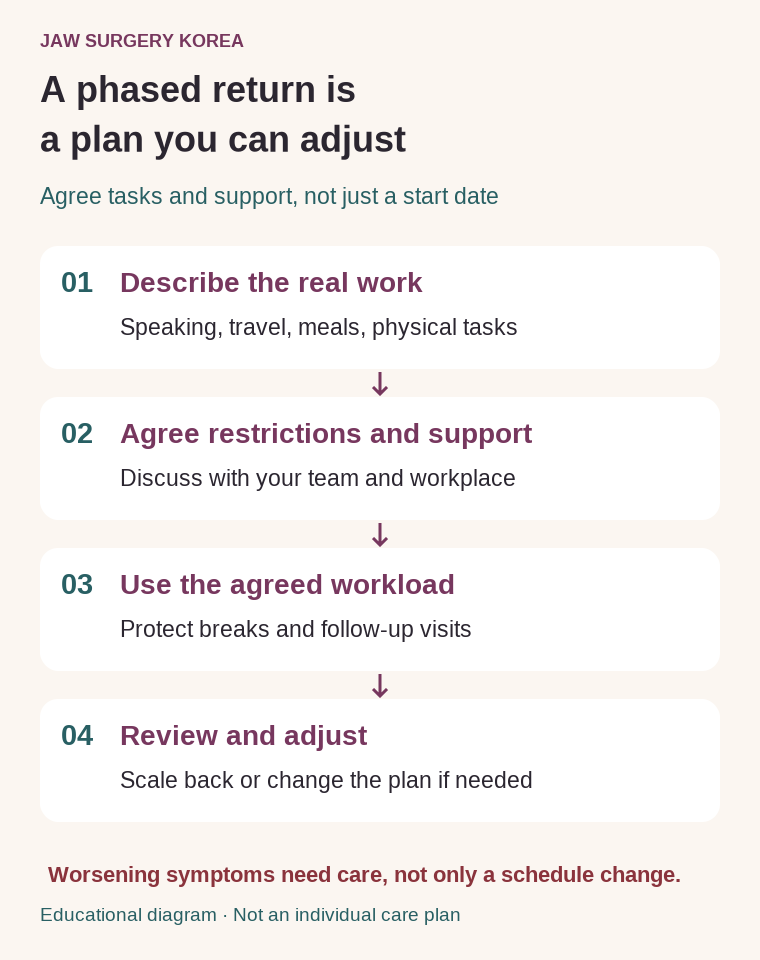
When planning a phased return, describe one whole shift to the surgical team. A quiet desk role may still involve a crowded commute, back-to-back calls and a lunch break too short for the foods you can manage. Ask your employer which demands can be changed for the first few shifts and arrange a date to review them. An afternoon of answering email at home gives useful information about concentration, but it leaves those other demands untested.
When can you return to work after jaw surgery?
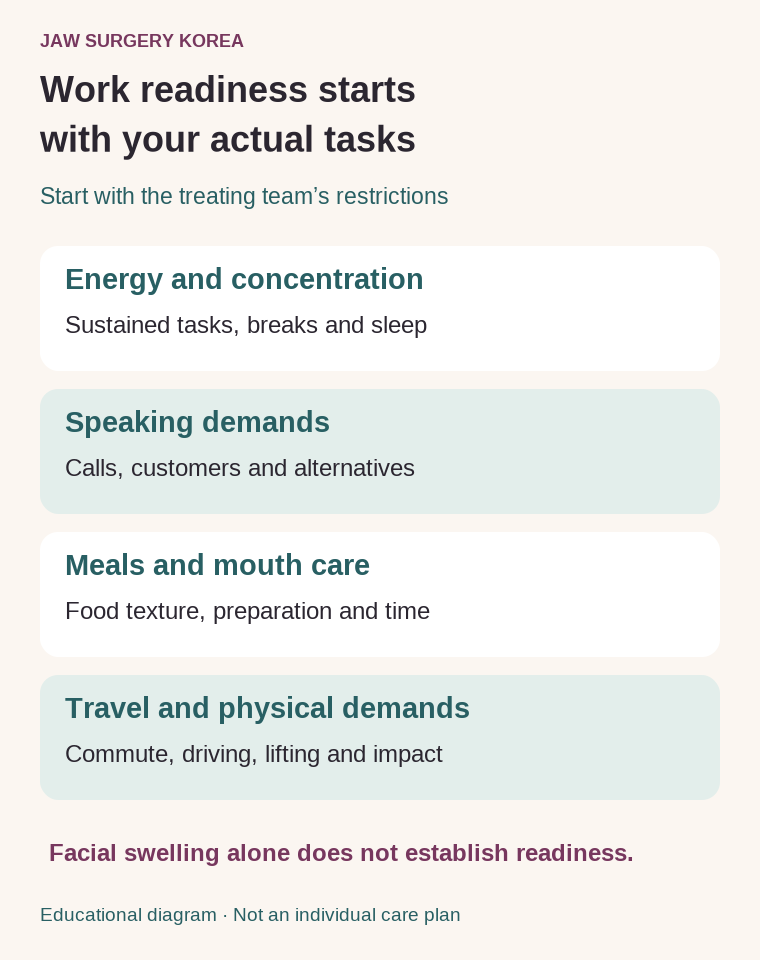
Returning to work after jaw surgery depends on the operation, your recovery and the work you actually do. Ask your surgeon for a provisional absence estimate before surgery and a review of your duties afterwards. Being discharged, looking less swollen or managing a short conversation does not establish readiness for a full working day. This guide helps you prepare that discussion; it does not clear you for work.
Hospital leaflets illustrate why a single online number is misleading. Cambridge University Hospitals describes around three weeks away from work for many upper- or lower-jaw operations, with variation by job and patient. Plymouth describes approximately three to six weeks, depending on the operation and individual recovery. These are local planning estimates, not a minimum, a promise or a countdown for your own treatment in Korea. A chin-only procedure also cannot be used as the recovery benchmark for repositioning the jaws.
Cambridge University Hospitals: Jaw or chin corrective surgery ↗
Start with a work-demand list, not your job title
Before the surgical consultation, describe a normal shift from leaving home to returning. Include how long you stand, how much you speak, what you lift, whether you drive, and how easily you can stop to eat or rest. Add tasks that happen only occasionally, such as emergency cover, moving stock or a monthly presentation. A mostly seated role may still contain one duty that needs a separate decision.
Sort the list into duties that are essential, duties that could be reassigned and duties that can wait. For each essential duty, write down what a temporary alternative would look like. For example, answering written enquiries is different from staffing a telephone line continuously. Ask the surgeon to identify medically restricted tasks; ask the workplace which adjustments are actually available. Neither conversation substitutes for the other.
Plan leave with a review point and a backup
Give your workplace an estimated absence and the date when you expect a medical update, rather than promising an unchangeable first day back. Find out what documentation is needed, which language it must be in and who should receive it. Ask the treating team in advance whether they can provide a summary of current restrictions and the next review date. Requirements vary by workplace and country; a Korean medical document does not automatically satisfy every employer or insurer.
Keep preoperative visits, the hospital stay, recovery appointments and any further absence visible in your own calendar. For international treatment, separate time in Korea from time away from work: they are not necessarily identical. Consider who will cover unfinished tasks if the estimated return changes. If your leave allowance is limited, discuss feasibility before committing to surgery rather than planning to work through an uncertain recovery.
You can describe functional needs without giving every colleague your personal medical history. Ask the relevant workplace contact what information is necessary. This is practical planning, not advice about entitlement to paid leave, confidentiality protections or job security.
Judge stamina across a day, not one successful task
A short email session at home may be manageable while a commute followed by meetings is not. The important question is whether you can sustain the agreed workload while still following your care plan. Singapore General Hospital identifies several possible contributors to postoperative lethargy or dizziness, including medication, reduced intake and disturbed sleep. Do not assume that tiredness is a character flaw or that its cause can be identified without assessment.
When your clinician permits work, keep a brief record of how the actual sessions go: concentration, breaks, meals, discomfort and how you feel afterwards. Useful observations are specific, such as being unable to finish lunch before the next meeting or needing to stop a call. You do not need to prove readiness by deliberately exhausting yourself. Ask for review if the pattern suggests the workload is not sustainable, and seek medical advice for new or concerning symptoms rather than treating them only as a scheduling problem.
Singapore General Hospital: Post-operative care for orthognathic surgery ↗
Speaking-heavy work needs its own plan
Teaching, interpreting, reception, sales and healthcare can require far more speech than an ordinary conversation. Swelling and limited mouth opening can complicate early recovery. Tell the surgical team whether the challenge is long speaking periods, precise pronunciation, being heard in a noisy setting or communicating urgently. The question is not simply whether you can talk, but whether the particular task is appropriate at this stage.
Possible arrangements to discuss include written customer responses, shorter meetings, a colleague handling telephone calls or preparation work instead of live delivery. These are options to negotiate, not instructions that every employer can implement. Do not remove prescribed elastics or appliances to sound clearer without the treating team’s direction. Persistent speech changes deserve assessment; the separate speaking-after-surgery guide explores that issue rather than treating every concern as a work-planning problem.
Cambridge University Hospitals: Jaw or chin corrective surgery ↗
Meals, fluids and mouth care belong in the working schedule
Work is not ready to resume simply because you can sit at a desk. You also need a practical way to follow the prescribed food texture, drink adequately and care for your mouth. Veterans Health Library emphasizes nutrition, fluids and following discharge instructions after jaw surgery. Permission to work is not permission to chew foods that your surgeon still restricts.
Before the first permitted shift, check the actual facilities: somewhere to store suitable food, a way to prepare it if needed, enough uninterrupted eating time and access to the mouth-care supplies your team recommended. A business lunch or a shared cafeteria menu may not fit your instructions. Bring an appropriate alternative instead of skipping a meal to avoid explaining it.
Ask what to do if meetings regularly overlap with meals or medication. Do not change a dose, stop treatment or alter an appliance schedule for convenience. If swallowing tablets is difficult, ask the pharmacist or prescriber about an appropriate formulation rather than crushing them yourself. Trouble maintaining food or fluid intake needs prompt advice, not simply a better packed lunch.
Treat the commute as a separate task
Compare the journey with the work itself. A quiet remote task and that same task after a crowded train, stairs and carrying equipment place different demands on the day. Ask whether a later start, a shorter route, temporary remote work or help carrying items is feasible. For a role involving travel between sites, include those journeys too; the first trip to the office is only part of the picture.
Driving requires its own assessment of postoperative restrictions and medication effects. The NHS warns that codeine can cause sleepiness and that people affected should not drive, cycle or use machinery. This example does not mean everyone receives codeine or that other medicines are free of impairment risks. Review your actual medication list with the prescriber or pharmacist. Passing the immediate anaesthetic restriction does not establish fitness for a professional driving shift.
This page concerns the everyday journey to work. Permission to fly home after surgery is a different clinical and travel decision, and arriving home does not itself mean you are fit for employment.
NHS: Codeine and medicine-related sleepiness ↗
Cambridge University Hospitals: Jaw or chin corrective surgery ↗
Physical and safety-sensitive duties need explicit restrictions
If your work includes lifting, strenuous effort, work at heights, machinery, patient handling or a risk of being struck in the face, describe it explicitly. Singapore General Hospital discusses postoperative activity limits and protecting the face and jaws from injury. Do not transfer a general exercise timetable to an occupational task, and do not treat approval for administrative work as approval for every duty on the rota.
Ask the surgeon what restrictions apply and which require reassessment. Where relevant, involve occupational health or the workplace safety lead to translate the clinical advice into actual duties. For protective equipment, ask whether required masks, respirators, helmets or other items can be worn correctly without conflicting with your postoperative care. Never loosen required safety equipment to accommodate discomfort or swelling.
A modified shift must remain modified when the workplace gets busy. Clarify who will take over an unexpected heavy or safety-critical task, whether you might be asked to work alone and how you can stop if unwell. If essential duties cannot be made compatible with the clinical restrictions, ask the treating team and workplace to revisit the return plan rather than improvising around them.
Singapore General Hospital: Post-operative care for orthognathic surgery ↗
Make a phased return specific enough to use
A useful plan records five things: permitted duties, starting hours, protected breaks, tasks excluded for now and the next review. Add the person responsible for approving changes. Avoid vague phrases such as light duties unless everyone understands what they mean for that particular job. A reduced day filled with back-to-back calls may not be a reduced speaking workload.
As an illustration, a desk-based worker might discuss short blocks of written tasks, no live presentations and time for prescribed meals and care. A retail worker might discuss seated stock administration rather than customer cover or lifting. A clinician might ask about non-patient-facing administrative duties. These are conversation examples, not medically approved schedules, and some roles cannot offer them.
Increase duties only within the agreed clinical advice and workplace arrangement. It can be useful to change one major demand at a time so you can describe what became harder. Review the whole day, including transport and recovery afterwards. If the plan needs to step back, identify the problem and revise it; you have not failed because an estimate needed adjustment.
Appearance and readiness are different concerns
Visible swelling or bruising may affect your comfort with face-to-face work even when some tasks are permitted. Conversely, looking well on a video call does not show that you can eat, concentrate or complete a shift reliably. Decide which concern you are trying to solve before asking for an adjustment. A camera-off meeting may address privacy or appearance, but it does not solve fatigue or sustained speaking demands.
For a public event or presentation, have a named backup rather than treating a cosmetic milestone as a medical deadline. You can choose a brief explanation such as recovering from surgery and temporarily limiting calls. Ask for support if worry about returning is becoming difficult to manage. The aim is a workable plan that respects both recovery and your comfort, without promising that swelling will disappear by a particular date.
Protect follow-up when returning home from Korea
Plymouth advises frequent follow-up early after jaw surgery. Before returning to your ordinary routine, confirm which appointments remain in Korea, who will assess you at home and what requires an in-person examination. Ask for the operative summary, medication list, current restrictions and a contact route for questions. A remote update may be helpful, but it cannot replace every examination.
Put appointments into the work plan before accepting a full diary. Confirm that the receiving clinician has agreed to the handover rather than assuming any nearby dental practice can take over. Keep the surgical and orthodontic roles clear: work attendance and completion of orthodontic treatment are different milestones. If two teams give conflicting instructions, ask them to reconcile the advice before you change your routine.
When work should stop for medical advice
Get urgent medical help for breathing difficulty or severe bleeding. Contact the treating team promptly for worsening swelling, uncontrolled pain or vomiting, fever, or difficulty taking fluids; follow your discharge instructions about urgency and where to attend. Veterans Health Library lists these types of problems as reasons to seek assessment. Do not wait for the end of a shift or a routine online appointment when symptoms are urgent.
Keep the surgical contact and a local urgent-care plan available at work. If you are too unwell to travel safely, seek help rather than driving yourself. Ordinary scheduling difficulties can be discussed at the planned review, but a new clinical problem should not be hidden in a routine employer update.
A listed clinic to consider for a recovery-planning consultation
Faceline Plastic Surgery is listed on Jaw Surgery Korea and its official international website describes a two-jaw surgery service. Its team page identifies Lee Jin-soo with double-jaw and facial-contouring work and Lee Shin-jung with orthodontics. Those stated roles make it a relevant option to ask about coordination of surgical recovery and orthodontic visits. This selection is based on the published service and team, not a comparison of outcomes or a promise of faster return to work.
Review the linked clinic profile and official service page, then ask who would assess your work restrictions, when those restrictions would be reviewed and how follow-up would work after you leave Korea. Ask whether any required medical letter can be supplied in the language and format your workplace accepts. Availability of a particular document, interpreter or appointment arrangement must be confirmed directly. A useful consultation should produce an individualized plan and an opportunity to consider it, not pressure to accept an early return date.
Faceline Plastic Surgery: Listed clinic profile (English) ↗
Questions to take to the next review
Can I work remotely before returning on site? Ask about the actual hours and tasks, not remote work as a blanket category. Removing a commute does not remove the need for rest, meals, mouth care and follow-up.
Does one good day mean I can resume a full week? Ask what observations should guide progression and when to review the first permitted sessions. A single successful task does not reproduce a repeated workload.
What should my workplace update include? A provisional absence, the next medical review and the specific duties that may need adjustment are usually more useful planning information than an unsupported promise of full recovery. Confirm documentation requirements directly.
What if I cannot get the adjustments I need? Explain the essential duties and unavailable alternatives to your treating team before returning. Ask for a revised clinical assessment and discuss the practical options with your workplace. Do not interpret financial or staffing pressure as medical clearance.
Explore the listed clinic and clinician
Read the listed Faceline clinic profile ↗
Sources & further reading
- University Hospitals Plymouth: Orthognathic surgery ↗
- Cambridge University Hospitals: Jaw or chin corrective surgery ↗
- Singapore General Hospital: Post-operative care for orthognathic surgery ↗
- NHS: Codeine and medicine-related sleepiness ↗
- Veterans Health Library: Jaw surgery, recovering at home ↗
- 長崎大学病院:顎変形症の治療と退院後の通院 ↗
- 大阪大学:顎変形症外来、退院と術後矯正治療 ↗
- Faceline: Official two-jaw surgery service (English) ↗
- Faceline: Official team information (English) ↗
- Faceline Plastic Surgery: Listed clinic profile (English) ↗
For personal recommendations, discuss your examination and records with your treating surgeon and orthodontist.