Do jaw-surgery plates always need to be removed?
No. Titanium plates and screws used in corrective jaw surgery are commonly left in place when they are not causing a problem. Cambridge University Hospitals describes permanent retention as usual, with removal sometimes needed for infection. A routine anniversary, an online story or the availability of a discounted removal package is not by itself a clinical indication.
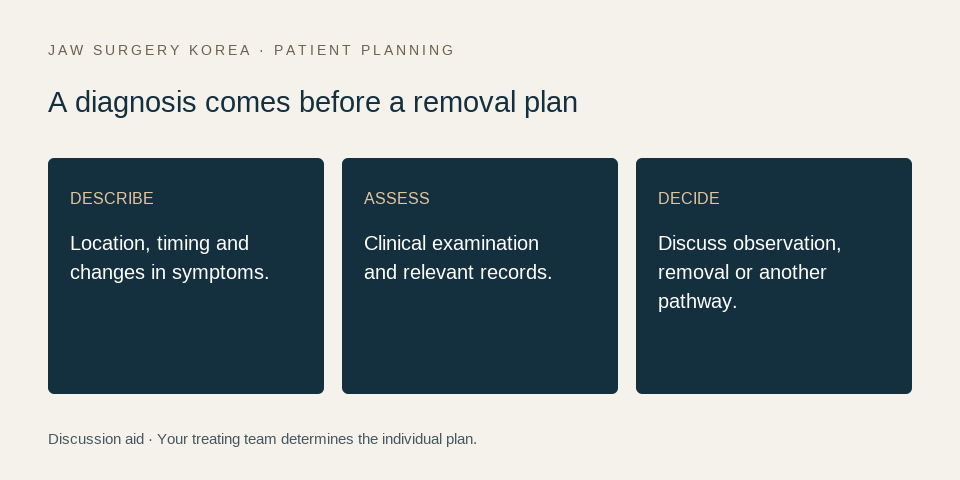
The first question is whether you have a specific problem that needs diagnosis. The second is whether removing any hardware is an appropriate way to address it. Keep those questions separate. A person with a new wound problem needs assessment even if they had planned to keep every plate; someone with no symptoms should understand why another operation is being proposed before arranging it.
Removal needs an individual reason
Fixation holds bone segments during healing, and plates or screws can often remain afterward. Removal may be considered in particular circumstances, but it is not automatically required for every patient. Ask the surgeon to explain the reason in your case and whether the concern has been confirmed by examination or imaging.
The decision should distinguish symptoms caused by hardware from symptoms with another explanation. If removal is proposed because of discomfort, ask how confident the clinician is that it will address that discomfort. A clear indication is more useful than a general claim that everyone should remove metal at a certain age or interval.
Removing fixation does not reverse the jaw movement
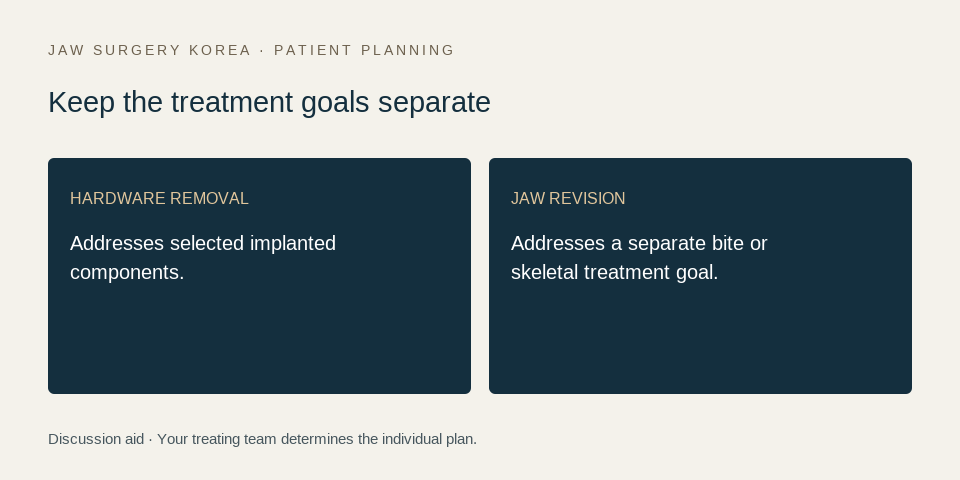
A hardware-removal operation addresses implanted components. It does not by itself move the jaws back to their original position or recreate the first operation in reverse. If a patient also wants a change in bite or facial shape, that is a separate treatment question requiring its own assessment. This distinction prevents an unrealistic expectation that taking out plates will solve every postoperative concern. The proposed removal should have a defined goal, such as addressing a confirmed hardware-related problem, and the limits should be clear.
Collect the original records
A surgeon considering removal needs to understand the first operation and fixation. Request the operation report, implant information and relevant imaging. Explain any previous infection, wound problem, numbness or later procedure. If the original surgery was in Korea and removal is planned elsewhere, arrange records before the consultation.
Ask whether additional imaging is needed and what it will clarify. Do not assume every screw can be identified or removed in the same way. The clinician should explain the expected approach and what might make the operation more complex.
Discuss the new operation on its own terms
Removal has its own consent discussion, anesthesia plan and recovery requirements. Ask about the incision, expected limitations, follow-up and the possibility that some hardware may be difficult to remove or better left in place. The risks and benefits should be specific to the proposed extent of removal.
Ask whether the original symptom could persist and what the next step would be if it does. Clarify whether treatment of an infection or another problem is part of the same plan. Do not treat removal as a guaranteed reset of the original surgery.
What can lead to a removal discussion?
A systematic review of orthognathic surgery studies identified infection, exposed hardware, temperature sensitivity, palpable components and pain among reported reasons for removal. These are reasons to investigate, not a checklist that proves a plate is responsible. The review also combined different studies and clinical practices, so its results cannot supply an individual forecast for your recovery.
Describe the problem precisely to the clinician: where it is, when it started, whether it is constant, and whether there is visible change. Distinguish discomfort on touch from pain during chewing or a change in the way the teeth meet. Mention dental treatment, injury or infection since the original operation. This helps the clinician decide what to examine rather than assuming that every symptom near a plate has the same cause.
A symptom diary can be useful without becoming an exercise in repeated checking. Note important changes and take photographs only if requested through the clinic's clinical communication process. Avoid pressing, picking at a wound or trying to expose a component yourself. A visible piece of metal should be assessed by a clinician; it is not an invitation to manipulate it at home.
Systematic review of reasons for orthognathic plate removal ↗
Observation, targeted removal and broader surgery are different choices
When the surgeon explains the options, ask for the goal of each one. Observation may be discussed when there is no indication for an operation. Targeted removal concerns particular components. A more extensive operation may involve several sites or treatment of another problem. The comparison should include what each approach is expected to improve and what it will leave unchanged.
Ask whether a proposed second procedure is removal alone or also a revision of the jaw, chin or contour. Those descriptions are not interchangeable. If your main concern is appearance or bite alignment, say that explicitly before consenting to hardware removal. Request a separate explanation of any additional procedure and avoid allowing a package title to combine different goals without discussion.
For a second opinion, bring the first recommendation rather than asking only for a competing price. A helpful comparison uses the same symptom, records and proposed extent of surgery. If the recommendations differ, ask which finding explains the difference. You do not need to decide which clinician is right from online reading; you need enough explanation to understand the choices being offered.
Discuss uncertainty before another operation
Ask about the intended incision, anesthesia and whether the surgeon expects to remove every planned component. Discuss how the team would respond if access is more difficult than expected or if a component is better left in place. The point is to understand the limits of consent before anesthesia, while you can ask questions and express preferences.
Removal is still an operation. Request discussion of bleeding, infection, altered sensation, wound healing and the possibility that the original discomfort may persist. Ask which risks are relevant to the specific site and your previous treatment. Do not assume a shorter planned procedure means no meaningful risk, and do not assume that the risk profile is identical to your original jaw operation.
Tell the team about current medicines, allergies, nicotine use and changes in health since the first surgery. A previous uneventful anesthetic does not replace a current assessment. If you are worried about being unable to work or care for children afterward, discuss that at the planning visit. Recovery arrangements should be based on this proposed operation, not solely on how quickly another patient recovered.
A practical consultation file for removal in Korea
Keep the original operation report, relevant imaging and implant information together. Add a short timeline of later procedures and symptoms. Ask the receiving clinic which documents it can assess before travel and which require translation. If you do not have a particular record, tell the clinic what is missing instead of substituting an approximate memory of the operation.
For cost comparisons, request an estimate that names the intended sites and includes the assessment, imaging, anesthesia, procedure and follow-up. Ask what happens financially if the operation is more limited than planned, some fixation remains or additional review is required. Clarify whether a quote assumes that the clinic performed the original surgery. Do not assume a benefit offered to previous patients applies to someone treated elsewhere.
Plan where to stay and who will help after discharge. Ask when the surgeon needs to review the wound, how you will obtain help after hours and what information should go to a clinician back home. Keep travel decisions conditional on the team's advice. A prearranged flight does not establish fitness to travel after another operation.
A listed clinic for reassessing a previous jaw operation
Faceline Plastic Surgery is a relevant listed clinic to consider for reassessment because its Korean treatment directory includes revision jaw surgery, while its international team page identifies Dr. Lee Jin-soo with double-jaw surgery. For a hardware concern, ask whether the team can assess your previous operation and determine whether removal, observation or another pathway is appropriate.
This selection is based on published jaw-surgery and revision scope. It does not establish that removal is necessary or promise that the clinic will accept every case from another surgeon. Review the Faceline profile and international website, explain where and when the original surgery took place, and ask what records are required for an assessment. The original operating team is also an important source of records and follow-up advice.
Questions patients ask about plates and screws
Will removal change my face back? Hardware removal is not a plan for reversing the original jaw movement. If changing the bite or appearance is your goal, request a specific reassessment of that goal. Do not expect a removal-only operation to deliver a revision result that has not been discussed.
Can an X-ray tell me everything? Imaging can help the clinician assess the situation, but ask how it fits with the examination and symptoms. An image of a plate alone does not establish that it causes pain or that removal would relieve it. Request an explanation of the finding that changes the recommendation.
What should I keep after removal? Request a new operation summary describing what was removed and what remains, along with follow-up instructions and a contact pathway. Keep it with the original records. If you need future dental or surgical care, this paired history is more useful than saying that all your metal was removed when you are not certain.
Plan practical recovery and cost
Confirm whether someone needs to accompany you and remain available afterward. Ask about food, mouth care, work, exercise and travel restrictions for this procedure rather than assuming they are identical to the first operation. Obtain the medication and emergency plan before discharge.
Request an itemized estimate that identifies imaging, anesthesia, hospital care and follow-up. If a clinic advertises removal as included, ask what included actually covers and whether treatment outside that clinic is reimbursed. Keep the financial conversation separate from the clinical decision so that a package benefit does not become the reason for an unnecessary operation.
Know when a concern should be assessed promptly
Increasing swelling, drainage, wound opening, significant pain or a bite change needs clinical advice. If severe bleeding, breathing difficulty or rapid deterioration occurs, seek emergency care. Do not wait for a planned elective removal appointment when a new problem has developed.
After removal, keep the new operative record with the original one and ask whether any fixation remains. Future clinicians should have an accurate account of both procedures. The useful outcome is a documented, clinically justified plan, not simply a count of how many plates have been taken out.
Explore the listed clinic and clinician
Explore the clinic directly
Explore the clinic’s international website ↗Sources & further reading
- CUH: fixation and infection after corrective jaw surgery ↗
- Systematic review of reasons for orthognathic plate removal ↗
- Faceline: official team ↗
- Faceline: Korean revision-surgery page ↗
For personal recommendations, discuss your examination and records with your treating surgeon and orthodontist.