When can you fly home after jaw surgery in Korea?
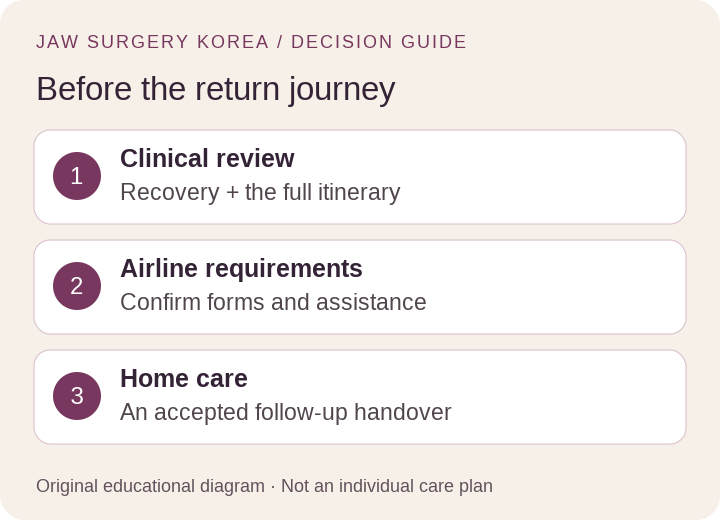
There is no universal safe departure day. Your surgeon must assess recovery and the full itinerary, and your airline may have separate medical-document requirements. Keep travel flexible, arrange home aftercare and seek reassessment if symptoms change after clearance.
There is no universal departure day
Recent surgery and prolonged travel can increase the risk of blood clots, and travel suitability also depends on your surgical recovery. The length of the journey, medical history, symptoms and access to follow-up matter. A package advertised with a fixed stay does not establish that every patient is ready to fly at its end.
Ask your surgeon to assess the actual itinerary, including connections and ground travel. A short flight and a long journey with several transfers are different practical situations. Book flexibility where possible and ask what findings could require a longer stay.
CDC Yellow Book 2026: medical tourism ↗
CDC Yellow Book 2026: deep-vein thrombosis and pulmonary embolism ↗
Why a long journey is more than cabin pressure
Prolonged sitting is one reason travel matters after surgery: reduced movement can contribute to clot risk, which varies with personal risk factors. A long trip also limits access to the treating team and can make food, fluids and medication routines difficult. These issues remain even when the face looks less swollen. Clearance therefore considers the whole condition and itinerary rather than only the number of days since surgery. Measures intended to reduce clot risk should be individualized rather than copied from another traveler.
CDC Yellow Book 2026: deep-vein thrombosis and pulmonary embolism ↗
Medical clearance and airline acceptance differ
The surgical team evaluates your condition; the airline applies its own carriage and documentation requirements. Check both. Ask the airline what information or forms it requires after surgery and how far in advance they must be submitted. Do not assume a general clinic letter automatically satisfies every carrier.
Confirm insurance arrangements directly with the provider, including any exclusions related to planned treatment and complications. Keep the policy and emergency contact details accessible. Financial planning should include the possibility of additional accommodation, changed flights or local care if recovery does not follow the intended schedule.
UK Civil Aviation Authority: surgical conditions and flying ↗
Make the final review a travel review
At the pre-departure appointment, discuss breathing, bleeding, eating, drinking, medication, mobility and any unresolved symptoms. Ask which restrictions remain in force during the journey. If nasal symptoms or a bite concern persist, mention them specifically rather than focusing only on obtaining a letter.
Ask the clinician whether any clot-prevention measures are appropriate for your individual risk. Do not start aspirin, anticoagulants or compression products on your own. Follow the individualized plan and clarify how it fits the journey. Travel advice from another operation may not be suitable for jaw surgery.
CDC Yellow Book 2026: deep-vein thrombosis and pulmonary embolism ↗
Cambridge University Hospitals: jaw or chin corrective surgery and consent ↗
Prepare for the practical journey
Carry the operation summary, medication list, prescriptions, allergies and clinic contact information. Plan access to permitted food and fluids, and confirm any airport or airline rules affecting what you carry. Keep necessary supplies in accessible luggage according to transport rules.
Consider whether you need a companion or assistance at the airport. Ask how to manage any appliances during meals and what to do if a problem occurs in transit. A long queue, missed connection or delayed flight can turn a manageable plan into a difficult day, so build in practical flexibility.
Aftercare should already be arranged
Before departure, identify the clinician who will see you at home and confirm that they have accepted the handover. Send records securely and arrange the first appointment. Ask the Korean team how urgent concerns will be handled across time zones and which issues require local examination.
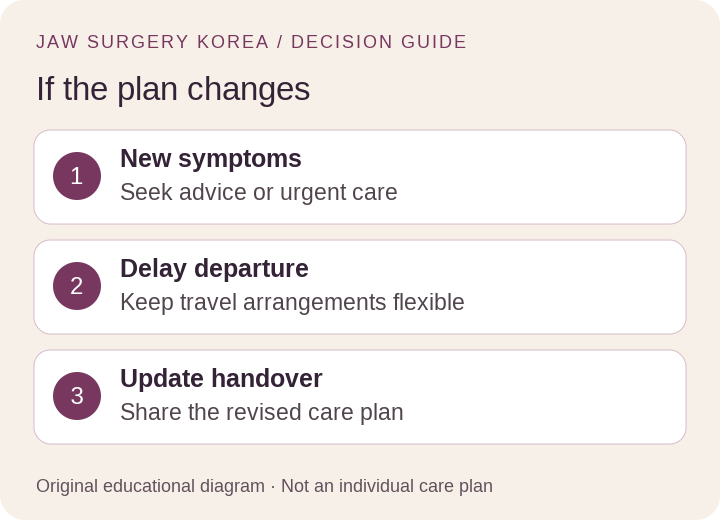
If you develop severe breathlessness, chest pain, significant bleeding or other severe symptoms during travel, seek immediate medical help. Do not continue a journey simply to reach the original clinic or home destination. Readiness to travel is a clinical decision made at the relevant time, not a milestone guaranteed when surgery is booked.
Do not borrow a departure date from another procedure
General travel guidance sometimes gives waiting periods for particular operations. Those figures are not a universal flight rule for orthognathic surgery. An eyelid procedure, abdominal operation and two-jaw osteotomy have different recovery issues. Even two patients who had the same named jaw operation may have different symptoms, medical risks and journeys. Ask the treating surgeon to explain the basis for your own recommendation.
Arrange the assessment before the point when changing travel becomes difficult. When booking, ask how long the team expects you to remain close to the clinic, when it makes the final travel decision, and what would trigger reassessment. Keep a way to extend accommodation and rearrange transport. The aim is not to purchase a certificate on a fixed day; it is to make a safe decision using your condition at the time.
Hospital discharge, removal of stitches and permission to fly are separate decisions. Discharge may mean you can recover in local accommodation with support and access to the clinic. It does not necessarily mean you can manage a lengthy journey or leave the local follow-up pathway. Clarify those distinctions with anyone helping arrange your trip.
CDC Yellow Book 2026: medical tourism ↗
UK Civil Aviation Authority: surgical conditions and flying ↗
Bring a useful symptom and travel summary
At the travel review, describe changes since your last examination: breathing or nasal symptoms, bleeding, wound concerns, pain, swelling, fluid intake, medicines and ability to move around. Tell the clinician about any new problem even if you are worried it could delay departure. The review cannot account for a symptom you have not mentioned.
Bring the door-to-door schedule, including overnight transfers, the longest period seated, and where you will get help at each end. If your plan involves a train or car journey as well as flights, include it. Tell the team if you are traveling alone, have limited mobility, or will be responsible for children or heavy luggage. These practical details help them judge the real trip rather than a flight number alone.
Write down the remaining restrictions and the next review date before leaving. If your condition changes after clearance, contact the team again and check whether the plan still applies. A letter issued earlier is not evidence that a new episode of bleeding, breathlessness or illness is safe to ignore.
UK Civil Aviation Authority: surgical conditions and flying ↗
Cambridge University Hospitals: jaw or chin corrective surgery and consent ↗
Clot prevention should be personal, not improvised
Recent surgery and restricted mobility are among the factors clinicians consider when assessing travel-associated blood-clot risk. Mention a previous clot, relevant family history, known clotting disorder and all medicines, including hormonal medicines. Do not stop a prescribed medicine because you saw a travel warning online; ask the prescribing clinician and surgical team how to coordinate the plan.
Ask what movement is appropriate during the journey and whether your individual risk calls for any other measures. Compression garments and medicines are not universal travel accessories. If recommended, obtain specific instructions from the clinician. Starting aspirin or an anticoagulant yourself can create bleeding risks and may not be the appropriate prevention for your situation.
Maintaining the fluid intake recommended for your recovery is important for general comfort and nourishment, but drinking water should not be presented as proven protection against travel-related clots. Do not let a bottle of water, a special seat or a short walk replace medical assessment. The aim is a realistic plan that respects both your surgical restrictions and your travel risks.
CDC Yellow Book 2026: deep-vein thrombosis and pulmonary embolism ↗
Pack for a delayed journey, not just the scheduled flight
Keep the operation summary, allergies, medicine names and doses, relevant prescriptions, clinic contacts and home clinician details accessible. A concise paper copy can help if your phone battery fails. Ask your team which imaging or further records the next clinician may need and arrange secure transfer separately; do not rely on being able to download everything during an emergency.
Discuss a practical food and fluid plan that follows your prescribed texture restrictions. Confirm what the airport and airline permit, including medically necessary liquids, and plan how you will obtain suitable options during a delay. An ordinary airline meal may not fit your postoperative instructions. Ask your team about any equipment they have specifically advised and how to use it safely while traveling.
Ask a companion to help with luggage, communication and transport if needed. Confirm any airport assistance in advance rather than assuming it will be available at the gate. Keep enough flexibility to pause the journey if you become unwell. Insurance, airline paperwork and practical help serve different purposes; none replaces the surgeon's assessment.
Know when to stop traveling and get help
New one-sided leg pain or swelling can be a sign of deep-vein thrombosis and needs urgent medical assessment. Sudden shortness of breath, chest pain, fainting or coughing blood can indicate a serious emergency. Seek emergency care immediately rather than waiting for a reply from the clinic or continuing to the airport. Tell the medical team about the recent operation and any travel already completed.
Jaw-related emergencies also take priority over the itinerary. Breathing difficulty or heavy uncontrolled bleeding requires immediate medical help. If you are already on board, alert cabin crew promptly. If symptoms are less severe but new or worsening, contact the treating team for advice before continuing. Do not try to solve a suspected serious complication by changing medicines or adjusting surgical appliances on your own.
Have the local emergency plan in a form you and your companion understand. The plan should identify where to seek urgent assessment, how to describe the operation and where the operative summary is stored. You do not need to determine which complication is occurring before asking for help.
NHS: symptoms of deep-vein thrombosis ↗
Cambridge University Hospitals: jaw or chin corrective surgery and consent ↗
Relevant listed clinics to ask about departure and handover
If considering Faceline Plastic Surgery's published two-jaw service in Seoul, ask during the planning consultation who performs the pre-departure assessment, what local reviews are expected, and how the operating team will hand over care. Review its platform profile and official international service page before making an enquiry. Its published service does not establish any guaranteed departure date.
For Sinsa Oral & Maxillofacial Surgery in Changwon, ask how the travel assessment accounts for reaching your departure airport as well as the flight itself. Its listed jaw realignment service makes continuity-of-care questions relevant, but confirm the specific follow-up arrangements directly. Do not assume that an online service description includes airport assistance, interpretation or accepted home follow-up.
These are relevant consultation options from the platform, selected for published jaw-surgery services rather than a ranking. Use the clinics' international websites for enquiries. Before committing, ask for the actual discharge, local review, emergency and records-transfer arrangements in writing, including what happens if the planned flight must change.
Three final questions before leaving Korea
Has the clinician assessed this journey, rather than simply the day since surgery? Has the airline confirmed any required medical paperwork? Has a home clinician accepted the handover and agreed the next review? These checks answer different questions and should all be addressed before departure.
If one answer is still uncertain, resolve it rather than interpreting silence as approval. Keep copies of the current plan and make sure your companion knows the emergency route. Traveling home should continue your care pathway, not create a gap between the Korean team and the people who will help you afterward.
Explore the listed clinic and clinician
Faceline Plastic Surgery: profile and current photo context ↗
Faceline: enquire through the international website ↗
Sources & further reading
- CDC Yellow Book 2026: medical tourism ↗
- CDC Yellow Book 2026: deep-vein thrombosis and pulmonary embolism ↗
- UK Civil Aviation Authority: surgical conditions and flying ↗
- NHS: treatment abroad checklist ↗
- Cambridge University Hospitals: jaw or chin corrective surgery and consent ↗
- NHS: symptoms of deep-vein thrombosis ↗
- Faceline: official international two-jaw service ↗
- Sinsa: official international clinic and jaw services ↗
For personal recommendations, discuss your examination and records with your treating surgeon and orthodontist.