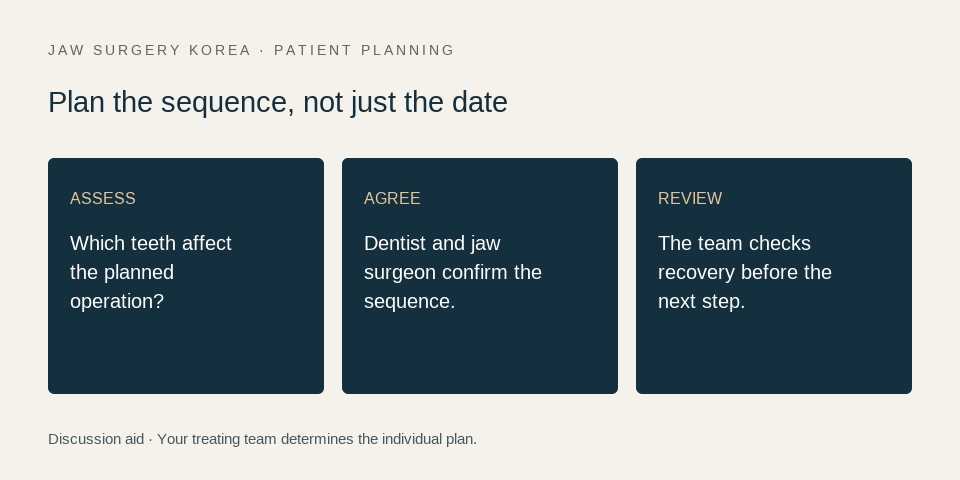
Why the lower wisdom teeth matter to a jaw-surgery plan
A wisdom tooth is the third molar at the back of the dental arch. An impacted tooth has not erupted normally into the mouth. Its position can matter even when it does not hurt: the surgeon needs to consider the tooth alongside the planned operation, rather than treating symptoms as the only question. Conversely, having an impacted tooth does not tell you which jaw operation you need. The assessment of the bite and facial skeleton comes first.
Bring a simple tooth history to the consultation. Identify teeth already removed, any episodes of swelling, treatment with antibiotics and any lingering altered sensation. If you cannot remember the tooth numbers, say so and bring the dentist's record. A photograph of your smile cannot show everything the team needs to assess. Ask which existing images are useful and whether the surgeon needs a new examination before deciding about extraction.
Do not assume one rule fits everyone
Wisdom teeth can be relevant to jaw surgery planning, but the need for removal and its timing depend on your individual assessment and the proposed operation. Ask your surgeon whether each wisdom tooth affects the plan and why. An online rule such as 'all teeth must be removed at the same interval' is not a substitute for that explanation.
Bring any previous X-rays and records of extractions. If you have pain, swelling or a history of infection around a tooth, tell the team early. These details may affect the sequence of care, and it is better to address them before travel and surgical dates are finalized.
Coordinate before arranging an extraction
If your dentist recommends removal while you are also planning jaw surgery, ask the dentist and surgeon to communicate. Clarify whether the proposed timing fits the surgical plan and whether additional imaging or assessment is required. Do not book an extraction simply because it appears on a generic preoperative checklist.
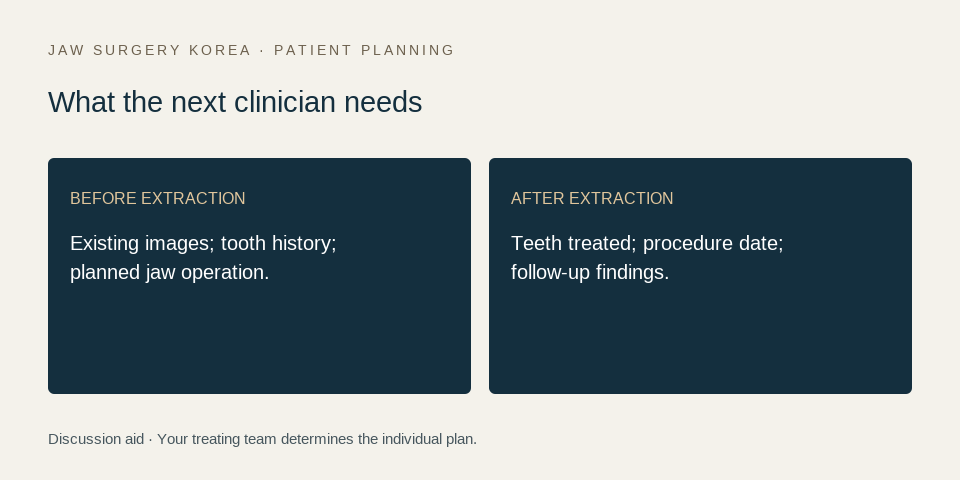
Ask who will perform the removal, what follow-up is needed and which records should be sent afterward. If it is done at home, the Korean team may want confirmation of the procedure and healing. Establish the documentation requirements in advance rather than discovering them just before surgery.
Keep the two consent discussions distinct
Wisdom-tooth removal has its own benefits, risks and recovery considerations. Ask the clinician performing it to explain those in relation to your anatomy. If removal is proposed during another procedure, ask why that approach is preferred and how it changes the overall plan.
You should understand whether removal is being recommended because of a current dental problem, because it interacts with the planned operation, or for another reason. The label 'preparation' should not prevent you from asking questions. Each procedure deserves a clear rationale and a chance to discuss alternatives.
Build flexibility into the schedule
Ask what must be confirmed before moving on to the next treatment stage. If healing or symptoms do not follow the expected course, contact the treating clinician and notify the jaw surgery team. Do not assume that a calendar date alone proves readiness for another operation.
Keep receipts, procedure notes and imaging organized with your main treatment records. When comparing clinic quotations, check whether wisdom-tooth assessment or removal is included, optional or separately billed. Understanding this early helps you avoid both unexpected costs and last-minute changes to your travel plan.
Why published timing advice differs
Some surgical services ask for lower wisdom teeth to be removed well before a planned jaw operation. UI Health, for example, describes removal at least six months before lower-jaw surgery in its own pathway, while allowing upper wisdom teeth to be removed during surgery. This is an example of a team protocol, not a rule that establishes the correct interval for every person travelling to Korea.
A useful way to handle different recommendations is to ask each surgeon the same question: what feature of my tooth position or planned operation makes you prefer this timing? Then ask whether the recommendation depends on the final choice of operation. If one clinician has assumed a lower-jaw procedure and another has assessed an upper-jaw-only plan, apparently conflicting instructions may be answering different questions.
Do not shorten an interval independently because the extraction site feels comfortable. Ask the treating team what evidence of recovery it needs and when it will review that evidence. Equally, do not postpone necessary assessment of a painful tooth simply because the jaw operation is months away. Dental symptoms need their own clinical attention while the wider plan is being agreed.
The extraction decision has its own risk discussion
Wisdom-tooth removal can cause pain, swelling, bleeding, infection and dry socket. With lower wisdom teeth, altered feeling in the lower lip, chin or tongue is also a relevant risk because nearby nerves may be affected. Ask the clinician to explain the relationship between your tooth and the nerves using your records. A percentage from another patient's consent form cannot establish your own risk.
If the roots are close to a nerve, a clinician may discuss coronectomy, which removes the crown while leaving roots behind. It is not suitable for everyone. For a patient preparing for jaw surgery, ask both clinicians whether any proposed alternative is compatible with the future operation. Do not select a technique from its name alone or assume that the option with the smallest initial procedure must be the best overall sequence.
Write down what matters most to you before consent: concern about sensation, time away from work, anxiety about anesthesia or difficulty arranging a companion. These are legitimate parts of planning. Ask who can explain options if you do not understand the proposed procedure. An interpreter should help you discuss the clinical choices, not only translate a price or appointment time.
Plan the extraction recovery separately from the Korea trip
The NHS describes discomfort, swelling, stiffness and difficulty chewing after extraction, with recovery varying according to the procedure. Follow the instructions given by the team that removes the teeth, including wound care, food and activity advice. Do not use a future jaw-surgery diet sheet as a substitute for the extraction instructions. Obtain a contact number before leaving and check whether follow-up is planned.
Ask for prompt dental advice if pain or swelling is severe or worsening, bleeding will not stop, or you have signs of infection. Breathing difficulty or rapidly progressing swelling needs urgent emergency assessment. Report any new numbness to the treating clinician. A message to an overseas coordinator should not delay local care when symptoms are urgent.
For travel planning, keep two separate milestones: recovery from the extraction and clearance for the jaw operation. Ask which appointments can happen at home and which need the Korean surgical team. A practical written plan names the clinician responsible for each review, the information to send and the next decision date. This is more useful than an itinerary built around an assumed healing deadline.
NHS: recovery and complications after wisdom-tooth removal ↗
A listed clinic to discuss the surgical sequence
Sinsa Oral & Maxillofacial Surgery is a relevant listed starting point for a jaw-surgery assessment because its official international site describes orthognathic surgery and identifies Dr. Ji-woong Jung as its lead clinician. The practice is in Changwon. For this question, request an assessment of how any wisdom teeth relate to the proposed jaw procedure and who should coordinate extraction with your dentist.
Our recommendation is based on the clinic's published jaw-surgery scope, not a claim that it uses one extraction timetable or that it is the right choice for every patient. Review the Sinsa profile and its international website before requesting a consultation. Send existing dental records through the clinic's agreed channel, and ask whether a decision requires an in-person visit. Confirm the treating clinician and location before arranging travel.
Questions patients often ask about wisdom teeth and jaw surgery
Must all four wisdom teeth come out? Not automatically. Ask the surgeon to identify the teeth relevant to your plan and explain each recommendation. Upper and lower teeth can have different implications. A written tooth-by-tooth plan prevents a general instruction such as “remove the wisdom teeth” from becoming an ambiguous referral.
Can I have the extraction at home? Ask the jaw surgeon and local dentist to agree on the procedure, timing and handover first. Request a record of what was done and how any concerns will be reviewed. You should not have to act as the sole interpreter of technical instructions between two teams.
Does an extraction quote cover the whole preparation? Check examination, imaging, anesthesia, the procedure and follow-up individually. Then check whether any of these appear again in the jaw-surgery estimate. A useful budget distinguishes clinically required care from optional travel arrangements, and leaves room for an additional review if the treating team needs one.
Separate scheduling convenience from the clinical reason
A proposal to remove wisdom teeth can seem attractive if it avoids another trip or appointment. Ask the clinician to explain the clinical reason and timing independently of that convenience. You should understand whether removal is necessary for the planned treatment, advisable for a separate dental issue or one of several reasonable options.
If the teeth are being removed at home, ask the surgical team exactly what documentation it needs afterward. That may include a procedure note or confirmation of review, depending on the case. Do not ask your dentist for a generic certificate without first understanding the purpose. The information should answer the receiving clinician's actual question.
Discuss costs and recovery separately from the jaw operation. A combined package can obscure the fact that another procedure has its own consent and follow-up needs. Ask whom to contact if symptoms develop after the extraction and whether the jaw surgery date remains provisional until the team has reviewed your progress.
Explore the listed clinic and clinician
Explore the clinic directly
Explore the clinic’s international website ↗Sources & further reading
- BAOMS: impacted wisdom teeth ↗
- UI Health: a published preoperative pathway ↗
- BAOMS: risks and coronectomy ↗
- NHS: recovery and complications after wisdom-tooth removal ↗
- Sinsa: official international clinic website ↗
For personal recommendations, discuss your examination and records with your treating surgeon and orthodontist.