Can a 3D simulation guarantee your jaw surgery result?
No. A digital plan helps explain proposed jaw movements, while the facial preview estimates appearance. Ask which records were used, how the plan addresses your bite, and which changes are uncertain. Review the clinical reasoning and alternatives before judging the image.
Separate the plan from the prediction
Virtual surgical planning uses digital records to help a team describe and evaluate proposed jaw movements. It can make a complex discussion easier to follow, but a digital plan is not a promise that every feature of your healed face will match the screen. Ask the clinician which parts represent planned bone positions and which are predictions about appearance.
A useful review begins with the diagnosis and goals, then explains how the proposed movements address them. If you are shown a facial simulation before the bite problem is explained, ask to return to the clinical reasoning. The image should help you understand the plan rather than become the sole basis for choosing it.
From digital model to surgical guide
A digital plan can represent the jaws and teeth in three dimensions, allowing the team to simulate how repositioned segments relate. This is a planning task: the clinician chooses and evaluates movements based on the diagnosis rather than allowing software to decide the operation automatically.
One way a plan can be transferred to surgery is through a patient-specific dental splint. The splint fits the planned relationship of the teeth and helps the surgeon position the jaws. Computer-aided design and manufacturing can produce such a device from digital models. Other workflows use different guides or fixation strategies. The important distinction is between the digital proposal, the device that helps transfer it and the actual clinical result. A precise-looking model cannot remove every source of variation in positioning, healing or soft-tissue response.
Look at the inputs and assumptions
Ask which records were used and whether they reflect your current tooth positions. If orthodontic treatment is continuing, clarify when the final plan will be created. A preliminary simulation and a finalized operative plan serve different purposes, and the distinction should be explicit.
Ask whether the plan has been reviewed by both the surgeon and orthodontist. Discuss any assumptions about extractions, appliance preparation or additional procedures. If several versions are shown, request an explanation of the trade-offs rather than choosing the one that looks most appealing from a single angle.
Discuss the whole face and function
View the proposed changes from more than one perspective. Ask what the team expects around the lips, nose, chin and lower face, and which changes are difficult to predict. Discuss whether an additional procedure is necessary, optional or better reconsidered after healing. A simulation can be especially misleading if it quietly includes several procedures that are not part of your quotation.
Ask how the bite is assessed in the plan and how the team will judge whether the intended correction has been achieved. A digital facial image cannot by itself answer questions about comfort, sensation, chewing or long-term satisfaction.
Keep a clear record of what you agreed
Request the date and status of the plan you are reviewing. If a later change is proposed, ask what prompted it and whether it changes the expected benefits or risks. Keep a written description of your main priorities so the final discussion is anchored to your goals rather than only to measurements.
Useful questions include: Which features are estimates? What could look different after healing? What would cause you to alter the plan during surgery? Which changes require a new discussion with me? You do not need to master planning software, but you should understand the role it plays and the limits of what it can show.
Read three separate layers on the screen
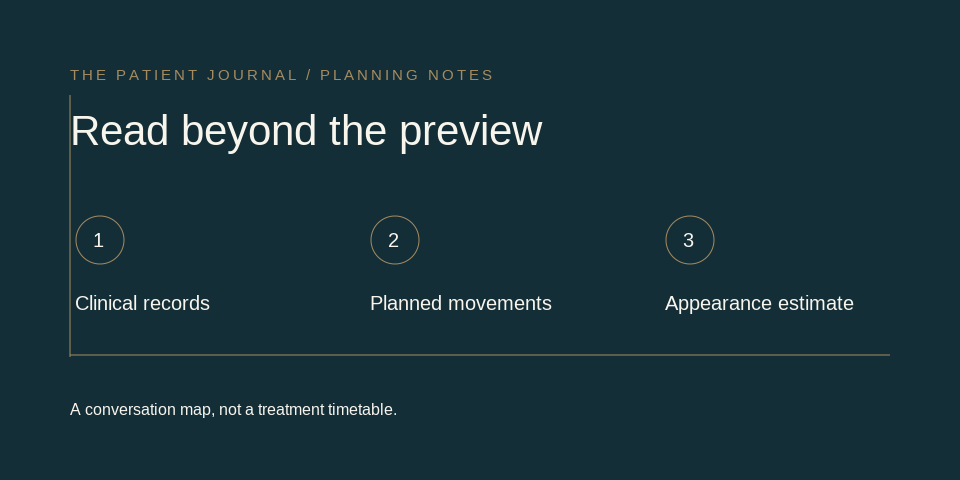
The records layer represents the information used to build the model. The movement layer represents the clinician's proposed changes to bones and teeth. The appearance layer estimates how the outer face may respond. Ask the presenter to identify which layer you are seeing. A realistic skin texture can make a prediction feel more certain than a plain model, even when both contain the same underlying assumptions.
You can review those layers in order without becoming a technical expert. First ask whether the records are current. Next ask what problem each movement addresses. Finally ask which visible changes remain uncertain. This order prevents a persuasive facial image from replacing the discussion about diagnosis, tooth contacts and the boundaries of treatment.
Make room for a fourth question: how will the plan be used during the operation? The answer may involve a splint or other guidance, but the exact method belongs to your team. A computer image and a surgical transfer device are not interchangeable. Ask the surgeon to describe their connection and what checks are made during care.
What research on prediction accuracy can and cannot tell you
Published studies evaluate particular methods in defined patient groups. The linked study by Kim and colleagues tested a facial soft-tissue prediction method after double-jaw surgery and examined different facial regions. Its findings concern that method and study setting. They do not establish that every clinic's simulation, phone application or marketing preview has equivalent performance.
When a clinic quotes an accuracy figure, ask what it measures: bone positioning, an average surface difference, a particular facial area, or patient satisfaction. Those are different outcomes. An average numerical result cannot tell you whether a feature that matters especially to you will look exactly as expected. Request an explanation of the uncertainty around your own priorities instead of relying on one impressive number.
Be especially careful when comparing research demonstrations with the software used in your consultation. Ask for the product or workflow name and whether the displayed image is a rough communication aid or part of the final clinical planning process. A team can use a useful planning tool while acknowledging its limits; uncertainty should be explained, not hidden behind technical language.
A practical worksheet for reviewing two options
Write the concern in the first column, such as an uneven smile or difficulty bringing the teeth together. Put the proposed movement in the second column using the clinician's explanation. In the third, record the expected benefit. Use a fourth column for uncertainties and a fifth for the alternative discussed. Leave unanswered cells blank so they remain visible questions.
For example, if one version includes a chin procedure and another does not, ask to compare the jaw correction first. Then discuss what the additional chin change contributes. This separates the decision about a functional correction from the decision about an optional appearance change. It also helps you check whether the written quotation and consent discussion cover the same proposed procedures.
Review comparable front, profile and angled views where available. Ask that the presentation remain consistent between versions. If a result appears dramatically different, establish whether that difference comes from the proposed treatment, the viewing angle or an added procedure. You are comparing plans, not choosing a favourite photograph for the team to reproduce.
Protect your priorities when the image is persuasive
Before the consultation, write down what brought you there. Use ordinary descriptions: a bite that feels awkward, concern about facial balance, or uncertainty after another opinion. Also list features you value and do not want to change unnecessarily. Take this short brief into the simulation review and refer back to it when new possibilities are introduced.
Afterward, describe the proposal in words without looking at the image. Can you explain what would move, why it would move, and what might remain different from the simulation? If not, request another explanation. Consider discussing the written proposal with your orthodontist or obtaining a second opinion before making a commitment driven mainly by the emotional effect of the preview.
A simulation does not communicate every consequence of an operation. Sensation changes, discomfort, the demands of recovery and the possibility of additional care still need a separate discussion. Ask how the proposed operation affects those considerations. A beautiful image can coexist with a substantial treatment burden; understanding both is part of deciding whether the plan fits your life.
Keep track of versions and personal records
Ask for a dated summary of the plan discussed, including whether it is preliminary or final. If copies of images are available, keep them with the explanation rather than separately in a phone gallery. An unlabeled screenshot can easily be confused with an earlier alternative. Mark questions for the next consultation instead of editing the clinical image yourself.
If orthodontics continues between consultations, ask when records should be updated and who determines whether the plan needs revision. When a change is proposed, clarify whether it changes only a technical detail or affects the treatment goals, procedure list, risks or cost. Those distinctions help you understand when a renewed consent discussion is needed.
Facial photographs and scans are personal health information. Ask how records should be transferred securely, who will receive them and whether any requested image is needed for clinical care or optional marketing. Do not assume that sending photographs for a consultation also gives permission for public use. Keep a record of what you agreed and raise any uncertainty with the practice before uploading additional material.
A relevant planning consultation in Seoul
Faceline lists two-jaw surgery, and Dr. Lee Jin-soo is identified on its official website as a plastic surgeon with a double-jaw and contouring focus. They are included here because their published scope matches a discussion about jaw planning. This is not independent validation of a branded method or a prediction of your result.
When contacting the practice, ask to discuss the reasoning behind the proposed movements, the role of orthodontics and the limits of any facial preview. Bring your existing records and written priorities. Use the linked clinic and clinician profiles for context, then the international website for a suitability enquiry rather than choosing an operation from a simulation alone.
Frequently asked questions about digital plans
Can a selfie tell me whether I need jaw surgery? A photograph may help communicate an appearance concern, but it does not provide a complete bite examination or establish the treatment needed. Ask the clinician which records and examination findings are necessary before treating any digitally altered photograph as clinically meaningful.
Should I choose the clinic with the most realistic preview? Presentation quality is only one part of the experience. Compare the explanation of diagnosis, alternatives, uncertainty, who performs the surgery and how follow-up works. Ask whether the team can explain its recommendation clearly even without the simulation.
What if I dislike every proposed image? Say so and identify the feature that concerns you. You may need a clearer explanation, different goals, another opinion or time to reconsider treatment. Declining or postponing an elective decision is an option. Do not accept an image you cannot reconcile with your priorities merely because a date is available.
Explore the listed clinic and clinician
Explore the clinic directly
Discuss your plan with Faceline ↗Sources & further reading
- British Orthodontic Society: Your Jaw Surgery ↗
- Chen and colleagues: Computer-aided dental splint design research ↗
- Faceline: Two-jaw service and team ↗
- Official clinician biography ↗
- Kim and colleagues: Evaluation of a soft-tissue prediction method ↗
For personal recommendations, discuss your examination and records with your treating surgeon and orthodontist.