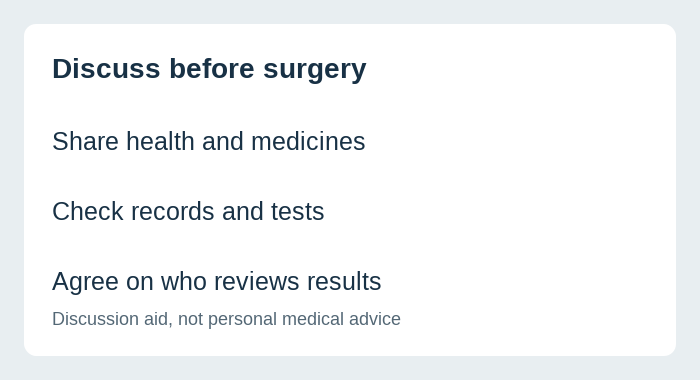
Testing should answer a clinical question
Preoperative assessment helps the team understand your health and prepare for the proposed operation and anesthesia. The tests requested may depend on your history, medications, symptoms and the procedure. Ask what each test is intended to clarify and who reviews the result.
A long test list does not automatically indicate better care, and a short list does not by itself indicate inadequate care. The useful issue is whether the assessment fits you. Tell the clinician about relevant changes since your first consultation, including new symptoms, diagnoses, medications or previous problems with surgery.
What common tests actually measure
A full blood count measures different blood-cell components. Kidney-function testing assesses substances in the blood that help clinicians evaluate kidney function and the balance of salts. A clotting test investigates aspects of blood coagulation. An ECG records electrical activity of the heart through electrodes on the skin. These tests answer different questions; none is a universal certificate that an operation is risk-free.
NICE guidance selects preoperative tests according to the procedure and the patient's health rather than recommending every test for everyone. A test may influence further investigation, medication planning or whether surgery should be delayed. The same result can have different implications in different clinical contexts, which is why the team needs your history as well as the laboratory report.
Clarify where testing should happen
Before paying for tests at home, ask the Korean clinic whether it accepts external results, what format is required and how recent the results must be. Some assessments may need to be completed by the treating team. Confirm this before arranging travel around an assumed one-day testing schedule.
Keep the original report and a readable translation when necessary. Do not submit only a photograph of a few values if the full report is available. Ask the clinic to confirm receipt and whether anything remains outstanding. Sending records is not the same as receiving a clinical decision about them.
Understand what an abnormal result means
If a result is outside the laboratory's reference range, ask the responsible clinician what it means for you. A flagged number does not always settle whether surgery can proceed, and an apparently normal panel does not rule out every relevant issue. Avoid interpreting isolated results through internet searches.
Ask whether further assessment, treatment or postponement is needed and who will arrange it. If the team needs input from your regular clinician, facilitate direct communication and provide the relevant history. The goal is a safe, understood plan rather than obtaining a document labeled clearance as quickly as possible.
Keep travel commitments conditional
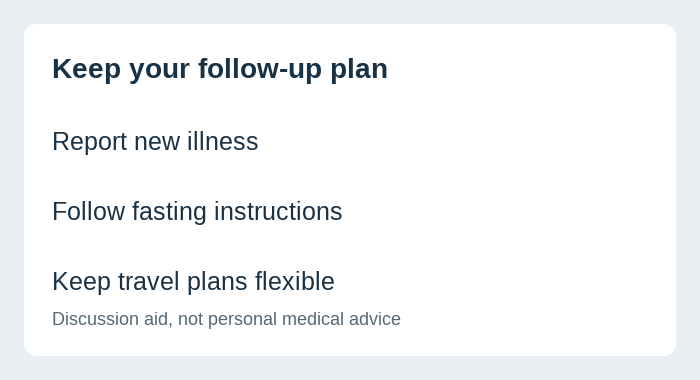
Ask which decisions remain pending until the preoperative assessment is complete. Make sure you understand the clinic's cancellation and rescheduling arrangements if surgery is deferred. Discuss the practical effects on accommodation, work leave and a caregiver before those bookings become difficult to change.
At the final review, confirm that all requested results have been assessed and that you have the current instructions for the days before surgery. Keep a record of who to contact if you become unwell. A previous assessment should not prevent you from reporting a new health concern.
Track decisions as well as results
Create a list with the requested test, the date it was completed, the person who reviewed it and the resulting action. This helps distinguish a result that has arrived from a result that has been clinically assessed. If the clinic says that a document is missing, you can identify exactly which item is involved rather than resending an entire folder.
Ask whether a test result has an expiry or needs repeating if the operation moves. The answer may depend on the test and your health circumstances. Do not assume that every result remains valid for the same period. Likewise, avoid repeating tests yourself simply because you are anxious; ask whether they would add useful information.
If another clinician recommends treatment or further investigation, tell the surgical team promptly. Ask who will coordinate the next step and how it affects the proposed date. A delay can be frustrating, particularly after travel expenses, but the relevant decision is whether the assessment is complete enough to proceed safely.
Before your final appointment, prepare a brief update on any changes since the previous assessment. Include new symptoms, medicines, dental problems or recent illnesses. This makes the review more accurate than simply stating that nothing important has happened. If you are unsure whether a change matters, mention it and let the clinician decide. The purpose of preoperative testing is to support an informed care plan, not to replace the ongoing conversation about your health.
Start with the planned operation and your health
Preoperative assessment is tailored to the person, operation and anaesthetic rather than a universal shopping list of tests. The team needs a clear medical history, current medicines, allergies, prior anaesthetic experiences and information about conditions that affect your care. Tell them about sleep apnoea, breathing problems, heart or lung disease, bleeding problems, diabetes and any previous difficulties with anaesthesia. Also describe dental appliances and limited mouth or neck movement where relevant. The anaesthetist determines what requires further evaluation.
Tell the team about prescription drugs, over-the-counter medicines, vitamins and supplements, including doses and why you take them. Do not stop an anticoagulant, diabetes medicine or other prescribed treatment on your own. The clinician who manages it and the surgical team should agree on a written plan for your specific operation.
Dental records are different from anaesthesia tests
Jaw surgery planning commonly uses a clinical bite examination and imaging to understand the position of the teeth and jaws. Depending on the case, this may include photographs, dental models or digital scans and radiographs. Their purpose is surgical and orthodontic planning; they do not replace the assessment of your general fitness for anaesthesia. Conversely, a normal blood result cannot by itself determine how the jaws should be moved.
Ask who will review each item, whether existing records can be accepted and how recent they need to be. Repeating imaging may sometimes be necessary because the original scan is unsuitable or the clinical situation has changed, but that decision belongs to your team. Do not arrange expensive scans merely because another traveller’s checklist mentions them.
Blood tests and other investigations
A clinician may request tests such as a blood count or other investigations based on your medical history and planned care. An ECG or additional heart or lung assessment may be appropriate for some people but is not a standard requirement for every patient. Ask what each requested test is intended to clarify, what the result may change and whether it can be performed locally before you travel. A clinic can also explain whether its laboratory must repeat a result.
An abnormal result does not automatically cancel treatment or make it safe to proceed. The issue may require confirmation, treatment or specialist advice. Ask the team when a decision will be made and what happens if an assessment identifies a condition needing attention. Keep travel and accommodation flexible until the treating team has completed its assessment.
Illness and changes before the operation
A new cough, fever, infection or other change in health shortly before surgery should be reported to the team promptly. The anaesthetist and surgeon can advise whether assessment or a change in timing is needed. Concealing a new symptom to avoid a postponement can deprive the team of information required to make a safe plan. NHS guidance also recommends informing the hospital when you become unwell before an operation.
Ask for instructions on eating, drinking and prescribed medication for the day of anaesthesia. Fasting directions are individualized and can differ by the type of food, drink and patient. Follow the written instructions from your anaesthetic team; do not replace them with a general internet timetable. Ask whom to call if the instructions are unclear or if you accidentally eat or drink outside the plan.
Coordinate tests across borders
If the treating team accepts tests performed in your home country, confirm the required format, date range and language before booking them. A PDF summary may not contain the image files needed for surgical planning. Ask how original imaging, dental records, a medication list and the laboratory report should be transmitted securely, and retain copies for your own records. Agree who is responsible for interpreting each result and notifying you if anything is missing.
For a two-stage journey, ask whether a remote consultation is a preliminary opinion or a final clearance. Determine which face-to-face examinations remain necessary in Korea, when the final anaesthetic assessment occurs, and what happens if a result changes the plan. The practical value of a checklist is that it identifies decisions and responsible clinicians, not that it promises a fixed operation date.
Questions for a clinic in Korea
Sinsa Oral & Maxillofacial Surgery lists orthognathic surgery and describes assessment and planning for jaw alignment on its international site. Patients comparing jaw-surgery teams can use that information as a starting point for a consultation, not as evidence that any specific procedure is indicated. Ask who coordinates the surgeon, orthodontist and anaesthetist; which records they need; who reviews them; and which preoperative findings might change the plan. The clinic’s profile and international service link are below. This is a relevant listed option, not a ranking or guarantee.
Obtain a written answer about timing, responsibilities and possible additional costs before purchasing nonrefundable travel. Ask for a cancellation and postponement policy, an interpreter plan and an emergency contact. Confirm how the team will transfer your operative and follow-up records to a clinician at home. A safe decision can include postponing surgery or choosing not to proceed after the assessment.
Explore the listed clinic and clinician
Explore the clinic directly
Review the clinic’s international website ↗Sources & further reading
- Royal College of Anaesthetists: Patient information ↗
- NICE: About preoperative tests ↗
- AAOMS: Recovery from orthognathic surgery ↗
- Cambridge University Hospitals: Jaw or chin corrective surgery ↗
- NHS: Preparing for an operation ↗
For personal recommendations, discuss your examination and records with your treating surgeon and orthodontist.