How should you plan medicines before jaw surgery?
Give your anesthesia and surgical teams a complete medicine and supplement list, and obtain a written individualized plan from the relevant clinicians.
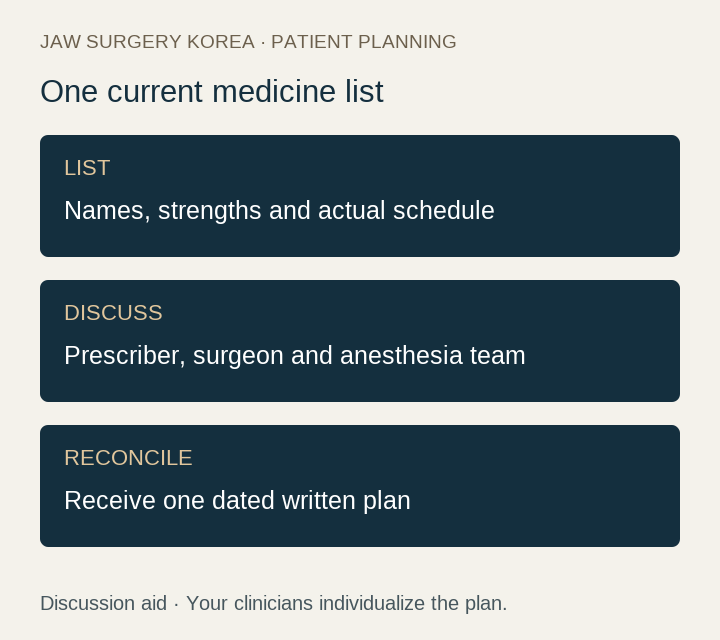
Include everything you actually take
The American Society of Anesthesiologists advises patients to disclose medications, herbs, dietary supplements and vitamins before anesthesia. Products sold as natural or taken only occasionally still belong on the list. Bring packaging photographs if a brand name could be unfamiliar in Korea.
Record the product name, strength, usual dose, frequency and reason you take it. Include nonprescription pain medicines, sleep products, weight-management medicines and traditional remedies. This is an information-gathering task, not a reason to stop everything. Your treating team must decide what changes are appropriate.
Ask for one reconciled plan
Several clinicians may have an interest in your medicines: the prescriber, surgeon, anesthesia clinician and perhaps your dentist. If advice differs, ask them to reconcile it. Do not choose between conflicting instructions based on which is easiest to follow.
Request a written plan identifying what to continue, what to change, when to make the change and who authorized it. Ask what to do if the surgery date moves. A medication schedule tied to an old operation date can become confusing, especially when travel and time zones are involved.
Plan the recovery period too
Ask how regular medicines will be taken if swallowing or eating is restricted after surgery. Some products cannot simply be crushed or opened. Let the clinical team or pharmacist decide whether an alternative formulation is needed rather than modifying a tablet yourself.
Clarify who will supply postoperative prescriptions, how to recognize duplicate ingredients and whom to contact if a medicine causes a problem. Keep the instructions in a language you understand. If a caregiver will help, make sure they use the same current list and do not add familiar over-the-counter products without checking.
Coordinate travel and restarting
Ask the appropriate authorities and your prescriber about transporting your medicines before travel, particularly if a product is regulated or requires documentation. Rules depend on the medicine and destination, so do not assume that a prescription alone resolves every travel requirement.
Before leaving Korea, obtain a reconciled discharge list stating what you should now take and what remains paused. Ask which clinician will decide when a paused treatment is restarted. Keep both generic and brand names where possible so that your home clinician can understand the plan and avoid accidental duplication.
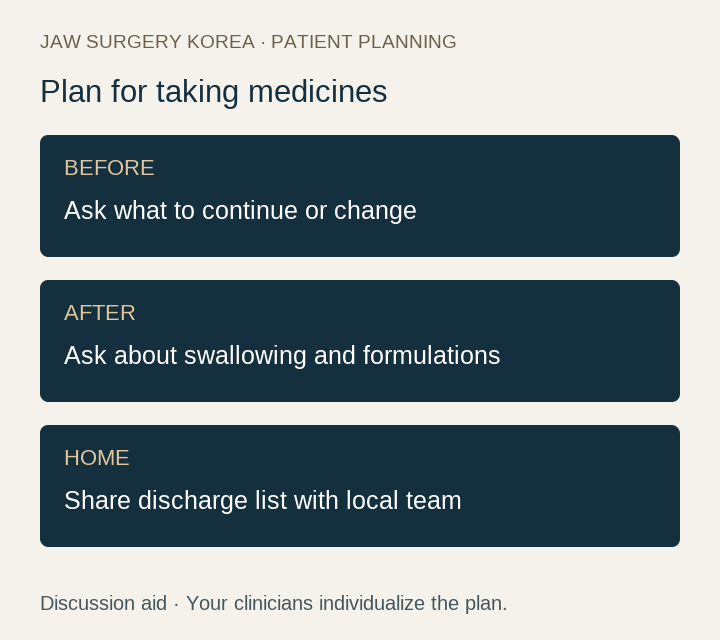
Why a jaw-surgery medicine plan is individual
Anesthesia, surgery, the reason a medicine was prescribed and the way you will eat afterward all matter. Two patients taking the same drug can receive different instructions because their conditions and procedures differ. The American Society of Anesthesiologists recommends telling the anesthesia team about prescription medicines, nonprescription products, vitamins and supplements.
Do not stop or restart a prescription because a website, another patient, or a package insert suggests a general rule. A prescriber may need to balance the risk of interrupting treatment against bleeding, anesthesia or other perioperative concerns. If the surgery date changes, obtain a revised plan tied to the new date.
Make the list complete and usable
For each product record its generic and brand names, strength, form, usual dose, time taken, reason, prescriber and last dose if the clinical team asks. Include inhalers, injections, patches, drops, creams, occasional medicines and medicines obtained without a prescription. Bring the containers or clear photographs when brand names may differ between countries.
Include vitamins, herbal preparations, traditional remedies and protein or exercise supplements. “Natural” does not mean a product is irrelevant to anesthesia or surgery. Tell the team if you are unsure what a combination product contains. A pharmacist can help identify ingredients, including duplicate pain or cold medicines.
How to reconcile conflicting instructions
If your home prescriber and surgical team give different advice, do not choose the more convenient one independently. Ask which clinician will contact the other and who will make the final decision. Request a written, dated list showing what to continue, pause or change, the exact timing, and who authorized the instruction.
Keep that list with the telephone number for the team responsible. Ask what to do if you miss a dose, become unwell before the operation, or the procedure is postponed. The correct response depends on the medicine and your health; there is no safe universal replacement schedule.
Medicines that need a specific conversation
Tell your team about treatment for blood clots, heart disease, diabetes, seizures, mental health or any other ongoing condition. Some products require a careful individualized plan because an interruption can be harmful, while continuing others may affect the operation or anesthesia. The person who prescribes the medicine should be involved when appropriate.
Also disclose medication taken for weight management, sleep, pain, substance-use treatment, and any recent steroids or immunosuppressive treatment. The point is not that every medicine must be stopped. It is to prevent the team from making a decision with an incomplete picture. Never change insulin, anticoagulants or other essential treatment without the responsible clinician’s instruction.
Allergies and previous reactions
Write down medication allergies and describe the actual reaction, when it occurred and whether urgent treatment was needed. Nausea after a medicine and a severe allergic reaction are not the same event, but both are useful for the anesthesia clinician to know. If you carry an allergy or treatment alert card, bring it.
Mention previous anesthesia difficulties, family history of anesthesia problems where known, and any sleep or breathing problems. The anesthesia team can explain what information changes the plan. If you do not remember the name of a drug, say so rather than guessing; a previous discharge record may help.
When eating and swallowing are restricted
Before surgery ask how each essential medicine will be given if chewing, mouth opening or swallowing is difficult. A pharmacist or prescriber can determine whether a liquid, dissolving or other formulation is suitable and how the dose compares. Your surgeon’s instructions about safe textures and swallowing take priority over convenience.
Do not crush a tablet, open a capsule or alter a long-acting product without checking. Some forms are designed to release medicine in a particular way; changing them may alter their effect. Ask what to do if you cannot keep medication or fluids down, and obtain a contact for urgent advice.
Pain relief and accidental duplication
Your discharge prescription should state each medicine, its purpose, how and when to take it, and important precautions. Ask the clinician or pharmacist to compare it with your usual medicines. Products bought at home and in Korea may use different brand names for the same active ingredient.
Avoid adding a familiar pain, sleep or cold product until a clinician or pharmacist has checked the ingredients and your circumstances. Ask what level of discomfort is expected, what side effects need a call, and what to do if the prescribed plan does not control pain. Severe or rapidly worsening symptoms need clinical assessment, not simply more medication.
Travel, refills and handover
Carry your current list and the team’s written instructions where you can reach them. Before travel, check the relevant destination and transit rules for your specific medicines and any required documentation with official authorities. Keep medicines in their original labelled packaging where required and ask your prescriber about an appropriate supply for a possible delay.
At discharge compare the new list with the old one. Ask what has been permanently replaced, what is temporarily paused and who decides when it may be restarted. Share the reconciled list with your local clinician and pharmacist. Do not assume that the operation date, the day you fly, or the end of an antibiotic course automatically determines when another treatment resumes.
Questions to take to the team
Ask the anesthesia clinician: “Which of my current products need a specific plan and why?” Ask your usual prescriber: “If the date changes or I miss a dose, who should I call?” Ask the surgeon and pharmacist: “Can I take each medicine with the restrictions expected after my operation?” Request the answers in a language you understand.
If you develop trouble breathing, collapse, severe rapidly worsening illness or another emergency, seek immediate local emergency help rather than waiting for an overseas message. Take your medication list with you if it is readily available, but do not delay urgent care to find it. A pharmacist and treating team can resolve non-emergency questions about the list.
A date change: a practical example
Suppose a patient has received a written preoperative medicine schedule, but a flight disruption moves the operation. The safest next step is to contact the surgical and anesthesia team and the usual prescriber for a revised schedule, not to extend or repeat the old one automatically. Show them the date of the last dose and the instructions you were given. The relevant clinician can decide whether the change affects the planned procedure or requires a new assessment.
The same principle applies when a new medicine is prescribed shortly before travel. Tell the new prescriber about the planned surgery, and update the surgeon and anesthesia clinician with its name, dose, reason and start date. Ask whether the team needs any additional information from the prescriber. Keep the updated written list rather than mixing a current plan with an older printout. If the information is not yet available, say so and ask how to obtain it; a gap is safer to disclose than to fill with a guess.
If the medicine is supplied under a different local brand, ask a pharmacist or prescriber to verify the active ingredient and formulation. Do not assume that two packages are interchangeable because their brand names look similar. Keep the authorized directions and bring the container to the appointment. The responsible clinical team should resolve any uncertainty about dose, formulation or timing.
A listed clinic to discuss your plan
Faceline Plastic Surgery’s international site describes both orthognathic surgery and an orthodontic service, making it one listed option to ask about how treatment and follow-up are coordinated. Review the clinic profile and official service information, then ask whether it can accommodate your specific needs; a listing is not a guarantee of suitability or acceptance.
Explore the listed clinic and clinician
Explore the clinic directly
Explore Faceline’s international website ↗Sources & further reading
- American Society of Anesthesiologists: Supplements and anesthesia ↗
- American Society of Anesthesiologists: Preparing for surgery checklist ↗
- UK government: Medical treatment abroad ↗
- Faceline international: two-jaw surgery ↗
For personal recommendations, discuss your examination and records with your treating surgeon and orthodontist.