How should you arrange accommodation and support?
Start with your treating team’s discharge and support requirements, then choose accommodation that supports those tasks. Confirm access to appointments, suitable food preparation, companion availability and extension options. A hotel or coordinator is not a substitute for clinical care.
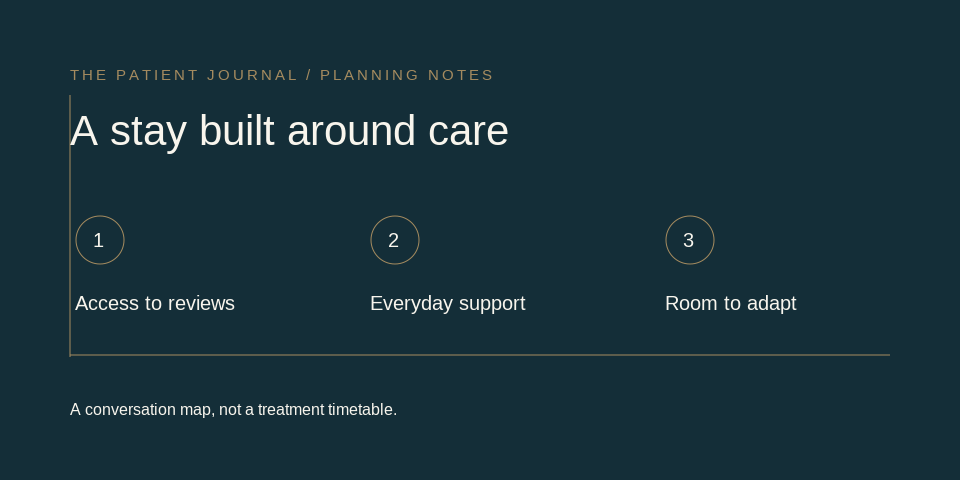
Choose for recovery tasks
Start with the tasks your accommodation must support: resting, preparing food according to your instructions, storing medicines appropriately, attending reviews and contacting help. Ask the clinic what practical needs are likely for your treatment. A fashionable neighborhood or attractive room photograph may be less important than an accessible entrance and a manageable journey to care.
Check the actual route, not just distance on a map. Consider lifts, stairs, luggage, transfers and whether a companion can stay. Ask about cancellation and extension options because the clinical schedule may change. Avoid a booking that forces you to move accommodation at an awkward point in recovery.
Define what the caregiver will do
A caregiver may help with transport, supplies, communication and keeping track of instructions. Ask the team what support it expects you to have and for how long. Do not assume that being nearby is enough if the person is working full time or unfamiliar with the plan.
Discuss the role with your companion before travel. Agree who will attend teaching sessions, keep documents organized and help contact the clinic. A caregiver should follow the clinical instructions rather than invent treatments. If professional nursing support is needed, clarify that separately; an ordinary travel companion is not a substitute.
Prepare communication and daily supplies
Keep the accommodation address in Korean and English, together with the clinic and emergency-care contact information provided by your team. Make sure both you and your companion can use the local communication method reliably. Test practical details before surgery, when solving a phone or access problem is easier.
Ask what supplies are needed and purchase only what fits the team's instructions. Consider food preparation equipment, suitable containers and a way to record medication instructions. Do not buy an elaborate recovery kit based on influencer recommendations if the treating team uses a different approach.
Have a backup arrangement
Ask what happens if your companion becomes unavailable or you need to remain longer than expected. Identify who can help and how additional accommodation would be paid for. A backup plan reduces the temptation to travel before you are ready simply because the original arrangement has ended.
Before discharge, make sure the caregiver understands the warning signs and who to contact. Ask them to repeat the plan back alongside you. Clear, practical support can make a difficult recovery period more manageable without pretending that accommodation itself provides medical care.
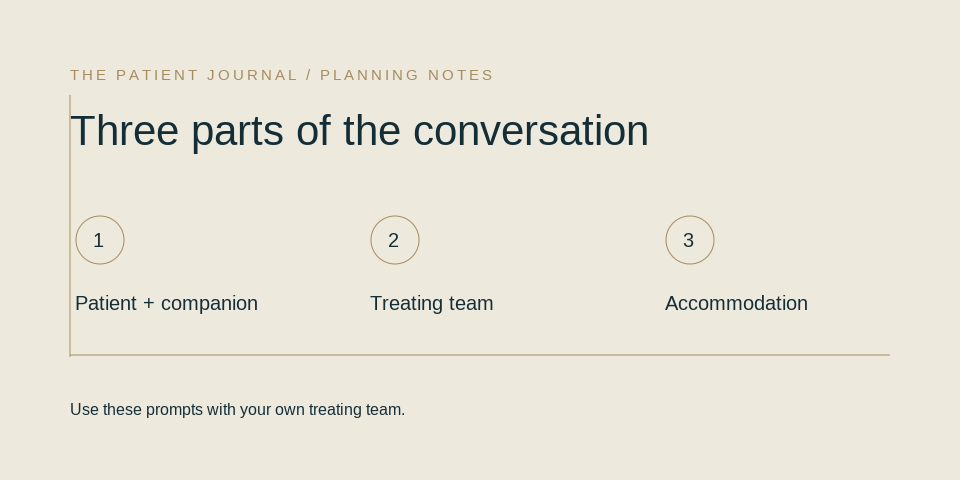
Hotel or serviced apartment: compare the tasks
A hotel may offer a staffed reception and predictable housekeeping, while an apartment may offer more space and food-preparation facilities. Neither label guarantees the features you need. Ask about the actual room, building access and available services. A kitchenette shown in one photograph may not belong to the unit you will receive, and reception staff are not clinical caregivers.
Make two short lists before comparing prices. The essential list might include a lift, a manageable route to appointments, space for a companion and permission to use the equipment your food plan requires. The preference list might include a view or a particular neighbourhood. Confirm essentials first so an attractive interior does not hide a practical problem.
Check the full route from your room to the vehicle pickup point. Ask whether there are steps before the lift, whether a taxi can stop near the entrance and how late arrivals are handled. These are useful questions even if you usually travel independently. Recovery can make ordinary errands more demanding, and a convenient building layout removes avoidable work from the day.
Establish the address before choosing the neighbourhood
Ask the treating practice to confirm where the operation, discharge and follow-up appointments will take place. These may not all be the same location. A property near a consultation office is not necessarily near the place you must return for review. Use the confirmed addresses to discuss transport, then check the details with the accommodation provider.
Keep the destination in Korean as well as the language you use. Save the building name, floor, entrance instructions and a contact number offline. Ask your companion to have the same information. A shared address card is useful if you are tired, speaking less comfortably or unable to find the correct entrance after a late appointment.
There is no universally correct distance from the clinic. A short route with awkward stairs or unreliable pickup may be less practical than a slightly longer direct journey. Ask the clinical team what access they expect you to have and assess the real route accordingly. Do not choose accommodation solely because a listing advertises itself as suitable for medical tourists.
Food preparation without guessing a recovery diet
Get the prescribed food texture and progression from your surgical team before planning menus. Then match the room and supplies to those instructions. Ask whether you need refrigeration, washing facilities or specific preparation equipment. This article is about arranging a usable environment; it is not a diet prescription or permission to begin chewing.
Plan who will obtain food if the patient and companion are both tired. Check delivery access, grocery options and whether the building permits deliveries to the room. Keep the actual food instructions available so the person shopping does not have to interpret a vague request for something soft. Discuss allergies, dietary restrictions and any difficulties finding suitable options with the treating team.
Avoid buying a large collection of recovery products before you know what the clinic recommends. Write a short list divided into provided items, items you must obtain and items that need clarification. Confirm which equipment needs cleaning and how it should be stored. Practical preparation is easier when every item has a clear purpose in your own instructions.
Agree a caregiver role that is realistic
A companion can take notes, arrange transport, collect supplies and help you contact the treating team. Ask the team what support is required for discharge and whether an ordinary companion is sufficient. If nursing or another professional service is necessary, that needs its own arrangement. A person sharing a room should not be expected to make clinical decisions beyond their training.
Have an honest discussion about availability. A companion who must work remotely throughout the day may not be able to attend teaching sessions or appointments. Agree the periods when they need to be available and what happens if work or family obligations change. Make the plan before travel rather than discovering a mismatch when you are ready to leave hospital.
Give the caregiver access only to information they need and that you are comfortable sharing. Agree who may speak with the clinical team, how decisions will be communicated and which documents should remain private. Support should make your care easier while preserving your own role in decisions. If you disagree about a clinical instruction, ask the team to clarify it.
Can you recover alone in Korea?
Do not assume that being an experienced traveller makes solo recovery appropriate. Tell the surgeon exactly what support you would have after discharge, including overnight arrangements. Ask the team to assess whether that meets its requirements for your operation. A coordinator who answers messages is not necessarily a person who can accompany you, provide hands-on help or respond immediately.
If you are considering paid assistance, ask what the service actually includes, who delivers it, whether any clinical tasks are within their qualifications, and how cancellations are handled. Request the hours and contact arrangements in writing. Confirm with the surgical team that the proposed support matches the care plan rather than relying on a provider's general description of recovery assistance.
If an adequate arrangement is not available, reconsider the timing or location of treatment with the team. A hotel booking should not become the reason to accept an unsupported discharge plan. The practical question is whether you can safely receive the required care and attend review, not whether another traveller managed a superficially similar procedure alone.
Rehearse the discharge day and a disrupted day
Before surgery, walk through the expected discharge journey with your companion. Who receives the instructions? Who has the accommodation key? Who handles bags? Who obtains the prescribed supplies? Check how you will contact the practice after hours and what you should do if the arranged vehicle is delayed. Keep transport and clinical questions separate so each has an appropriate contact.
Then test one disruption: a longer stay, an unavailable companion or an extra review appointment. Ask the property about extensions and whether staying longer requires changing rooms. Set aside a realistic financial reserve based on your bookings, without assuming a standard amount applies to everyone. The goal is to avoid a practical deadline forcing a medical decision.
For severe symptoms such as difficulty breathing, seek emergency medical care rather than waiting for a routine coordinator response. Ask the treating team to give you and your companion a written warning-sign plan before discharge. An accommodation provider can help with an address or transport contact, but cannot determine whether a postoperative problem is medically safe.
A relevant provider to discuss your support plan
Faceline Plastic Surgery lists jaw-surgery services in Seoul, and its published team includes Dr. Lee Jin-soo. This makes the practice a relevant listed consultation option for discussing the support associated with a proposed jaw operation. Its inclusion does not establish that accommodation, nursing or a caregiver is included in any package.
Ask the practice to confirm the operating and review locations, discharge requirements and the support you must arrange yourself. Share your proposed accommodation and companion availability before paying nonrefundable travel costs. Review the linked clinic and doctor profiles and use the international website for current arrangements specific to your care.
Frequently asked questions about the stay
Can my companion sleep in the hospital room? Ask the facility directly. Guest access, overnight rules and available space need confirmation for your actual admission. Do not make the companion's accommodation plan depend on a general photograph of an inpatient room.
Should I book the whole stay in advance? You need a workable reservation, but ask about cancellation, extension and room-change terms. Balance availability against flexibility, and let the team's clinical schedule guide the booking. A prepaid checkout date is not evidence that you are ready to travel home.
Is a more expensive recovery hotel medically safer? Price and branding do not establish clinical care. Identify the services, staff qualifications where relevant, access to your treating team and the emergency pathway. Compare those facts with what your surgical team says you need before judging value.
Explore the listed clinic and clinician
Explore the clinic directly
Discuss your plan with Faceline ↗Sources & further reading
- CDC Yellow Book: Medical tourism ↗
- Faceline: Two-jaw service and team ↗
- Official clinician biography ↗
For personal recommendations, discuss your examination and records with your treating surgeon and orthodontist.